AI-Powered Personalised Learning for SMEs
5 Feb 2026
Tailored AI training for SMEs that boosts engagement, cuts admin and targets real skill gaps for faster, cost‑effective growth.
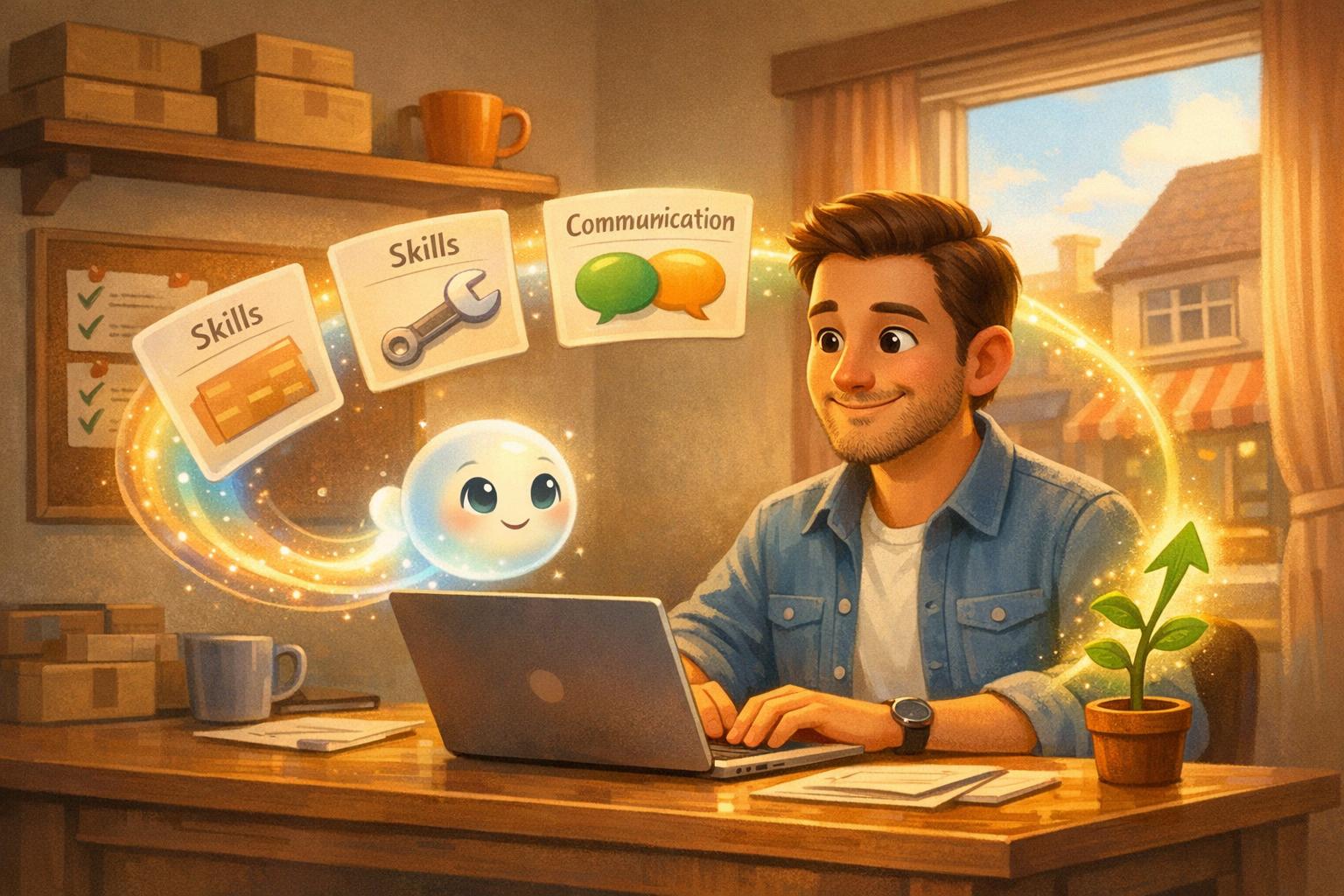
AI-powered personalised learning is transforming how SMEs train their teams. It replaces generic, one-size-fits-all training with tailored content that adjusts to each employee’s needs, improving engagement and outcomes. Here’s why it matters:
Time Efficiency: Employees skip what they already know and focus on their actual skill gaps.
Better Results: AI-driven learning boosts engagement by 30% and learning outcomes by 25%.
Cost Savings: Resources are spent effectively, targeting only relevant training needs.
Scalability: Small businesses can deliver high-quality training without needing large HR teams.
Automation: AI handles admin tasks like scheduling, tracking, and progress reporting.
Despite these advantages, adoption remains uneven, with only 21% of UK workers confident using AI at work. For SMEs, adopting AI-powered learning is no longer optional - it’s a way to stay competitive and support growth.
Quick Overview:
Current Challenge: Generic training wastes time and fails to meet individual needs.
AI Solution: Customised training paths, real-time feedback, and workflow integration.
Impact: Increased engagement, improved retention, and reduced admin workload.
For founder-led SMEs, AI-powered learning is a practical way to upskill teams and scale efficiently while staying ahead in a fast-changing business environment.
How AI Enables Personalised Learning for SMEs
AI is reshaping how learning happens by tailoring experiences to individual needs. By analysing data like quiz scores, time spent on tasks, and engagement patterns, it pinpoints specific skill gaps. Instead of sticking to a rigid curriculum, AI creates adaptive learning pathways that adjust in real time. If someone struggles, the system steps in with simpler material or step-by-step guides. On the other hand, if they’re excelling, it ramps up the difficulty with more advanced topics. This constant cycle of data collection and adjustment continues until the learner achieves mastery.
Think of it like Netflix’s recommendation engine, but for learning. AI suggests modules based on an employee’s profile, past learning history, and career goals. Many platforms go a step further, embedding training into everyday tools like Slack or project management software using the Model Context Protocol (MCP). This means employees can access training seamlessly without interrupting their workflow, which is a game-changer for small businesses.
For founder-led SMEs, this integration offers even more value. AI takes over time-consuming administrative tasks like scheduling sessions, sending reminders for incomplete modules, and generating progress reports. This allows founders to focus on growing their business instead of getting bogged down in manual oversight. Tools like AgentimiseAI’s GuidanceAI even connect leadership teams with AI agents trained by experts. These agents provide tailored advice on key areas like decision-making, conflict resolution, and scaling operations - without the need to hire full-time consultants.
Another standout feature is AI-powered 'Role Play' scenarios. Leaders can practise tricky situations like client negotiations, giving feedback, or handling conflicts, all while receiving instant feedback. This hands-on approach helps build confidence before applying new skills in real-world scenarios. Kevin D., founder of Moterra Campervans, explains its impact:
"I've always been passionate about productivity, and Gemini helps me overcome that blank-page problem. It reduces a lot of the friction I feel as an entrepreneur, allowing me to pick up momentum in a way I never would have been able to before".
The numbers back up the effectiveness of AI-driven learning. Research spanning 2012 to 2024 found that adaptive learning boosted learner performance in 59% of studies and increased engagement by 36%. The market for adaptive learning platforms is also on the rise, projected to grow from £1.72 billion in 2025 to £5.47 billion by 2032. This highlights the growing appeal of personalised, workflow-integrated training compared to traditional methods.
1. AI-Powered Personalised Learning
Customisation and Relevance
AI takes personalisation to a new level by analysing learning styles, performance data, and career goals to create tailored training modules for employees. It pinpoints skill gaps through tools like quizzes and performance reviews, then crafts learning paths to address those specific needs. For instance, a marketing coordinator can skip advanced financial modelling, while a finance manager avoids basic spreadsheet tutorials they've already mastered.
The system doesn’t stop there. It continuously fine-tunes learning paths based on real-time performance metrics. If an employee struggles with a topic, AI steps in with simpler explanations or detailed guides. On the flip side, if someone is excelling, the system introduces more advanced material to keep them challenged. This dynamic approach ensures that training stays relevant, cutting out the frustration of irrelevant lessons.
But it’s not just about customisation. AI also helps small businesses take their training programmes to the next level.
Scalability for SMEs
For small and medium-sized enterprises (SMEs) without the luxury of dedicated HR teams, AI becomes a game-changer by automating time-consuming admin tasks. Cloud-based AI solutions offer impressive responsiveness, achieving latency as low as 300 milliseconds during peak usage. A case study from October 2025 highlighted how integrating AI into the Canvas LMS platform led to a 25% reduction in manual content updates while maintaining 99.5% system uptime. This shows how AI can help SMEs scale their training efforts without compromising quality.
Using microservices architecture, SMEs can quickly roll out updates, cutting module update cycles by 30%. This means businesses can adapt their training content or introduce new features seamlessly as their needs evolve.
Cost Efficiency
AI doesn’t just personalise and scale training - it also slashes costs. Traditional training often wastes resources on topics employees either already know or don’t need. AI solves this by zeroing in on genuine skill gaps, ensuring budgets are spent effectively. Predictive analytics further enhance cost efficiency by forecasting future skill needs based on industry trends and employee performance. This allows SMEs to invest wisely in the skills that will fuel their growth.
Automated tools, like lightweight CNN models with an 85% accuracy rate, streamline assessments, reducing the need for manual evaluations while ensuring consistent feedback. AI chatbots also contribute by offering 24/7 support, answering employee queries instantly and freeing managers from constant oversight.
Impact on Employee Engagement and Retention
AI-driven learning doesn’t just improve efficiency - it also boosts employee engagement by aligning training with personal growth goals. By catering to individual interests and learning speeds, AI taps into intrinsic motivation, fostering autonomy and competence as outlined by Self-Determination Theory. Employees are more likely to stay engaged when they see content that resonates with their career aspirations.
Immediate feedback through quizzes and AI chatbots enables employees to adjust their strategies on the spot. Additionally, predictive analytics can outline potential career paths and certifications, helping employees see a future within the company. This not only motivates them but also shows that the business is invested in their development - a key factor in addressing retention challenges often faced by SMEs.
2. One-Size-Fits-All Training Approaches
Customisation and Relevance
Traditional training often assumes that all learners share the same background, skill level, and goals, which is far from reality. This "one-size-fits-all" model ignores how people learn differently - 65% are visual learners, 30% are auditory, and 5% are kinesthetic - yet it relies on a single method of delivery. Unsurprisingly, this leads to 80% of educators identifying major knowledge gaps.
The disconnect becomes even clearer when you realise that only 12% of employees use the skills they learn in traditional training in their day-to-day roles. Advanced employees sit through content they’ve already mastered, while those struggling are left behind as the material moves too quickly. Dr. Olufemi Ariyo, a Tech Researcher, highlights this issue:
"Education has long been one-size-fits-all, but the rise of Artificial Intelligence (AI) is making null that paradigm".
This approach not only fails to address individual learning needs but also makes it difficult for small and medium-sized enterprises (SMEs) to scale their training efforts effectively.
Scalability for SMEs
For SMEs experiencing growth, traditional training methods create bottlenecks that slow progress. Manually creating and deploying training materials simply can’t keep up with a workforce that’s expanding or shifting roles. As Stephen Wroblewski, Managing Director at Accenture, points out:
"The 'one size fits most' approach that we have relied on for decades, including classroom training and online training catalogues, are helpful, but do not deliver the new skills we need at the scale and speed required".
While 94% of employees are eager to learn new skills, only 5% of organisations are reskilling their workforce at scale. JD Dillon, Chief Learning Architect at Axonify, sums it up perfectly:
"It's a lose-lose proposition for L&D and employees that results in poor results for the entire company".
This lack of scalability means traditional training not only fails to meet the needs of employees but also becomes a significant drain on resources.
Cost Efficiency
Traditional training is expensive and inefficient, often wasting resources on redundant content. On average, it delivers a return on investment (ROI) of just 10%. This low ROI stems from the time-intensive process of involving subject matter experts in content creation and the fact that most training doesn’t lead to measurable performance improvements.
The financial impact goes beyond direct costs. 60% of companies report that their training programmes fail to enhance employee performance, effectively turning these initiatives into sunk costs. Additionally, the administrative burden of manually tracking progress and assigning training modules only compounds the inefficiencies, particularly for SMEs managing a growing workforce.
Impact on Employee Engagement and Retention
One of the most damaging effects of one-size-fits-all training is its impact on employee engagement. Unlike AI-driven methods that tailor content to individual needs, traditional training relies on passive formats like lectures and static presentations. This approach leads to low participation and poor retention - employees forget approximately 70% of what they learn within 24 hours. The lack of relevance to their roles or aspirations only worsens the problem.
The result? Engagement plummets. Only 34% of employees feel engaged at work, and traditional training methods are a major contributor to this disconnect. When training feels like a "tick-the-box" exercise rather than meaningful support for career growth, employees begin to question whether their organisation values their development. This is particularly concerning for SMEs, where 30% of frontline employees receive no formal training and 25% get nothing beyond initial onboarding. The message this sends is clear - and it’s not one that encourages loyalty or retention.
Pros and Cons
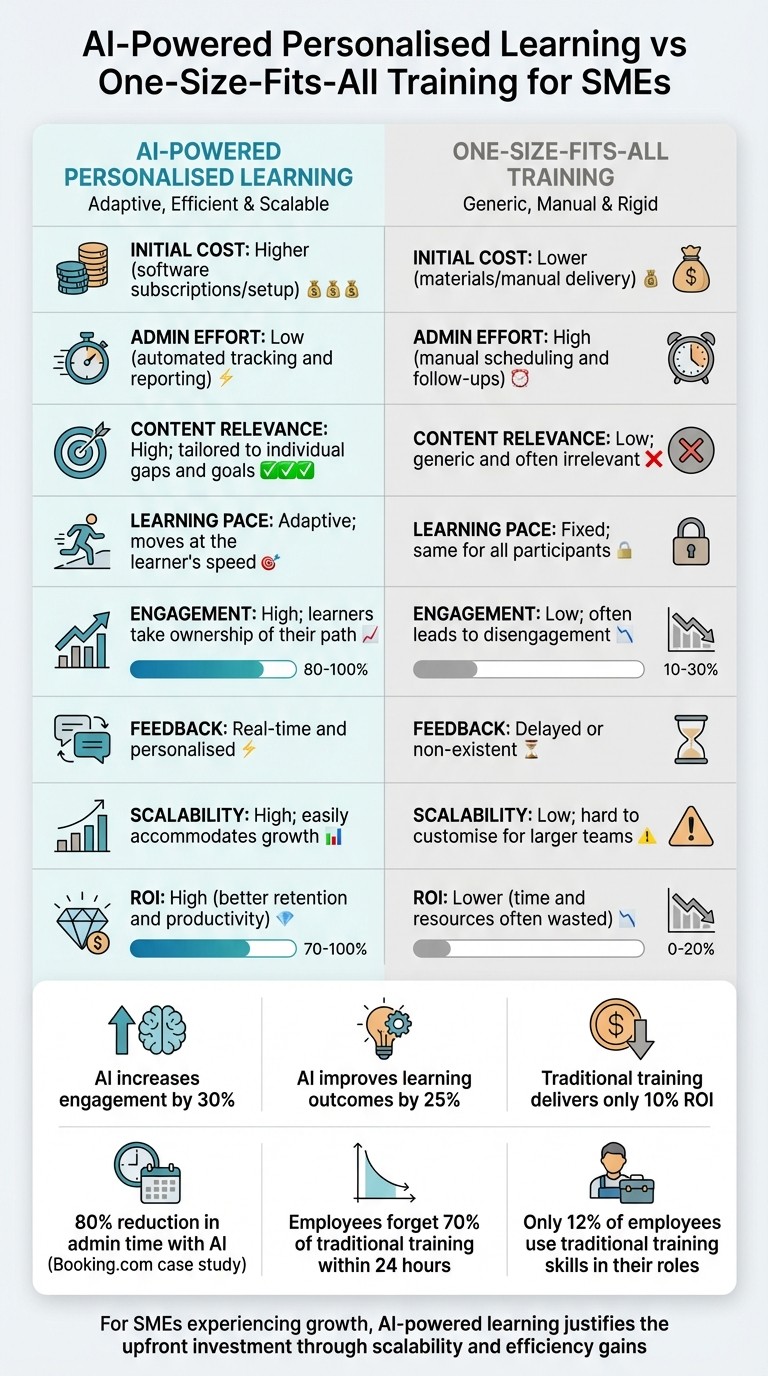
AI-Powered vs Traditional Training: Key Differences for SMEs
When it comes to training solutions, both AI-powered personalised learning and traditional one-size-fits-all training come with their own set of strengths and limitations. For SMEs, choosing the right approach depends on factors like budget, scalability, and how well the method engages learners.
AI-driven training systems excel by identifying skill gaps in real time, using individual data to recommend tailored learning modules. For instance, Booking.com achieved impressive results by integrating Docebo's AI-powered platform between 2024 and 2025. They cut down learning-programme administration by 80% and saved over 800 hours of team capacity annually through personalisation and workflow automation. However, these systems can be costly upfront due to software subscriptions and setup fees. There’s also the issue of data privacy and the risk of algorithmic bias to consider.
On the other hand, traditional training methods tend to require a smaller initial investment, relying on physical materials and manual instruction. But this often leads to inefficiencies - content may not suit individual learning styles, and managing the process can become administratively cumbersome.
Here’s a quick comparison of the two approaches:
Feature | AI-Powered Personalised Learning | One-Size-Fits-All Training |
|---|---|---|
Initial Cost | Higher (software subscriptions/setup) | Lower (materials/manual delivery) |
Admin Effort | Low (automated tracking and reporting) | High (manual scheduling and follow-ups) |
Content Relevance | High; tailored to individual gaps and goals | Low; generic and often irrelevant |
Learning Pace | Adaptive; moves at the learner's speed | Fixed; same for all participants |
Engagement | High; learners take ownership of their path | Low; often leads to disengagement |
Feedback | Real-time and personalised | Delayed or non-existent |
Scalability | High; easily accommodates growth | Low; hard to customise for larger teams |
ROI | High (better retention and productivity) | Lower (time and resources often wasted) |
For SMEs experiencing growth, the scalability and efficiency of AI-powered personalised learning often justify the upfront investment. As Zhisheng Chen from Nanjing University of Aeronautics and Astronautics explains:
"AI-based training transforms organisations into knowledge organisations that can meet the demands of personalised training and improve learning quality".
Conclusion
For UK founder-led SMEs operating with tight budgets and small teams, AI-powered personalised learning offers a practical and impactful solution. Tailored training has been shown to increase engagement by 30% and improve learning outcomes by 25% - efficiency gains that are especially critical for businesses without dedicated HR resources.
Unlike generic training methods that often waste time and money on irrelevant material, AI systems can quickly identify and address individual skill gaps. This is particularly important in the current landscape, where 94% of employees are keen to learn new skills to work with generative AI, yet only 5% of organisations are actively reskilling at scale. SMEs that adopt AI-driven learning now will position themselves ahead of competitors and gain a meaningful edge.
These benefits align with the UK Government's vision for digitally advanced SMEs. The SME Digital Adoption Taskforce has set a goal for British SMEs to lead the G7 in digital and AI capabilities by 2035. This initiative underscores the importance of AI as a tool for maintaining productivity with lean teams. For founder-led businesses, the decision is straightforward: invest in AI-driven learning platforms that grow with your business or risk being left behind with outdated, manual processes.
To make the most of these opportunities, consider adopting an AI-native LMS that automates skill assessments and content recommendations. Tools like AgentimiseAI's GuidanceAI take it a step further by connecting leadership teams with AI agents trained by experienced business professionals. These agents provide board-level insights without the cost of full-time senior executives, tackling both workforce development and strategic leadership needs - an essential advantage when every hire must deliver immediate results.
FAQs
How does AI-powered personalised learning boost training effectiveness for SMEs?
AI-driven personalised learning transforms the way SMEs approach training by tailoring content to match each employee's specific skills, requirements, and preferences. This customised method ensures that employees receive training that's directly applicable to their roles, boosting engagement and cutting down on time wasted on irrelevant material.
One of the standout advantages is automation. AI can streamline the creation and adjustment of training content, allowing SMEs to provide tailored learning experiences on a larger scale without stretching their resources. Beyond just delivering content, AI offers real-time feedback and monitors performance. This means businesses can quickly identify skill gaps and fine-tune learning paths, ensuring employees progress efficiently.
The result? Employees develop skills faster, perform better in their roles, and the overall training process becomes more streamlined and effective. For SMEs, this approach can be a game-changer in building a capable and agile workforce.
What are the costs involved in adopting AI-driven learning systems for small businesses?
The cost of adopting AI-driven learning systems can vary significantly for small businesses, but many options are now designed to be both affordable and scalable. Building custom AI models in-house can be extremely expensive - sometimes running into millions of pounds. However, pre-built AI platforms aimed at SMEs are far more budget-friendly, with some starting as low as £129 per month.
For SMEs in the UK, there’s good news. Government initiatives like the £6.4 million AI Upskilling Fund can help ease the financial burden. These grants can cover up to 50% of training costs, making it easier for businesses to get started. When you weigh this against the potential benefits - like faster onboarding, personalised training experiences, and better decision-making - the investment often translates into higher productivity and long-term growth.
How does AI improve employee engagement and retention in SMEs?
AI has the potential to reshape how SMEs approach employee engagement and retention, particularly through personalised learning experiences. By customising training to match each employee's unique needs, skill gaps, and learning styles, AI creates a sense of care and investment. This personalised approach not only boosts engagement but also keeps motivation levels high, as employees feel their growth is genuinely supported. Plus, it helps them build the skills they need in a way that feels relevant and effective, leading to a stronger sense of accomplishment and purpose.
Another key advantage lies in AI's ability to drive continuous development. Through adaptive learning paths and tailored career plans, AI can spot skill gaps early and recommend specific training opportunities. This helps employees grow in their roles while staying aligned with the company's objectives. The result? Increased job satisfaction, stronger loyalty, and a workforce that's more committed - ultimately reducing turnover and building a more dedicated team.