AI for Leadership Teams: Boosting Innovation
17 Nov 2025
Explore how SMEs can leverage AI to drive innovation, enhance decision-making, and navigate market challenges with limited resources.

AI is no longer just for large corporations. Small and medium-sized enterprises (SMEs) are using it to cut costs, increase revenue, and make better decisions. By automating tasks, using data for predictions, and improving workflows, leadership teams can solve common challenges like limited resources, resistance to change, and fast-moving markets. Here’s what you need to know:
Cost Savings: SMEs using AI have cut operational costs by up to 30%.
Revenue Growth: Predictive analytics has boosted revenues by 25%.
Efficiency Gains: AI-powered tools reduce downtime and free up resources for innovation.
AI tools like predictive analytics, workflow automation, and real-time market insights are making it easier for SMEs to compete with larger players. Start small, involve employees, and focus on areas where AI can make the biggest difference. With the right approach, AI can transform how leadership teams drive growth and innovation.
Common Problems Leadership Teams Face When Driving Innovation
Small and medium-sized enterprise (SME) leadership teams face unique hurdles when trying to drive innovation. Unlike large corporations with dedicated innovation teams and hefty budgets, SMEs often operate within tighter constraints. These limitations can spur creativity but also make execution far more challenging. Understanding these obstacles is crucial for successfully leveraging tools like AI to spark meaningful progress.
Research by Microsoft (2025) highlights that SMEs using AI-powered predictive analytics are 2.3 times more likely to report year-on-year revenue growth compared to those not using such tools. Yet, despite recognising the need to innovate, many leadership teams struggle with where to start or how to move forward effectively within their limitations. The tension between ambitious goals and practical realities often defines this struggle.
Managing Goals with Limited Resources
One of the biggest challenges SMEs face is the constant juggling act between their ambitions and the resources available to them. Limited budgets and staff capacity often lead to tough decisions, slowing progress and creating frustration.
Budget constraints force leadership teams to carefully choose how to allocate funds. Should they spend on upgrading equipment, hiring new talent, or investing in AI tools? Meanwhile, staffing challenges compound the problem. In many SMEs, especially founder-led ones, key team members often juggle multiple responsibilities, leaving little room for innovation projects.
A UK-based manufacturing SME provides a great example of how AI can ease these pressures. By adopting AI-driven predictive maintenance, they cut equipment downtime by 35% and repair costs by 25% in just one year. This freed up both money and employee time, allowing the company to focus on strategic innovation instead of constantly reacting to maintenance issues.
The secret lies in smart prioritisation. Leadership teams need to focus on innovations that offer the best returns with minimal upfront investment. Starting small with pilot projects can be a practical way to test ideas, prove their value, and build momentum for larger initiatives.
Dealing with Resistance to Change
Beyond resource issues, resistance to change within organisations is another major roadblock to innovation. This resistance often stems from employee concerns and a lack of familiarity with new technologies.
Job security worries are common. A 2024 Deloitte study found that 48% of SME employees expressed concern about AI adoption affecting their roles. Many fear that automation will replace their jobs or significantly alter their responsibilities, leading to uncertainty and hesitation.
On top of this, unfamiliarity with AI breeds scepticism. Employees often doubt the reliability or usefulness of these tools, which can result in passive compliance rather than active engagement. This lack of trust can limit the feedback needed to refine and improve new initiatives.
Addressing these concerns requires clear and open communication. Leadership teams should emphasise AI’s role as a tool to support, not replace, human workers. Involving employees in pilot projects can also help ease fears, as they experience the benefits firsthand and grow more comfortable with the technology.
Creating a culture where experimentation is encouraged can also make a big difference. By celebrating both successes and failures as opportunities to learn, leadership teams can normalise change and foster a more open-minded approach to innovation. Ongoing training to improve digital skills across the organisation can further build confidence and engagement.
Keeping Up with Fast Market Changes
External market dynamics present yet another challenge for SME leadership teams. The pace at which markets evolve today demands agility, but smaller organisations often lack the resources to pivot quickly.
Limited access to market data is a common issue. SMEs may wait weeks to gather insights, missing critical opportunities in the process. Without sophisticated market intelligence systems, they often rely on outdated reports or anecdotal feedback, which can lead to less informed decisions.
The rapid pace of technological advancements adds another layer of difficulty. With new tools and platforms constantly emerging, it can be overwhelming for leadership teams to determine which are worth adopting and which are fleeting trends.
AI-powered real-time analytics can help SMEs overcome these challenges. These tools provide instant insights into market trends, customer behaviour, and competitive landscapes, enabling faster and more informed decisions. What was once available only to large corporations is now accessible to smaller businesses, levelling the playing field.
To succeed, leadership teams must embrace continuous learning and flexible planning. Instead of rigid long-term strategies, SMEs can benefit from adaptive frameworks that allow them to respond quickly to market changes while staying aligned with their overall goals. By integrating AI-driven market analysis tools, SMEs can gain the insights they need to compete effectively, even against much larger players. This shift represents an exciting opportunity for those ready to embrace new ways of staying agile in a fast-moving world.
AI Tools and Methods for Leadership Teams
Discover how AI tools can transform challenges into opportunities. These tools are designed to tackle issues like limited resources, resistance to change, and the need for market agility - problems leadership teams often face. By integrating these solutions into their strategies, leaders can navigate complexities more effectively.
A 2024 survey by Upskill Universe found that 68% of SME leaders reported greater decision-making accuracy after adopting predictive analytics tools. This shift towards data-driven leadership is levelling the playing field, enabling smaller businesses to compete with larger organisations. The secret lies in choosing tools that fit your goals and resources.
Predictive Analytics for Better Decision-Making
Predictive analytics transform raw data into actionable insights, enabling leadership teams to foresee market trends and make smarter decisions. By analysing historical data, these tools help predict outcomes, cutting down on guesswork in crucial business choices.
Platforms like Tableau and IBM Watson are leaders in this space. They process vast amounts of data and present findings on user-friendly dashboards. These tools uncover patterns that may not be immediately obvious, offering valuable insights into customer behaviours, market dynamics, and operational metrics.
Take the example of German retailer OTTO. In 2024, they used AI to analyse customer behaviour and automate inventory management. This created a supply chain that adapted in real time to demand, improving both agility and efficiency.
The Quantum Leadership framework, discussed earlier, complements such tools by merging human expertise with machine intelligence. This blend enhances decision-making by minimising cognitive biases and speeding up complex analyses.
AI-Powered Workflow Improvement
Automation tools are a game-changer for leadership teams, freeing them from repetitive tasks and allowing more time for strategic planning. Tools like Monday.com and ClickUp simplify project management by automating task assignments, sending reminders, and generating progress reports.
These platforms also tackle operational inefficiencies by addressing potential issues before they escalate, cutting down on downtime and repair expenses. To maximise automation’s impact, AI Discovery Workshops can help identify areas in workflows where AI could eliminate bottlenecks or reduce manual efforts. This ensures AI is implemented where it truly matters, avoiding unnecessary complications.
AI for Better Team Collaboration and Communication
Natural Language Processing (NLP) underpins modern AI-driven communication tools. Virtual assistants and chatbots powered by NLP streamline internal communication, making collaboration more efficient. For instance, Otter automatically transcribes meetings and highlights key action items, saving teams from laborious note-taking and follow-ups.
AI also enhances customer interactions. Tools like HubSpot analyse customer behaviour using machine learning, enabling leaders to refine strategies that boost satisfaction and sales. With AI-powered insights into both team dynamics and customer interactions, leadership teams can make better decisions on collaboration and innovation.
The GuidanceAI platform takes this a step further by offering virtual C-suite advisors. These AI advisors simulate the expertise of industry professionals, providing valuable input during strategic discussions and improving decision-making quality.
AI Tool Category | Example Tools/Platforms | Benefits for Leadership Teams |
|---|---|---|
Predictive Analytics | Tableau, IBM Watson | Anticipate trends; make data-driven choices |
Workflow Automation | Monday.com, ClickUp | Automate tasks; boost productivity |
Communication & Collaboration | Otter, NLP chatbots | Streamline meetings; improve coordination |
However, introducing AI requires careful communication. Teams accustomed to traditional workflows may initially view AI as a threat. Leadership must emphasise that these tools are designed to enhance - not replace - human capabilities. By automating repetitive tasks, employees can focus on strategic and creative problem-solving.
Building a culture of continuous learning and open dialogue is key. When employees see AI as a partner rather than a competitor, the transition becomes smoother, and adoption across the organisation becomes more effective.
How to Implement AI-Powered Innovation in SMEs
Bringing AI into your SME requires a careful, step-by-step approach that balances ambition with realistic goals. Jumping into AI adoption without proper preparation can lead to resistance, wasted resources, and underwhelming results. The secret lies in starting small and building momentum.
For instance, SMEs that used AI for predictive analytics reported a 25% reduction in operational costs and a 15% boost in revenue growth within just 12 months. These numbers show the potential benefits but also stress the importance of getting things right from the beginning. Start by assessing your current processes to uncover where AI can make an immediate impact.
Reviewing Current Processes and Identifying Gaps
Before diving into AI, it's crucial to evaluate your existing workflows. Engage key stakeholders in this process to ensure you have a complete picture. AI Discovery Workshops are a great way to identify and prioritise opportunities for AI integration. These sessions help teams understand how AI can work for them, making its benefits clear to both leadership and employees.
"Agentimise delivered an engaging, thought-provoking workshop that sparked creativity across our team. Gerry and Lewis were friendly, knowledgeable, and solutions-focused - offering cost-effective ideas using existing tools and, where needed, bespoke software options. Their expertise in AI integration and process automation was invaluable, and I'd happily recommend them without hesitation."
Agentimise Client
Start by focusing on areas where AI can deliver quick wins. Repetitive tasks, data-heavy processes, and decision-making bottlenecks are prime targets. Common examples include customer service, inventory management, and financial forecasting. Document any gaps in time, resources, or efficiency to build a clear roadmap.
Data readiness is another essential step. AI tools rely on quality data to function effectively, so take stock of the information you already collect. Identify missing data points and ensure your data aligns with your business goals. This groundwork ensures that your AI strategy is built on a solid foundation.
Building a Culture of Testing and Learning
For AI adoption to succeed, it needs more than leadership approval - it requires a mindset shift across the organisation. With 72% of SME leaders identifying employee adaptation and training as the biggest challenge in AI adoption, fostering a supportive environment is key.
Start by addressing concerns about AI. Explain that it’s a tool designed to assist, not replace, employees. Offer targeted AI leadership training to equip decision-makers with the knowledge they need to guide their teams. Encourage small-scale experiments with AI to minimise risk and build confidence. Regularly share insights and successes across departments to keep the momentum going.
When the team sees AI as a helpful ally rather than a threat, they’ll be more open to learning and experimenting. This culture of curiosity and collaboration lays the groundwork for scaling AI projects effectively.
Scaling AI Projects Across the Organisation
The next step is to expand AI initiatives gradually, ensuring they align with your resources and goals. Start by securing full leadership support for scaling efforts. This guarantees consistent backing as projects grow in complexity.
Focus on scaling projects that have already demonstrated success during pilot phases. Prioritise those with measurable benefits, while also considering factors like resource needs and how they might disrupt existing workflows. Careful planning at this stage prevents overextension and ensures smooth implementation.
Set clear metrics to track progress, covering both numbers (like cost savings and revenue growth) and softer outcomes (like employee satisfaction and process efficiency). This data will guide your expansion efforts and highlight areas for improvement.
As AI tools reach new teams, provide ongoing training and support. Onboarding, troubleshooting, and continuous learning are crucial to maintaining long-term success. By investing in these areas, you ensure that AI continues to deliver value as it becomes an integral part of your organisation.
How AgentimiseAI Supports Leadership Teams
AgentimiseAI helps leadership teams tackle common challenges in innovation by offering tailored AI training, advisory services, and integration solutions. While many SMEs see the potential of AI, they often face difficulties adapting generic tools to their specific operations due to limited technical expertise. AgentimiseAI bridges this gap with solutions designed to align with each SME's unique needs, driving meaningful progress.
By focusing on the specific hurdles faced by leadership teams, AgentimiseAI ensures that AI integration is not only possible but also scalable. Their approach includes in-depth training, virtual advisory services, and AI solutions tailored to fit particular workflows.
AI Leadership Training and Advisory Services
AgentimiseAI provides leadership training that goes far beyond introducing AI concepts. It offers practical, actionable advice, specifically designed for leadership teams. Delivered by seasoned professionals, the training breaks down complex AI topics into manageable insights, making it accessible even to those without a technical background.
One client from Covers shared their experience:
"It's been an absolute pleasure beginning our AI journey with Agentimise. Gerry and Lewis introduced us to AI with such finesse, making the experience engaging and easier to comprehend. What seemed complex and intimidating was demystified by your expert explanations, making AI's potential truly exciting for Covers."
To further support businesses, AgentimiseAI offers Discovery Workshops. These workshops help map out key opportunities for AI application, providing businesses with a tailored roadmap to guide their AI journey.
GuidanceAI: Virtual C-Suite Advisors
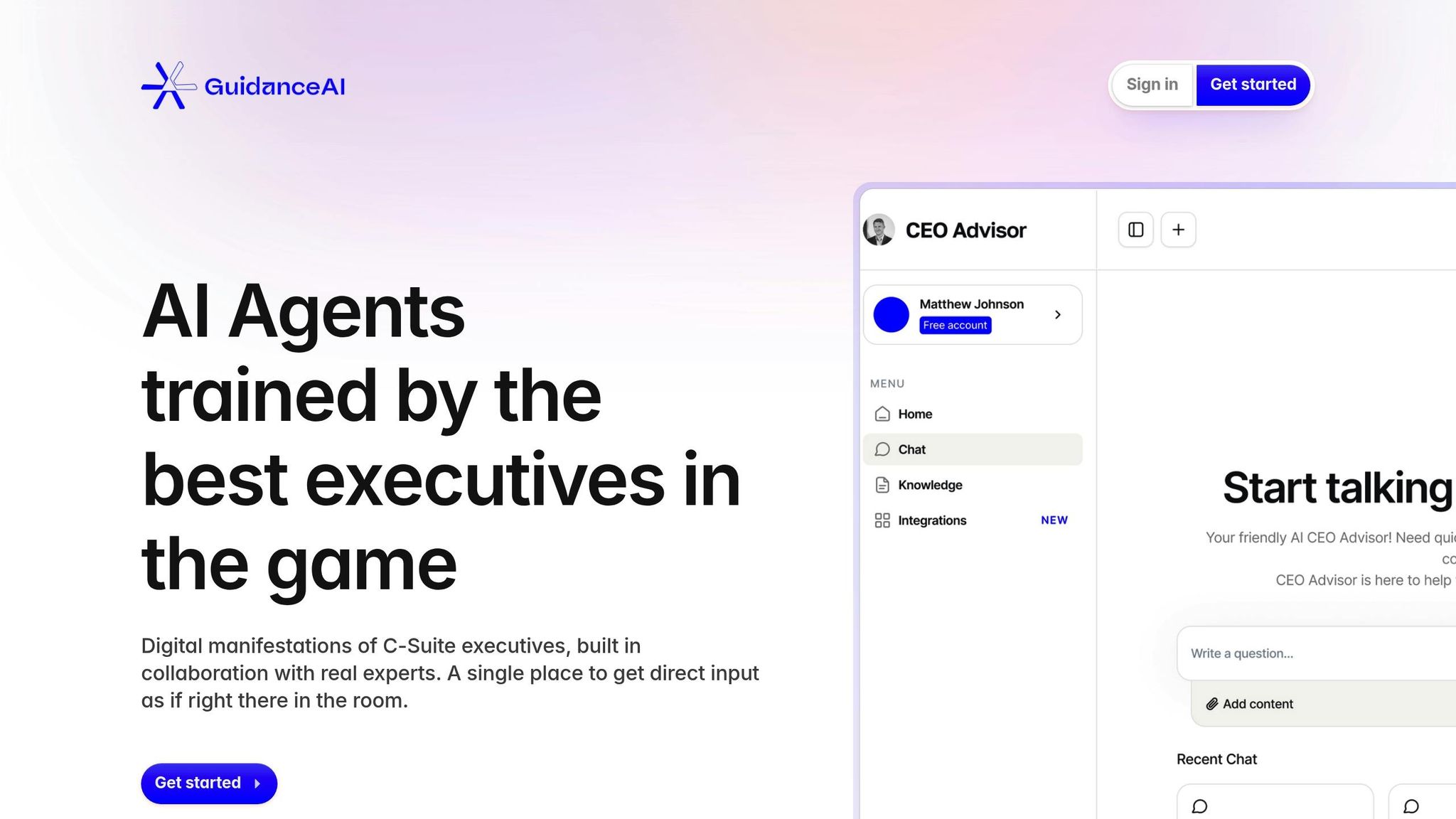
AgentimiseAI takes leadership support to the next level with GuidanceAI, a virtual advisory service designed to provide SMEs with strategic input from digital C-suite advisors. These AI-powered advisors act as the virtual counterparts of experienced executives, delivering high-level guidance to founder-led teams. This allows businesses to access boardroom-level expertise without the need to hire full-time senior executives, giving them the tools to make informed, strategic decisions.
Custom AI Solutions for SME Workflows
Since every SME operates differently, AgentimiseAI develops AI solutions that are designed to integrate seamlessly with existing systems and workflows. These customised agents replicate internal expertise, enabling businesses to scale while maintaining the quality of decision-making. The process begins with a detailed analysis of the company’s workflows to identify areas where AI can add the most value. These solutions go beyond simple automation, helping with complex decisions and freeing up leadership to focus on driving growth and innovation.
Conclusion: The Future of AI for SME Leadership Teams
The role of leadership in small and medium-sized enterprises (SMEs) is changing rapidly as the collaboration between humans and machines becomes a cornerstone of success. AI has moved beyond being a futuristic idea - it's now a practical tool that strengthens leaders' abilities in areas like data analysis, risk evaluation, and planning for various scenarios.
The concept of Quantum Leadership, which merges human intuition with machine intelligence, is shaping the future for SMEs in fast-changing markets. This approach highlights the need to pair forward-thinking strategies with practical implementation. By doing so, businesses can build adaptability and resilience - two crucial traits for thriving in today’s competitive landscape.
For SME leaders, the best way to start is by focusing on small, impactful AI projects and gradually expanding as confidence and understanding grow. It all begins with a detailed review of current processes to pinpoint areas where AI can provide the most value. This step-by-step method ensures smoother integration and prepares businesses for more advanced AI applications.
AgentimiseAI plays a pivotal role in this journey by bridging the gap between complex AI technology and practical business needs. Their approach focuses on creating AI systems that mimic internal expertise while acting as trusted strategic partners. This helps SMEs scale operations effectively without the chaos that often accompanies growth.
The future will favour leaders who embrace AI as a tool to enhance strategic thinking. Those who invest in AI training, work with virtual C-suite advisors, and adopt customised AI solutions will be better equipped to innovate, respond to market shifts, and achieve sustainable growth in a competitive world.
FAQs
How can SMEs start using AI tools effectively, even with limited resources?
Small and medium-sized enterprises (SMEs) can make the most of AI tools by focusing on solutions that align with their unique workflows and challenges. One such option is AgentimiseAI, which offers AI-powered leadership training and personalised AI agents to help SMEs improve decision-making, boost efficiency, and spark new ideas.
Their GuidanceAI platform stands out by connecting leadership teams with virtual C-suite advisors and coaches. These AI agents are trained by seasoned business professionals, offering expert-level insights without the expense of hiring full-time senior executives. It's a smart, budget-friendly way for SMEs to scale their operations and optimise processes.
How can leadership teams address employee concerns about adopting AI in the workplace?
To ease employee concerns about adopting AI, leadership should prioritise open communication and nurturing trust within the organisation. Start by clearly outlining how AI tools can bring value to both the company and its workforce. For example, AI can take over repetitive, time-consuming tasks, allowing employees to focus on more engaging and meaningful work. Emphasise that AI is designed to support human roles, not replace them.
Involving employees early in the process is key. Offer opportunities for them to participate, provide training sessions, and address any specific worries they might have. Consistent support and transparency about the goals and boundaries of AI technology can go a long way in reducing resistance. When leadership links AI initiatives to employees' professional growth and demonstrates how it can streamline workflows, it builds trust and confidence, making adoption much smoother.
How can AI help SMEs remain competitive in fast-changing markets?
AI gives SMEs the tools to respond swiftly to shifts in the market by improving decision-making, simplifying processes, and encouraging new ideas. For instance, AI-powered leadership training and specialised virtual advisors allow leadership teams to make smart, strategic choices without relying on full-time senior executives.
By adopting AI solutions designed to meet their unique requirements, SMEs can refine their operations, grow effectively, and stay competitive in fast-changing industries.