
AI Literacy vs. AI Expertise: What Founders Need
16 Mar 2026
Founders need AI literacy—know where AI adds value, manage risks, and delegate technical work to experts to deliver measurable business outcomes.

AI literacy matters more than technical expertise for founders. You don’t need to code or build AI systems, but you do need to understand how AI can create value, manage risks, and align with your business goals. This knowledge helps you make smarter decisions, delegate effectively, and avoid costly mistakes.
Here’s what you should know:
AI Literacy: Focuses on understanding AI’s capabilities, limitations, and business applications. It’s about asking the right questions, assessing risks, and ensuring AI supports your strategy.
AI Expertise: Involves technical skills like coding and training AI models. This is typically a role you hire for, not something a founder needs to master.
Why literacy matters more:
77% of leaders admit they lack confidence in managing AI risks.
Only 8% of senior executives truly understand AI.
Many AI initiatives fail due to poor strategy, not technical issues.
What AI Literacy and AI Expertise Mean
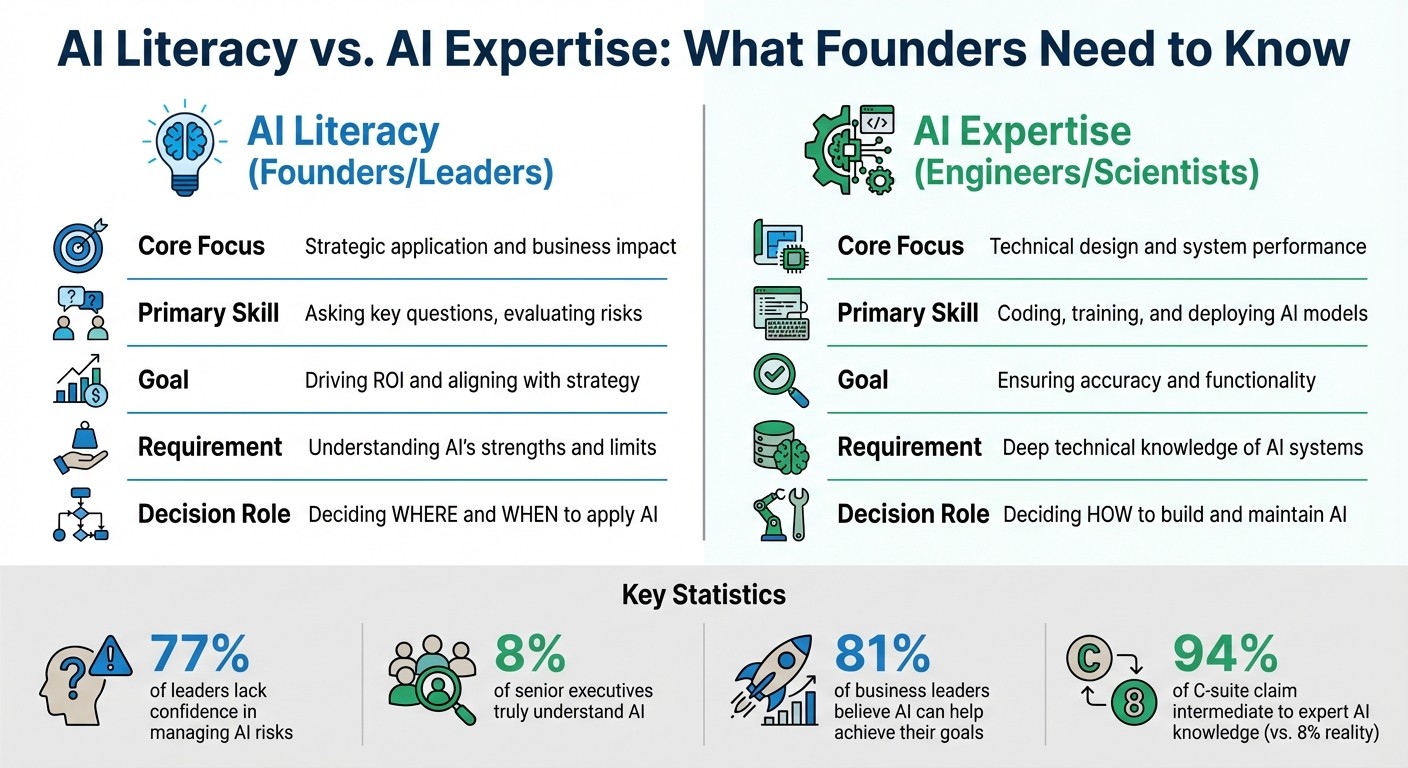
AI Literacy vs AI Expertise: Key Differences for Founders
Founders need to understand the difference between AI literacy and AI expertise to lead effectively and delegate appropriately. This distinction is more than just a technicality - it shapes how you approach leadership, decision-making, and investment in AI technologies.
What is AI Literacy?
AI literacy refers to the ability to assess and use AI in practical ways without needing to code or build models. It’s about understanding what AI can and cannot do, recognising its strengths in areas like pattern recognition and summarisation, and being aware of its limitations in judgement, human context, and ethical considerations. Think of it as knowing the rules of a game without having to play every match.
For founders, this means understanding when AI is a useful tool and when it isn’t - especially in high-stakes situations that involve moral judgement or unclear accountability.
"Not knowing AI today is like not knowing finance, marketing, or operations. You don't need to run the models, but you do need to understand the game you're playing." - Jeff Pelliccio, Founder, Allied Insight
AI literacy isn’t about becoming a technical expert. It’s about developing the ability to ask the right questions, assess risks, and ensure AI aligns with your broader strategy. By grasping how AI processes data and recognising its limitations, you can make informed choices about when to rely on it and when human oversight is essential.
While AI literacy equips leaders to think strategically and make informed decisions, AI expertise is about the technical know-how required to bring AI systems to life.
What is AI Expertise?
AI expertise involves the specialised skills needed to design, train, and deploy AI systems. These professionals focus on the technical side - coding algorithms, training models, and maintaining the infrastructure that powers AI. Their primary concern is ensuring the system functions effectively and delivers accurate results.
For founders, mastering these technical details is less important than understanding AI’s strategic potential. This is why AI expertise is typically a role you hire for, much like you’d bring in legal or financial experts as your company grows. Founders don’t need to build AI systems themselves; they need to understand how to leverage them.
AI Literacy vs. AI Expertise: The Main Differences
The distinction between literacy and expertise becomes clearer when you compare what each enables:
Feature | AI Literacy (Founders/Leaders) | AI Expertise (Engineers/Scientists) |
|---|---|---|
Core Focus | Strategic application and business impact | Technical design and system performance |
Primary Skill | Asking key questions, evaluating risks | Coding, training, and deploying AI models |
Goal | Driving ROI and aligning with strategy | Ensuring accuracy and functionality |
Requirement | Understanding AI’s strengths and limits | Deep technical knowledge of AI systems |
Decision Role | Deciding where and when to apply AI | Deciding how to build and maintain AI |
The difference lies in strategy versus execution. AI literacy enables leaders to rethink business processes and embrace transformative changes, moving beyond simple automation to a deeper integration of AI into the organisation. On the other hand, AI expertise focuses on the technical execution of these strategic visions.
This distinction is crucial for founders. With 81% of business leaders believing AI can help achieve their goals, yet only 8% of senior executives having a solid grasp of AI concepts, it’s clear that literacy - not expertise - is what leaders need most. By focusing on AI literacy, founders can lead with confidence while leaving the technical details to their expert teams, ensuring smarter investments and better overall results.
Why Founders Need AI Literacy More Than Expertise
Founders face a critical choice: dive into coding AI models or grasp how AI can shape business strategies. The answer is straightforward - understanding AI's strategic role is far more important than mastering its technical details.
How AI Literacy Supports Leadership Decisions
AI literacy equips founders with the ability to make informed decisions, ensuring that every investment in AI delivers measurable business value. This helps avoid "strategic drift", where key decisions unintentionally shift to technical teams who may lack the broader business context needed for effective implementation.
"A CEO who can't articulate how that investment creates value, manages risk, and aligns with strategic purpose isn't qualified to steward that capital." - Faisal Hoque, Founder, Shadoka
While 98% of companies are exploring AI, only 4% have seen substantial returns on their investments [18, 19]. Even more striking, 71% of organisations using AI report no noticeable impact on earnings - not because the technology itself failed, but because leadership wasn't prepared. The real gap lies in strategy, not technology.
Before committing to any AI initiative, consider three essential questions: What business outcome are we aiming for?, Where does the value reside - data, workflow, or revenue?, and What potential risks could arise if this succeeds?. These questions keep projects focused on delivering tangible results rather than chasing flashy but ineffective innovations.
AI literacy also helps founders differentiate between meaningful applications and superficial "vanity demos" - projects that may look impressive but fail to deliver real value [17, 19]. Instead of simply automating tasks, informed leaders focus on rethinking entire processes, like customer onboarding or decision-making workflows, to drive lasting impact.
This clarity strengthens the relationship between leadership and technical teams, ensuring alignment on goals and outcomes.
Connecting Leadership with Technical Teams
A shared understanding of AI creates a bridge between leadership and technical teams, ensuring that everyone is working towards the same business objectives. Without this common ground, founders risk approving projects they can't fully evaluate or challenge.
Here's an eye-opening statistic: while 94% of C-suite executives claim to have intermediate to expert knowledge of AI, only 8% actually have a solid grasp of the technology's core concepts. This disconnect can lead to blind spots, where leaders greenlight initiatives without fully understanding their potential risks or rewards.
AI literacy allows founders to act as "conductors", setting the strategic direction while relying on technical teams for execution. You don't need to understand the intricate mathematics behind AI, but you do need to hold your team accountable for outcomes that matter - like faster processes or better decision-making - rather than focusing on technical metrics that don't translate into business success.
One way to ensure alignment is by establishing an AI Council that includes representatives from IT, legal, HR, and finance. This group can set clear boundaries and track the value of AI projects before they escalate to the board level.
Using AI Expertise Through Delegation
Strong leadership also means knowing when and how to delegate. Founders should hire AI specialists to handle the technical details while they focus on setting the strategic vision and defining the outcomes they want to achieve.
"You can't lead people through AI transformation if you don't understand AI transformation." - Bryan Ackermann, Head of AI Strategy and Transformation, Korn Ferry
Understanding AI doesn't mean learning to code - it means knowing enough to ask the right questions and assess whether proposed solutions align with your business goals.
Platforms like AgentimiseAI make this delegation easier. Through tools like GuidanceAI, founders can access virtual advisors - AI agents trained by real experts - without needing to develop these systems themselves. This lets you retain strategic control while relying on specialists for technical execution.
Shift your focus to understanding how AI can drive value and be governed responsibly, rather than getting bogged down in the technical details. Instead of worrying about neural networks or data preparation, concentrate on the practical aspects: AI's business applications, risk management, and ethical considerations. This approach ensures you can oversee specialists effectively while keeping AI initiatives aligned with your company's goals and values.
The move from technical expertise to strategic literacy isn't about lowering expectations - it's about directing your attention to where it matters most. As MIT Sloan Executive Education puts it, "AI literacy at the leadership level is less about technical detail and more about judgment". That judgment - knowing when and how to use AI, how to measure its success, and where human oversight is essential - can make the difference between meaningful AI adoption and costly experiments that fail to deliver.
How AgentimiseAI Supports Founders with AI-Driven Leadership
AgentimiseAI steps in to help founders navigate the growing importance of AI in decision-making, offering tailored tools that simplify the process. For many founders, the challenge lies in balancing the need for AI literacy with the limited time to develop it. Instead of requiring them to master technical skills, AgentimiseAI translates business objectives into actionable technical instructions, delivering results in straightforward business terms. This approach underscores how understanding AI's potential can be more impactful than deep technical knowledge.
One major issue the platform addresses is the "Admin Tax" - the hidden cost of manual tasks like data entry and formatting, which can cost UK SMEs with 5 to 20 employees between £1,500 and £4,000 each month. By automating these processes, founders can focus on strategic priorities, maintaining control over key decisions while freeing up valuable time.
GuidanceAI: Virtual C-Suite Advisors
GuidanceAI offers founders access to specialised AI agents that act as virtual C-suite advisors, trained by experienced business professionals. These agents are tailored to a company’s specific needs, taking into account factors like business plans, buyer personas, and brand voice. This creates what AgentimiseAI refers to as a "Virtual Boardroom".
In December 2025, Rosemary Ndukuba, founder of Cenu Cacao, adopted this approach by consolidating her business’s "Single Source of Truth", which included a 3-year plan and eight buyer personas. She then introduced custom AI agents, such as a Virtual Sales Director, Marketing Manager, and Event Director, to provide strategic advice aligned with her goals. This allowed her to effectively expand her team without incurring the costs of additional full-time staff.
This solution is particularly relevant given that 80% of C-suite executives believe an AI specialist is essential at the board level to oversee governance and strategy. GuidanceAI provides this expertise without requiring a permanent hire. The AI handles tasks like strategic planning and drafting, but the final say on critical decisions always rests with human leaders.
Tailored AI Solutions for SMEs
AgentimiseAI goes beyond generic AI tools, offering customised systems that align with the unique workflows of founder-led SMEs. This process, referred to as "agentification", shifts AI from being a passive tool to an active participant in business operations.
Customisation also extends to governance. Founders can set specific thresholds for AI autonomy. For instance, an AI agent might automatically approve customer refunds up to £25, while larger amounts would require human authorisation. This "human in the loop" model ensures founders retain control while automating time-consuming tasks.
Criteria | AI-Driven Training (AgentimiseAI) | Traditional Training |
|---|---|---|
Customisation | Adapts to individual needs in real time | Limited to pre-designed modules |
Scalability | Scales effortlessly without quality loss | Constrained by trainer availability |
Cost-Effectiveness | £50–£200 per user annually | £1,500–£3,000 per participant |
Accessibility | 24/7 availability from anywhere | Limited to scheduled sessions |
Application Rates | 60–75% with just-in-time guidance | Lower due to lack of ongoing support |
By tailoring workflows to individual businesses, AgentimiseAI not only improves efficiency but also enhances strategic decision-making.
Improving Decision-Making and Operations
AgentimiseAI enables founders to focus on high-level strategy by automating technical and administrative tasks. This shift allows founders to oversee AI agents managing repetitive workflows, freeing up time for more critical decisions. This is especially important given that 93% of C-level executives admit to relying on AI-informed decisions based on flawed data, with 40% experiencing serious consequences as a result.
"The people with the greatest autonomy over AI are also the ones most exposed to its risks... Organisations must ensure leaders have the right expertise before these decisions cause real business impact." – Ollie Whiting, CEO, La Fosse
AgentimiseAI addresses this challenge by acting as a "translator", converting business goals into technical commands and delivering results in clear, actionable terms. Founders only need to define their desired outcomes, leaving the platform to handle the technical execution.
This approach reinforces the idea that AI literacy is more valuable than technical expertise. Founders maintain strategic control while delegating complex tasks to AI specialists. The result is faster, more accurate decision-making, streamlined processes, and scalable growth - all while preserving the unique, founder-led culture that defines SMEs. AgentimiseAI ensures technology supports business objectives, rather than dictating them.
Conclusion
For SME founders, AI literacy - not technical expertise - is the real game-changer. While 81% of business leaders believe AI can help them achieve their objectives, only 8% of senior executives have a solid grasp of AI. This gap explains why so many AI initiatives fail to deliver measurable results.
Founders don’t need to master the technical details of AI. Instead, they should focus on understanding where AI adds value, the risks it brings, and how it shifts accountability. As Jeff Pelliccio, Founder of Allied Insight, puts it: "Not knowing AI today is like not knowing finance, marketing, or operations". This kind of literacy enables founders to ask the right questions, spot high-value opportunities, and stay in control of strategic decisions.
This shift from technical know-how to AI literacy also changes how founders approach team-building. Research suggests that for every one person creating AI solutions, businesses typically need 10 to 20 "appliers" - people who can integrate AI into their specific work areas. Instead of hiring technical specialists, founders should focus on training their best sales, marketing, or operations professionals in AI literacy. AI is most effective when it enhances existing expertise rather than replacing it. This approach ensures that business goals are translated into practical, AI-driven solutions.
With this foundation in place, tools like AgentimiseAI allow founders to delegate technical tasks while keeping strategic control. By enabling founders to define outcomes and leave the technical execution to experts, AgentimiseAI supports a founder-led culture while enabling efficient scaling. It reinforces a simple but powerful idea: AI should handle focused, well-defined tasks within a framework designed by humans, leaving the strategic heart of the business intact.
FAQs
What level of AI knowledge do I actually need as a founder?
As a founder, having a solid grasp of AI literacy is essential. This means understanding the basics of how AI operates, recognising its limitations, and ensuring its ethical application. With this knowledge, you’ll be better equipped to make strategic decisions, evaluate AI-generated outputs, and identify potential risks.
While you don’t need to be an AI specialist, being familiar with what AI can do and how it can be applied allows you to lead your team with confidence, oversee projects effectively, and push forward new ideas with purpose.
How do I pick the right first AI project for my business?
When starting with AI, pick a project that aligns with your business objectives, is realistic in scale, and can provide noticeable benefits early on. Begin by clearly identifying the problem you aim to address. Next, evaluate how prepared your organisation is for AI adoption. Tools like the RICE framework - which considers reach, impact, confidence, and effort - can help you prioritise effectively. By focusing on what’s achievable and aligns with your strategy, you’ll set yourself up for a strong introduction to AI.
What risks should I watch for when using AI in decisions?
One of the biggest challenges with AI-driven decisions is the risk of relying on inaccurate or incomplete data. If the data feeding the AI is flawed, the decisions it produces can be equally flawed, leading to serious consequences.
Another issue is the lack of AI literacy among leadership. Many decision-makers simply don't have the expertise to fully understand or interpret AI outputs. This gap can result in poor decisions or even compliance problems if regulations aren't properly considered.
There's also the danger of using AI for tasks outside one's area of expertise. Without a solid understanding of the domain, misjudgements can occur, undermining the effectiveness of AI tools.
To tackle these risks, it's crucial to focus on building AI literacy within organisations and implementing strong governance frameworks. These steps can help ensure that AI is used responsibly and effectively.