AI Scalability vs. AI Readiness: Key Differences
19 Mar 2026
How UK SMEs can assess AI readiness—data, skills and governance—and scale pilots into cost‑efficient, enterprise-wide systems.

AI readiness and scalability are two critical, yet distinct, stages in adopting artificial intelligence. AI readiness ensures your organisation is prepared to implement AI by focusing on clean data, skilled teams, and structured processes. Without this, projects often fail before they start. On the other hand, AI scalability addresses how to grow successful AI pilots into full-scale systems that handle increased data and complexity without excessive costs.
For UK SMEs, the challenge lies in balancing these stages. While 80% of AI projects fail due to poor readiness, only 22% of companies successfully scale AI after initial pilots. Readiness helps avoid wasted resources, and scalability ensures AI delivers long-term value.
Key takeaway: Start with a readiness assessment to build a solid foundation, then focus on scaling proven pilots for sustainable growth. Both stages are essential for turning AI into a tool that supports business expansion effectively.
What is AI Readiness?
AI readiness is about determining if your organisation is equipped to adopt and integrate AI technologies effectively. It highlights areas of strength, identifies gaps, and pinpoints risks across critical domains like data, workforce, processes, and governance. Before diving into AI solutions, it's crucial to evaluate whether your current setup can genuinely support them.
The stakes are high. By 2025, only 13% of organisations worldwide will be fully AI-ready. For UK SMEs, this readiness gap often means the difference between successful AI deployment and projects that fail to progress beyond initial trials. Shockingly, 95% of enterprise generative AI initiatives lack measurable profit and loss impact, largely due to insufficient readiness.
Core Elements of AI Readiness
Four key areas determine how prepared your SME is for AI adoption:
Data Foundations: Reliable, clean, and well-governed data is essential. Poor data quality costs organisations approximately £12.9 million annually, and AI systems typically require at least 12 months of historical data with 95% completeness to perform effectively. Without this, AI investments can amplify inefficiencies instead of solving problems.
People and Skills: Your team doesn’t need to be packed with data scientists, but they should understand AI's capabilities and limitations. Having internal champions who can connect AI tools to daily operations is vital for long-term success.
Organisational Culture: Leadership must align on the importance of AI and engage employees in the process. Without this shared vision and trust, even the most advanced technology can fail to gain traction.
Governance and Ethics: With regulations like GDPR and the EU AI Act in place, transparency and risk management are non-negotiable. Data governance, vendor risk assessments, and ethical AI practices need to be prioritised. By 2026, 70% of AI success will hinge on governance, process documentation, and change management - technical readiness will account for just 30%.
These pillars demonstrate why neglecting readiness can derail AI initiatives before they deliver value.
Why SMEs Need AI Readiness
Skipping a readiness assessment can lead to costly errors. Only 48% of AI projects make it into production, and those that do take an average of eight months to deploy. For SMEs with limited budgets, this inefficiency can waste valuable time and resources.
On the flip side, SMEs that prioritise readiness can see results faster. For instance, Lumen Technologies identified a major inefficiency: their sales teams spent four hours per call on research. By pinpointing this issue and ensuring their data was ready, they used AI to cut research time to 15 minutes, aiming for £50 million in annual savings.
"AI should never be a science experiment in search of a use case. It's a strategic capability that must begin with purpose." - Reverie Digital
AI readiness is not about ticking boxes - it’s about creating a strong foundation that allows AI to deliver meaningful results. For UK SMEs, this means auditing data early, building the right team skills, and aligning AI projects with clear business goals. With the right groundwork, AI can move from being a buzzword to a game-changing tool for growth.
What is AI Scalability?
AI scalability refers to the ability to expand AI systems from small-scale pilot projects to full-scale operations without losing performance or incurring unsustainable costs. It’s about transitioning from isolated successes to making AI a central part of your business strategy. While readiness asks, “Are we prepared?”, scalability focuses on, “Can we grow this effectively?”
This challenge is no small feat. In 2023, 91% of companies invested in AI, but only 22% managed to scale it across multiple functions. The gap between initial success and enterprise-wide adoption often trips up small and medium-sized enterprises (SMEs). Without proper planning, scaling can cause costs to soar by 250% to 400%.
"AI pilots are easy. Scaling AI is hard." - Tredence Editorial Team
Interestingly, successful scalability isn’t about having better technology - it’s about having the right strategy. Companies that scale AI effectively grow their revenue 7 percentage points faster than those stuck in the experimental phase. Within 18 months of deployment, they also report a 13% productivity boost and an 11% cost reduction.
Core Principles of AI Scalability
To scale AI successfully, three key principles need to work in harmony:
Modular architecture: This approach breaks systems into independent components, allowing you to update or swap parts - like replacing one language model with another - without disrupting the entire system. Think of it as building with LEGO bricks rather than pouring concrete.
Governance: Scaling requires robust controls for security, compliance, and risk management. Automated governance includes four layers: access control, operational controls (like budgets), safety measures (e.g., human-in-the-loop checkpoints), and compliance audits to meet regulations like GDPR and the EU AI Act.
Cross-departmental integration: Instead of automating one isolated task, scalable AI transforms entire processes across departments like finance, marketing, and customer service. For example, in January 2026, an industrial goods company implemented AI agents to handle requests for quotes (RFQs). The system resolved 70% of RFQs without human input, cutting labour costs by 30% to 40% and generating millions in extra revenue through faster processing.
These principles create a foundation for sustainable AI growth, enabling businesses to expand their AI capabilities while driving measurable results.
How AI Scalability Supports Business Growth
Scalability turns AI from a promising experiment into a powerful driver of business growth. The focus shifts from automating individual tasks to redesigning entire processes. This is where the 10/20/70 rule comes into play: successful AI transformation involves 10% effort on algorithms, 20% on technology and data, and 70% on people and processes.
"Scaling AI requires new processes, not just new tools." - Eric Jesse, Zeeshan Shah, and Rajeev Singh, BCG
The impact of scalability is clear. In February 2026, Uber’s scalable AI processed billions of data points daily for demand forecasting. By analysing real-time traffic, weather, and ride history, the system dynamically adjusted fares and driver allocation, reducing wait times and optimising pricing across thousands of cities. For UK SMEs, similar principles can apply on a smaller scale - whether it’s fine-tuning inventory forecasts, personalising customer interactions, or streamlining quote-to-cash cycles.
Businesses with strong scalability frameworks grow 35% faster, and SMEs with high readiness scores achieve ROI up to 40% faster. The key is treating AI as a strategic asset rather than just a technical experiment. When done right, scalable AI continuously improves as it processes more data, enhancing decision-making, customer engagement, and operational efficiency over time.
AI Readiness vs AI Scalability: Main Differences
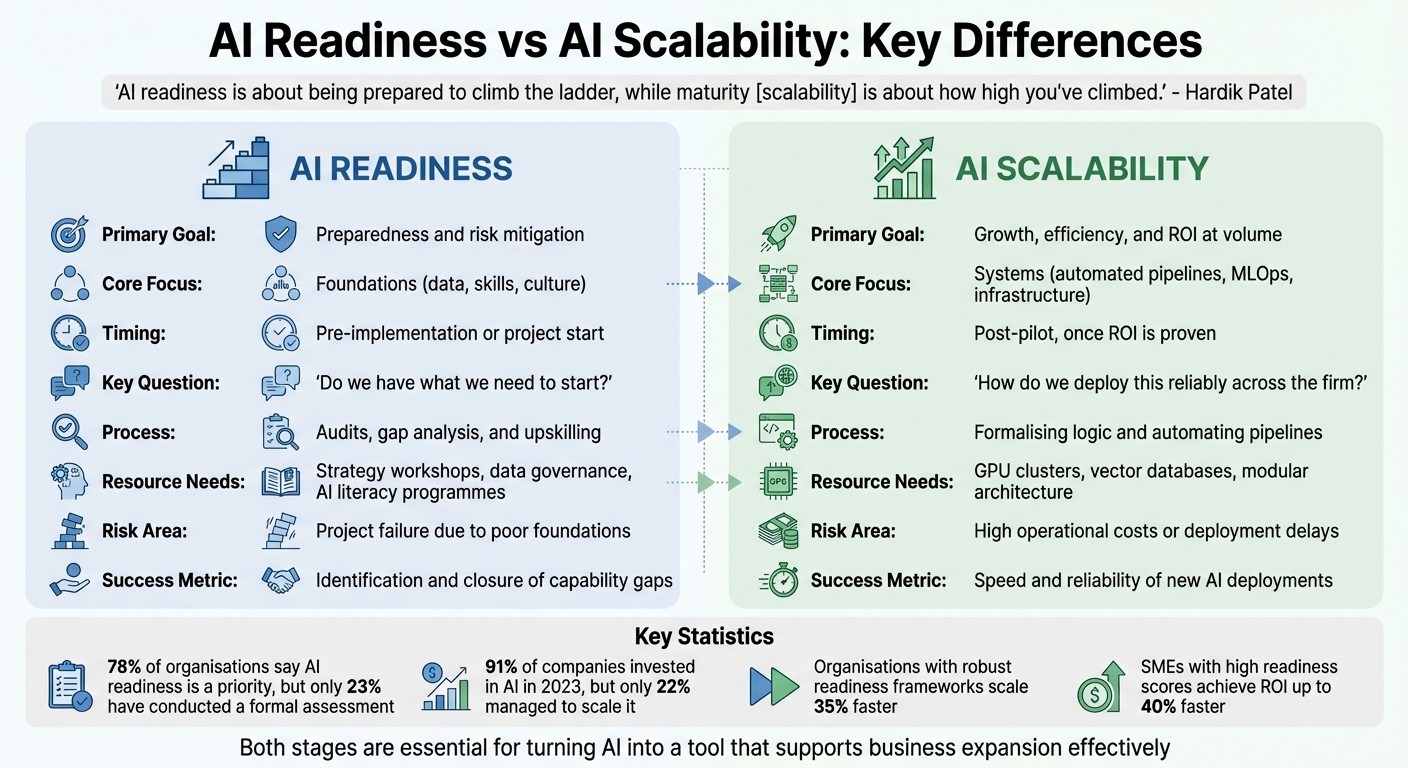
AI Readiness vs AI Scalability: Key Differences for UK SMEs
Let’s break down the key differences between AI readiness and scalability to help you understand where your organisation stands and what steps to take next.
AI readiness is all about ensuring your organisation has the right foundation - data, skills, and culture - to even begin deploying AI. In contrast, AI scalability is about taking a successful pilot and expanding it across the organisation efficiently, without spiralling costs.
"AI readiness is about being prepared to climb the ladder, while maturity [scalability] is about how high you've climbed." - Hardik Patel, GenAI Application Architect
This distinction is critical because many AI projects fail to progress beyond the pilot stage. By the end of 2025, 30% of generative AI projects are expected to be abandoned after proof-of-concept. Why? Organisations often rush to scale without first ensuring they’re ready. Proper readiness assessment is the foundation for successful scalability.
Comparison Table: Readiness vs Scalability
Dimension | AI Readiness | AI Scalability |
|---|---|---|
Primary Goal | Preparedness and risk mitigation | Growth, efficiency, and ROI at volume |
Core Focus | Foundations (data, skills, culture) | Systems (automated pipelines, MLOps, infrastructure) |
Timing | Pre-implementation or project start | Post-pilot, once ROI is proven |
Key Question | "Do we have what we need to start?" | "How do we deploy this reliably across the firm?" |
Process | Audits, gap analysis, and upskilling | Formalising logic and automating pipelines |
Resource Needs | Strategy workshops, data governance, AI literacy programmes | GPU clusters, vector databases, modular architecture |
Risk Area | Project failure due to poor foundations | High operational costs or deployment delays |
Success Metric | Identification and closure of capability gaps | Speed and reliability of new AI deployments |
This table highlights when to focus on building a foundation versus scaling proven AI projects.
When to Focus on Readiness or Scalability
Focus on readiness if your organisation is still grappling with unstructured data, unclear AI goals, or resistance to change. This is especially relevant for UK SMEs just starting their AI journey. While 78% of organisations say AI readiness is a priority, only 23% have conducted a formal assessment. Avoid rushing into tools and technologies - start with a gap analysis covering strategy, data, technology, people, culture, processes, and governance.
"The technology isn't the problem. Organisational readiness is." - Dheeraj Rathee, The Tech Founders
Shift to scalability when your pilots demonstrate clear ROI, and you’re ready to move from isolated projects to a structured AI portfolio. For example, if your pilots are currently managed manually or your infrastructure struggles with real-time data processing, it’s time to invest in scalable systems. Organisations with robust data practices see 3.2 times higher ROI from AI investments, and those with strong readiness frameworks scale 35% faster than their competitors. The secret? Structured, deliberate growth - not just speed - leads to success.
Why SMEs Need Both Readiness and Scalability
For small and medium-sized enterprises (SMEs), combining readiness with scalability is key to achieving sustainable AI growth. Treating these elements as separate can hinder effective AI integration. Research highlights that a lack of organisational readiness is a major factor behind AI project failures. Yet, many SMEs jump into scaling AI pilots without first ensuring their foundations are sound. This often leads to disorganised processes being amplified when workflows are messy or poorly documented.
Rather than seeing readiness and scalability as linear steps, it’s more effective to view them as part of a continuous cycle. Readiness ensures that your data is clean, your teams are skilled, and your governance structures are in place before making large investments. Scalability, on the other hand, takes successful pilots and expands them across the organisation while keeping costs under control. Aligning these two elements reduces the risk of stalled pilots or chaotic expansion. Focusing too heavily on readiness without a clear plan for scalability can leave SMEs stuck with pilots that don’t deliver long-term value.
This approach transitions businesses from manual processes to orchestrated automation. For instance, AI can handle routine tasks based on predefined rules. Take refunds as an example: amounts up to £25 could be automatically processed, amounts between £25 and £150 might require human approval, and anything over £150 could need a manager’s sign-off. This kind of system ensures automation is both efficient and well-regulated.
How AgentimiseAI Supports SMEs
AgentimiseAI offers tailored solutions to help UK SMEs balance readiness and scalability. Their services include:
AI Leadership Training: Priced at £1,050 per half-day session (for up to 10 participants), this training helps non-technical teams understand AI dashboards and how AI fits into daily workflows.
AI Discovery Workshops: Also £1,050 per half-day (in-person), these workshops identify high-return use cases and prioritise them based on your current capabilities, laying a solid foundation for AI adoption.
Custom AI Agent Development: Starting at £1,900, this service creates bespoke AI agents that integrate with your existing tools and workflows. Post-launch support ensures smooth scaling.
These services are designed to complement one another. Training builds team readiness, workshops focus your efforts on high-impact areas, and custom agents provide the scalable infrastructure needed for growth. For added value, a bundle combining training and workshops is available for £1,800 (a 15% saving), which also includes a free AI policy template to help establish governance from the outset.
Benefits for UK SMEs
Balancing readiness and scalability delivers clear, measurable benefits for SMEs. Enhanced decision-making and operational efficiency empower businesses to gain real-time insights without needing to hire additional senior staff. SMEs can also ensure compliance with regulations like UK GDPR, the Data Protection Act 2018, and ISO 27001, while focusing resources on high-value tasks. By adopting AI strategically, SMEs can strengthen their market position, achieve faster productivity improvements, and integrate AI throughout their operations - all while addressing regulatory and operational challenges.
"Automation without thresholds is just speed-running mistakes."
Assessing Your SME: Readiness Checklist and Scalability Roadmap
Before diving into AI investments, it’s crucial to evaluate where your business stands today and what it will need in the future. A successful AI journey starts with a thorough readiness check and a clear plan for scaling. Skipping this step can often lead to failure, as many SMEs have discovered the hard way.
Readiness Checklist
To begin, assess your SME across four key areas:
Data Quality: Your data needs to be clean, well-organised, and stored in structured formats, supported by clear data policies. If your data lives in messy spreadsheets with no governance, you're not ready yet.
Technology Infrastructure: Ensure your systems - like CRM and ERP - are API-connected and cloud-enabled. Outdated legacy systems without APIs are a major barrier.
People and Culture: You'll need internal advocates for AI and a formal training budget. If your team fears job losses or if informal IT practices dominate, address these challenges first.
Governance and Strategy: Compliance with regulations like GDPR, documented AI policies, and clear KPIs tied to an 18-month executive commitment are essential. AI projects driven by trends or "FOMO" rather than clear business goals often fail.
"I can fix bad data in 4 weeks. I can't fix the absence of someone who owns the outcome." - Jonathan Lasley, Fractional AI Director
Strong executive sponsorship is critical. Someone at the top must take ownership, clear roadblocks, and ensure AI aligns with your business objectives. SMEs that excel in readiness often see ROI up to 40% faster than those that skip this step.
Once you've ticked off the readiness criteria, it’s time to focus on scaling your efforts.
Scalability Roadmap
With a solid foundation in place, you can plan for growth in three phases:
Phase 1 (0–3 months): Lay the groundwork by auditing your data, upgrading your technology infrastructure, and delivering AI literacy training to your team.
Phase 2 (3–6 months): Run pilot projects targeting high-priority use cases, keeping a close eye on KPIs to measure success.
Phase 3 (6–12 months): Expand successful pilots across core operations. Integrate AI into your CRM and ERP systems while continuously monitoring the accuracy of your models.
AgentimiseAI offers tools to help you on this journey. Their AI Discovery Workshop (£1,050 per half-day) helps identify and prioritise impactful use cases tailored to your capabilities. Pair this with their AI Leadership Training (also £1,050 per half-day) to build both your roadmap and team readiness. Opt for the bundle at £1,800, and you’ll also receive a free AI policy template to establish governance right from the start.
Conclusion
AI readiness and scalability serve as two sides of the same coin, both essential for ensuring long-term SME growth. Readiness focuses on building a solid foundation - strong data, aligned leadership, and an adaptable culture - while scalability transforms early wins into lasting success without straining resources or budgets.
The numbers tell a clear story: 63% of UK businesses that skipped readiness assessments experienced delayed ROI or outright failure. On the flip side, SMEs with well-structured readiness plans scaled 35% faster and achieved ROI up to 40% sooner than those who jumped in unprepared. Interestingly, technical skills only account for about 30% of success. The remaining 70%? It’s all about people, processes, and effective change management. This highlights why a balanced approach, combining readiness and scalability, is non-negotiable.
"The technology isn't the problem. Organisational readiness is." - Dheeraj Rathee, The Tech Founders
To avoid the trap of "pilot purgatory", where projects stall indefinitely, start with a thorough readiness assessment. Evaluate your organisation across seven key areas: Vision, Data, Technology, People, Culture, Process, and Ethics. Once you’ve nailed this, create a scalability roadmap that includes clear milestones, well-documented processes, and governance frameworks that can grow alongside your ambitions.
FAQs
How do I know if we’re AI-ready?
To determine if your business is prepared to embrace AI, take a closer look at critical areas like data maturity, internal expertise, process efficiency, and compliance knowledge. Conducting an AI readiness assessment can reveal potential weaknesses, such as limited skills, fragile data systems, or a lack of clear strategies. By identifying and addressing these gaps, you'll be better positioned to integrate AI into your operations, align it with your objectives, and transition from trial phases to achieving impactful outcomes.
What should we scale first after a successful AI pilot?
After testing AI in a pilot programme, the next step is to integrate it into your core workflows, decision-making processes, and operations. This ensures its impact is consistent and measurable over time. To make this work, organisational readiness is key - align your people, processes, and technology while setting up clear governance structures and offering proper training.
Begin by creating a solid operational framework. This framework will help embed AI into everyday business activities, ensuring it delivers value over the long term.
What’s the cheapest way to scale AI without costs spiralling?
The smartest way to scale AI without breaking the bank is to take things step by step. Begin with small pilot projects that tackle specific challenges. This avoids hefty upfront investments while allowing you to test the waters. Tools like pre-trained AI agents or no-code platforms - such as those offered by AgentimiseAI - can significantly cut down on development and infrastructure costs.
By gradually building governance structures and strengthening organisational capabilities, UK SMEs can ensure scalability stays under control. This approach helps avoid unnecessary expenses while keeping things efficient and manageable.