Custom AI Solutions for Manufacturing SMEs
23 Mar 2026
Tailored AI helps UK manufacturing SMEs cut costs, reduce downtime, boost productivity and integrate with existing systems, with funding and low-cost pilots.
UK manufacturing SMEs face challenges like rising costs, labour shortages, and shrinking profit margins. AI offers a way to tackle these issues effectively, helping businesses improve productivity, reduce costs, and stay competitive. By 2025, 35% of UK SMEs had adopted AI, reporting productivity boosts of 27% to 133%. Custom AI solutions, tailored to existing systems, are proving more efficient and cost-effective than generic tools.
Key Takeaways:
Cost Efficiency: Custom AI solutions cost £15,000–£40,000 upfront but deliver three times the ROI of off-the-shelf tools.
Productivity Gains: AI reduces manual tasks, improves quality control, predicts maintenance needs, and optimises energy usage.
Real Examples: Companies like Tyne Chease and Dobson and Beaumont have saved time, reduced costs, and increased turnover with AI.
Support Available: Programmes like Made Smarter offer up to 50% matched funding for AI adoption.
AI is already transforming manufacturing processes, from predictive maintenance to supply chain management. Start small, identify key pain points, and explore funding or workshops to integrate AI into your operations.
Why Custom AI Benefits Manufacturing SMEs
Custom AI vs Off-the-Shelf Solutions: Cost Comparison and ROI for Manufacturing SMEs
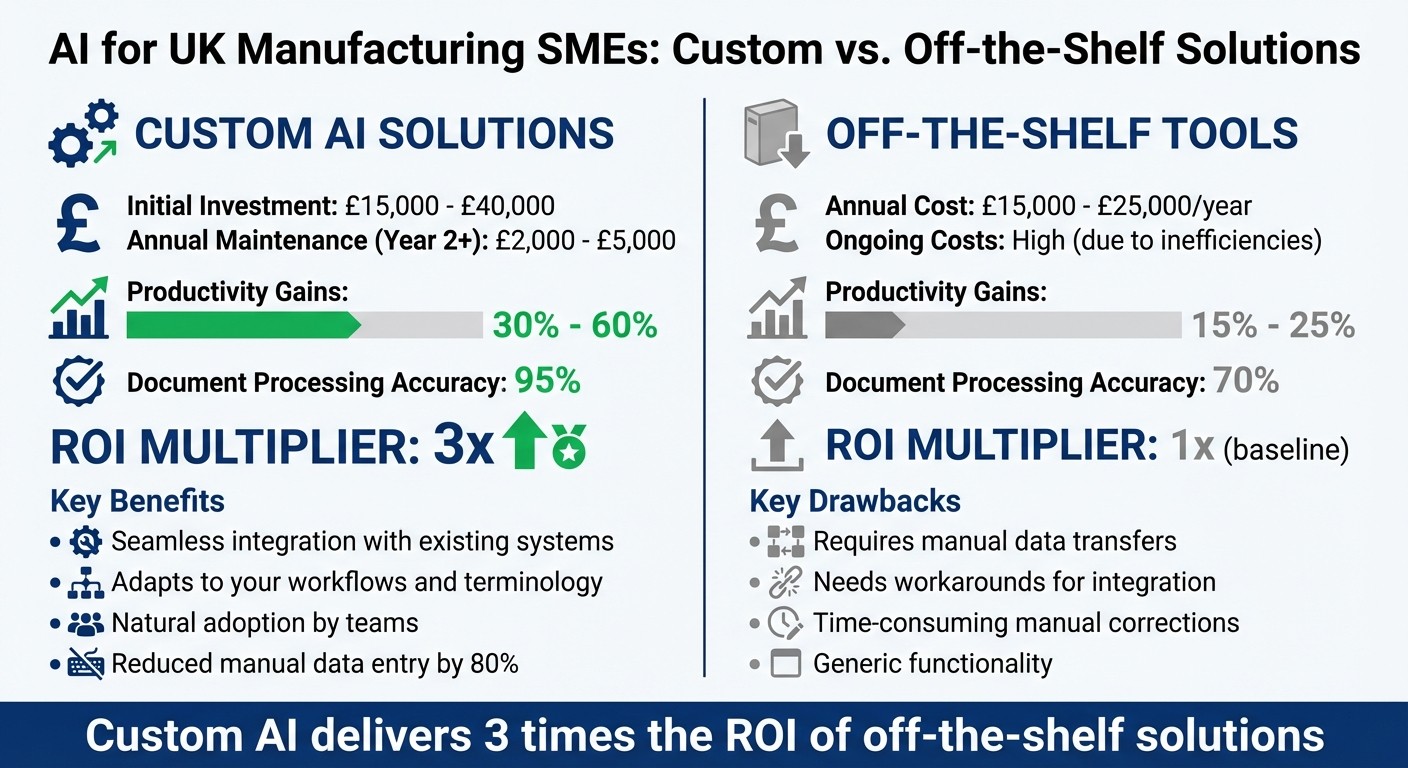
In a time when rising costs and limited resources are constant challenges, custom AI offers a practical and focused solution. It works by aligning perfectly with your existing systems - adapting to your workflows, terminology, and the tools you already rely on. Whether it’s your ERP system, CRM, or IoT sensors on the factory floor, custom AI integrates seamlessly. By mirroring your team’s current processes, it ensures adoption feels natural rather than disruptive. This personalised approach makes it easier to embed AI into your daily operations without overhauling everything.
The financial benefits are hard to ignore. While custom AI comes with an initial investment of £15,000 to £40,000, maintenance costs significantly drop to £2,000 to £5,000 annually by the second year. Compare this to generic tools, which can cost £15,000 to £25,000 per year due to inefficiencies like manual data transfers and workarounds. The numbers speak for themselves: tailored solutions deliver three times the ROI of off-the-shelf options, with productivity gains of 30% to 60%, far outpacing the 15% to 25% improvements seen with generic tools.
Fits Your Current Workflows
Custom AI slots right into your existing infrastructure, connecting with tools like SharePoint, maintenance databases, and production sensors. For example, it can provide real-time insights for process engineers monitoring production uptime, while supply chain managers receive automated inventory alerts. It learns from your business’s unique data - whether that’s specific invoice formats, technical manuals, or historical repair records. A custom document processor, for instance, achieves 95% accuracy in tasks like invoice matching, compared to the 70% accuracy of generic tools, which often require time-consuming manual corrections.
Reduces Costs and Improves Efficiency
Custom AI solutions can dramatically cut down on inefficiencies. Document processors, for instance, can reduce manual data entry time by 80%, allowing staff to focus on more valuable tasks. A manufacturing SME in Birmingham installed AI-powered sensors for predictive maintenance and managed to save £100,000 annually by detecting potential equipment failures early. This proactive approach reduced unplanned downtime by 30% - a game-changer for their cost structure.
Supports Growth and Competitiveness
One of the biggest advantages of custom AI is its ability to help businesses grow without needing to hire significantly more staff. For instance, an accounting firm using automated reconciliation tools increased its capacity by 30% without adding new employees. For manufacturing SMEs struggling with labour shortages and wage pressures, this can be transformative. AI agents act like digital colleagues, handling tasks such as supply chain management, generating safety reports, or providing instant access to technical documents through natural language queries. This boost in productivity helps level the playing field, enabling SMEs to compete with larger manufacturers who traditionally have more resources.
Where AI Works Best in Manufacturing
When it comes to manufacturing, AI shines in areas where real-time data and repetitive decision-making intersect. For UK SMEs, four key areas stand out for deploying tailored AI systems: predictive maintenance, quality control, supply chain management, and energy management. Let’s dive into how AI is making a difference in these processes.
Predictive Maintenance
AI uses sensor data to detect anomalies weeks before a failure occurs. This can reduce unplanned downtime by 30% to 50% and lower maintenance costs by 25%. Considering that unplanned downtime costs UK manufacturers a median of £125,000 per hour, these savings are game-changing.
Take Dobson and Beaumont, a precision engineering firm in Blackburn, as an example. With Made Smarter grant funding in 2024-2025, they installed AI-powered advanced measurement equipment. Managing Director Richard Guest shared the results:
"Our new machine has rapidly increased inspection times and efficiency, improved operator confidence and opened up further growth opportunities."
This investment led to a 60% increase in turnover over two years, with a further 35% growth projected as part of their digital transformation.
AI’s role doesn’t stop at maintenance - it’s also revolutionising quality control.
Quality Control
AI systems enable 100% inspection at production speeds, identifying surface defects, assembly errors, and dimensional issues with 97% to 99.8% accuracy. Compare that to the 85% to 95% accuracy typical of human inspectors, especially during long shifts. For SMEs aiming to meet high quality standards, this level of precision can reduce defect rates by 30% to 50% and help avoid costly recalls.
The entry cost for such systems ranges from £35,000 to £90,000, with payback periods of 12 to 20 months. When you think about the cost of defects reaching customers or the time spent on manual inspections, the investment often pays off quickly.
But AI’s benefits extend beyond the production line. It’s also streamlining supply chain operations.
Supply Chain Management
AI tools can monitor inventory levels, forecast demand in near real-time, and coordinate with suppliers - all while adhering to your spending limits. These systems handle tasks like autonomous replenishment and only flag exceptions for human review. The result? Inventory levels can drop by 35%, while stockout avoidance improves by 65%, freeing up working capital that’s no longer tied up in excess stock.
One North East manufacturer saw these benefits first-hand, reclaiming over 10 hours weekly by optimising inventory, which allowed them to focus more on innovation.
Finally, AI is also making strides in energy management.
Energy Management
AI systems track machine-level energy usage, optimise HVAC systems, and reschedule energy-intensive operations to avoid peak demand charges. Predictive maintenance plays a role here too - well-maintained equipment tends to run more efficiently, cutting energy consumption by 6% to 15%. For manufacturers grappling with rising utility costs and sustainability pressures, AI can reduce emissions by up to 40%.
A great example is Batch Works, a London-based circular manufacturer. In 2025, they used Matta AI and nozzle-mounted cameras to monitor 3D printing in real-time. The result? They saved 40 tonnes of material waste over three years and reduced total process energy by 25% - a win for both their budget and environmental goals.
Application | Entry Cost | Typical ROI Period | Key Impact |
|---|---|---|---|
Quality Control | £35,000 - £90,000 | 12 - 20 months | 99%+ detection accuracy |
Predictive Maintenance | £40,000 - £100,000 | 12 - 18 months | 30-50% downtime reduction |
Supply Chain AI | £25,000 - £60,000 | 11 - 28 months | 35% lower inventory levels |
Energy Management | Varies | 12 - 24 months | Up to 40% emissions reduction |
These examples show how AI is transforming manufacturing workflows. Up next, we’ll look at practical steps for implementing these systems and unlocking their full potential.
Common AI Implementation Challenges and Solutions
Adopting AI in manufacturing can feel daunting, especially for small and medium-sized enterprises (SMEs) in the UK. Skill shortages, limited budgets, and fragmented data often hold businesses back. In fact, 52% of SMEs admit they lack sufficient internal AI expertise. But these obstacles aren't insurmountable. By taking a practical and focused approach, SMEs can integrate AI effectively without breaking the bank. Here's how.
Cost-Effective Entry Points for SMEs
Starting with AI doesn’t have to mean spending a fortune. One smart option is AI Discovery Workshops, which cost £1,050 for a half-day session. These workshops help identify high-return opportunities by mapping your workflows and highlighting where AI can make the biggest impact - all without committing to full-scale development.
Once priorities are clear, businesses can explore Custom AI Agent Development, starting at £1,900 for fixed-scope projects. These agents work seamlessly with your existing systems, so there’s no need for a costly tech overhaul. For SMEs looking to build confidence internally, a combined package of AI Leadership Training and a Discovery Workshop is available for £1,800 (saving £300). This bundle also includes a free AI policy template to set up governance from day one.
Building Leadership Confidence in AI
AI adoption often stalls without leadership buy-in. To address this, AI Leadership Training offers a practical solution. For £1,050, up to 10 team members can participate in a half-day workshop that explains AI’s role in business without requiring technical expertise. These sessions help managing directors and operations leaders see how AI fits into their strategy.
A helpful framework to guide adoption is the 10-20-70 rule: focus 10% on algorithms, 20% on technology and data, and 70% on people and processes. This approach ensures AI isn’t treated as just another IT initiative but instead transforms how your team works. Appointing internal AI champions - team members who lead adoption efforts - can further strengthen your team’s expertise and confidence.
For SMEs seeking strategic direction without hiring full-time executives, platforms like GuidanceAI offer a cost-effective alternative. These virtual advisors, trained by business experts, provide tailored boardroom-level advice - perfect for founder-led SMEs navigating AI for the first time.
Preparing Your Data for AI
Even the best AI tools won’t deliver results without quality data. Start by assessing your data: catalogue sources, identify gaps, and break down silos where departments aren’t sharing information. Consolidating your data into a unified format ensures consistent and reliable AI outputs.
If a complete data overhaul feels too ambitious, start small with low-risk pilots. Many SMEs already have access to AI features in tools like Microsoft Copilot, Google Workspace, or their CRM platforms. Testing these built-in capabilities can help identify data quality issues and build team confidence before investing in custom solutions. Use real-time dashboards to monitor key performance indicators (KPIs) and gather employee feedback, refining your approach as you expand.
How to Implement Custom AI: A Practical Guide
Implementing custom AI in UK manufacturing SMEs doesn't have to be overwhelming. By starting small, building confidence, and scaling based on results, you can introduce AI without disrupting daily operations. Here's a step-by-step guide to help you move from curiosity to successful deployment.
1. Assess Your Needs and Find Opportunities
Start by pinpointing tasks that take up time and are repetitive. Focus on digital tasks that happen at least 50 times a week and follow a standardised process 80% of the time - these are ideal for automation. Instead of relying solely on outdated process documentation, observe 10–15 workflow cycles to capture the "hidden" steps and nuances that keep processes running smoothly.
An AI Discovery Workshop can help. For £1,050, a half-day session brings together key people from operations, technology, and finance to map workflows, identify inefficiencies, and uncover areas where AI can make a difference. Use this session to set SMART objectives - for example, cutting response times from 4 hours to 15 minutes - rather than vague goals like "boosting efficiency." Then, categorise opportunities using a simple framework:
Accelerate to MVP: High impact and technically feasible.
Incubate: Feasible but lower priority.
Research: High potential but not feasible yet.
Shelve: Low impact and high difficulty.
2. Build and Integrate Custom AI Agents
Once you've prioritised tasks, it's time to build your AI solution. Custom AI Agent Development starts at £1,900 for fixed-scope projects. These agents can integrate seamlessly with existing systems like your ERP, CRM, or production management tools, so there's no need for a complete tech overhaul.
To maintain smooth operations, design agents with a human escalation feature. If the AI struggles to resolve an issue after three attempts or detects user frustration, it should escalate to a human. This "safety net" protects both customer satisfaction and employee confidence. Allocate 40–60% of your budget to data governance and integration infrastructure to ensure your system stays reliable over time.
3. Deploy with Training and Support
Even the best AI solution will fail without proper training and leadership support. Refer to the previous section on training and workshops for pricing details.
Assign an internal AI champion to oversee performance, review interactions, and lead scaling efforts. This person doesn't need to be a technical expert but should have the authority to make decisions and the time to focus on AI adoption. Before launching, establish rollback criteria - for example, pausing deployment if the error rate exceeds 20% or the resolution rate drops below 50% for two consecutive hours.
Once your AI agents are live, shift focus to ensuring your team is ready and equipped to use the system effectively.
4. Track Performance and Scale Up
To get the most out of your AI, monitor its performance with real-time dashboards. These should track metrics specific to your use case. For instance:
Predictive maintenance can cut unplanned downtime by 30–50% and maintenance costs by 15–25%.
AI-powered computer vision for quality control can achieve detection accuracy of 99–99.8%, compared to human accuracy of 85–95%.
AI-driven inventory management can reduce inventory levels by 35% and improve stockout avoidance by 65%.
As Resultsense Strategic Analysis (2026) explains:
"The gap between experimentation and meaningful deployment is where productivity gains - and competitive advantage - reside."
Start small - focus on one process and prove the value. For example, Batch Works in London used AI-powered cameras for real-time 3D printing error detection in 2025. The system, trained on 4.5 million data points, saved 40 tonnes of material waste over three years and enabled autonomous overnight printing. Once you've shown success in one area, use those results to gain support for expanding AI across other processes.
Case Studies from UK Manufacturing SMEs
Examples from UK manufacturing SMEs show how tailored AI solutions can deliver measurable results without requiring massive investments or major system overhauls. These stories highlight how AI directly addresses specific challenges faced by the industry.
Reducing Downtime with Predictive Maintenance
Advanced Aerospace Ltd, managing 50 factories across the UK, adopted the iMaintain AI platform under Maintenance Manager Sophie Turner. In just one year, they cut unplanned downtime by 30% and reduced repeat failures by 40%. The platform integrated seamlessly with their existing systems, offering AI-driven repair suggestions that helped the maintenance team resolve issues 30% faster. Turner shared:
"Today, our maintenance squad resolves issues 30% faster, and knowledge no longer vanishes when someone leaves."
In another aerospace facility, AI reduced unplanned downtime by 20% and sped up fault diagnosis by 30%, saving £240,000 in just 12 months. The subscription cost paid for itself within three months.
Similarly, ELE Advanced Technologies in Colne equipped six critical machines with sensors in August 2021 to monitor spindle load and temperature. Technical Director Dave Dudley anticipated a 10% boost in uptime and a 10% drop in maintenance costs. Dudley explained:
"What we needed to develop was an early warning signal to highlight when machines are no longer performing at their optimum level, so we could investigate any issues while the machine was still running."
The system set performance baselines for each part number and issued dashboard alerts in real time when deviations occurred. This proactive approach highlights how AI can optimise manufacturing operations.
Improving Quality Control
Unilathe Ltd, a machining company in Stoke-on-Trent with 130 employees, upgraded to the Seiki AIR data capture system in May 2024. Managing Director Andrew Sims and Production Manager Josh Tittensor installed the system on 80% of their machines to monitor overall equipment effectiveness (OEE) and real-time output. By eliminating manual data entry errors, the system provided accurate insights, challenging long-held assumptions about machine performance. Sims remarked:
"Assumptions we had previously made about certain machines' capabilities were proven wrong almost overnight, which allowed us to make more informed decisions about using them in more productive ways."
This upgrade not only improved quality control but also supported better decision-making across operations.
Increasing Production Output
A precision engineering firm specialising in aerospace and defence automated its Manufacturing Record Books using an AI platform. The system automatically verified that test certificates and technical specifications matched customer requirements, reducing the quality team’s workload by 75%. This efficiency sped up shipping and invoicing processes, improving both cash flow and production throughput. This example underscores how AI can streamline operations and enhance productivity in manufacturing.
Next Steps for Your Manufacturing Business
Let’s dive into how to bring custom AI into your manufacturing operations. Real-world examples show that integrating AI can lead to measurable benefits like cutting downtime and lowering costs. The good news? Custom AI solutions are now within reach for small and medium-sized manufacturers in the UK. By addressing specific challenges in their workflows, businesses have already seen impressive results.
The best way to begin is by starting small. Pinpoint one operational pain point - whether it’s unplanned downtime, inconsistent quality control, or gaps in supply chain visibility. Tackling a single issue first allows you to see quick results, build confidence, and get your team familiar with AI before scaling up.
If you’re unsure where to start, AgentimiseAI offers Discovery Workshops and Leadership Training programmes (as detailed earlier) to help you identify areas where AI could make the biggest impact. These programmes are designed to sharpen your team’s understanding of AI and uncover high-value opportunities tailored to your business.
Once you’ve identified the right opportunity, the next step is to develop custom AI agents that integrate smoothly with your current systems. AgentimiseAI provides purpose-built AI agents starting at £1,900, with clear pricing and a fixed scope. These agents work seamlessly with tools you already rely on, like Microsoft 365, ERP platforms, or even factory floor equipment.
UK SMEs have shown that starting with a focused AI investment can deliver quick wins. By addressing one specific challenge, implementing a tailored solution, and scaling from there, they’ve boosted efficiency, reduced downtime, and set the stage for growth. Follow these steps to do the same for your manufacturing operations.
FAQs
Which manufacturing process should we automate first with AI?
When deciding which process to automate first, it’s crucial to consider your operation’s specific needs. However, predictive maintenance is frequently a great place to start. This approach leverages AI to keep an eye on equipment, anticipating potential failures before they occur. The result? Less downtime and lower costs.
Another smart option is automating repetitive workflows such as data entry, inventory management, or document processing. These tasks often yield quick efficiency improvements with relatively low investment. Prioritise processes that are time-intensive or prone to errors to see the biggest benefits right away.
What data is needed to build a custom AI agent?
To create a tailored AI agent, start by ensuring your data is clean, well-organised, and easily accessible. Take a close look at your existing processes, define your goals, and assess how ready you are for AI integration. This step helps pinpoint challenges and set clear, measurable objectives. Proper preparation ensures the AI agent is designed to meet your specific requirements and perform effectively.
How long does it take to see ROI from custom AI in a factory?
The return on investment (ROI) for implementing custom AI in a factory typically ranges from several months to over a year. How quickly you see results largely depends on factors such as the specific application and how complex the implementation is. For instance, straightforward use cases might deliver results faster, while more intricate systems need additional time to fine-tune operations and show tangible improvements.