How to Measure AI ROI for SMEs
26 Mar 2026
Practical steps for SMEs to measure AI ROI: set baselines, track all costs, quantify benefits, use the ROI formula and review regularly.

AI can be a game-changer for SMEs, but only if it delivers measurable returns. For every pound spent, you need to know what you're gaining. Here's a quick breakdown of how to measure AI ROI effectively:
Start with a Baseline: Document current performance metrics like labour hours, error rates, and revenue before implementing AI. Without this, you can't measure improvement.
Track Costs Accurately: Include setup, training, software fees, maintenance, and hidden expenses like data preparation or integration challenges.
Measure Benefits: Focus on labour savings, revenue growth, and process improvements. For example, automating tasks can save hours and reduce errors significantly.
Use the ROI Formula: Calculate ROI using ((Net Benefits – Total Costs) / Total Costs) × 100%. Expect returns to build over time, with initial costs often outweighing early gains.
Review Regularly: Reassess performance every six months to ensure AI investments are delivering value and adjust strategies as needed.
Patience is key - AI projects often show negative ROI in the first few months but can deliver 180% or more within a year. By tracking costs and benefits systematically, SMEs can make smarter decisions and focus on what works.
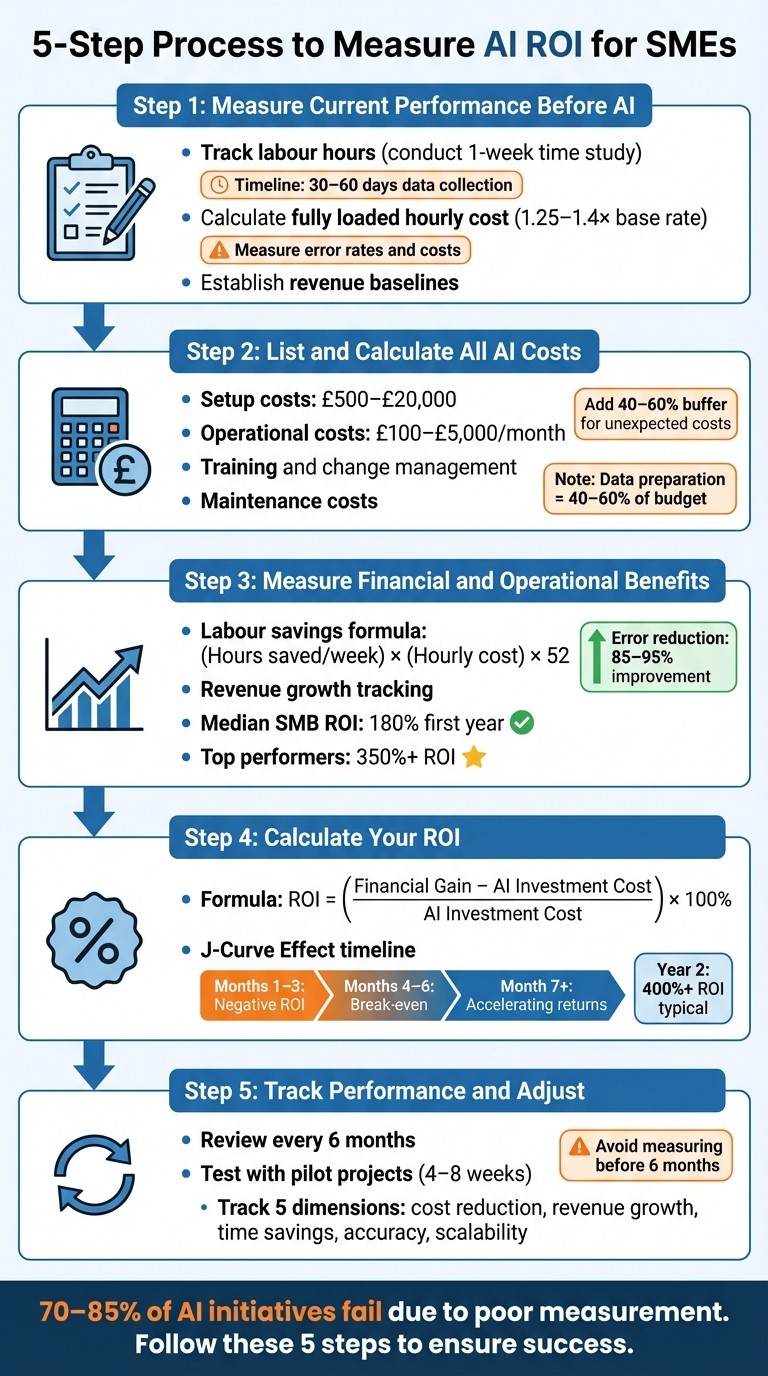
5-Step Process to Measure AI ROI for SMEs
The AI ROI Formula Explained
To make sense of the value AI brings to your business, you need a way to measure it. That’s where the AI ROI formula comes in.
The formula is simple: ROI = (Net Benefits – Total Costs) / Total Costs × 100%. Essentially, it tells you how much return you’re getting for every pound invested. A positive result means your AI project has delivered more value than it cost, while a negative result indicates it hasn’t.
Breaking Down the Formula
Net Benefits represent all the advantages AI delivers. This includes things like increased revenue from faster decision-making, cost savings from automating repetitive tasks, and improved efficiency through reduced errors or faster processing times. For instance, if automating invoice processing saves £40,000 in labour costs and generates an extra £10,000 in revenue annually, your net benefit totals £50,000.
Total Costs cover every expense tied to the project. This includes the initial setup (ranging from £500 to £20,000 for small to medium-sized businesses, depending on complexity), ongoing maintenance and cloud services (£100 to £5,000 per month), team training, and integration efforts. To avoid budget surprises, it’s wise to add a 40–60% buffer for unexpected costs.
Example in Action
Let’s say you invest £10,000 in AI email automation. After six months, it brings in £50,000 through combined savings and new revenue. Plugging those numbers into the formula gives you: (£50,000 – £10,000) / £10,000 × 100 = 400% ROI. That’s a fourfold return, turning AI from a risky bet into a calculated, strategic move. This formula also serves as the foundation for tracking performance over time.
Timing Matters
It’s common for returns to be negative during the first 6–12 months, as upfront costs often outweigh immediate benefits. To get meaningful insights, calculate ROI after at least six months. From there, regular performance tracking ensures your AI investments stay aligned with your goals.
Step 1: Measure Current Performance Before AI
Before diving into AI implementation, it's crucial to define what "working" means for your business. This starts with documenting your current performance in areas AI will impact. Without a clear baseline, you won't know if your investment is driving real improvements or just giving the illusion of progress. A solid baseline is the foundation for calculating ROI later.
"Without baselines, you cannot measure change. This step is non-negotiable." - Orris AI Team
Start by tracking labour hours spent on repetitive tasks. Conduct a one-week time study to see how much time is dedicated to tasks like processing invoices, handling customer enquiries, or entering data. Then calculate the fully loaded hourly cost for your staff. This includes not just their base wage but also National Insurance, pension contributions, and overheads - usually 1.25–1.4 times the base rate. These figures will help you quantify potential savings down the line.
Next, look at error rates and their costs. Count how many errors occur in manual processes each month, and assign a financial cost to each mistake. This could include the cost of rework, customer compensation, or even fines. For context, AI-driven document processing can reduce data entry errors by 85–95%, but you’ll need to know your starting point to measure that improvement.
Finally, establish revenue and capacity baselines. Track metrics like your lead-to-customer conversion rate, average sales cycle length, and lead response time. Also, measure the maximum number of transactions or support tickets your team can handle without adding new staff. Collect this data over 30–60 days to capture a realistic snapshot of your operations. This will help you determine whether AI is boosting growth or simply cutting costs.
Step 2: List and Calculate All AI Costs
With your performance baseline ready, the next step is to pin down all AI-related costs. This thorough cost review works hand in hand with your performance metrics, making future ROI calculations more accurate. Be sure to account for both obvious expenses and hidden ones. Many SMEs overlook the less visible costs, like data preparation and system integration, which can add up quickly.
For a UK SME, AI costs generally fall into four main categories: setup and implementation, operational subscriptions, training and change management, and ongoing maintenance. These costs can vary widely depending on the scale of your project. For example, data preparation alone can swallow up 40–60% of your total project budget.
"Most AI cost overruns stem from underestimating data work and integration challenges." - Scottish Government
How to Categorise Your Costs
Breaking down your AI expenses into clear categories is key:
Setup costs: Include expenses like discovery phases, pilot projects, and consulting fees.
Training costs: Cover both initial onboarding and any ongoing upskilling required for staff.
Operational costs: Think software licences, API usage, and cloud computing fees.
Maintenance costs: Account for things like model updates, tuning, and ongoing monitoring.
For example, if you're implementing a customer support AI, you might separate setup fees, training costs, monthly SaaS subscriptions, and annual maintenance into different columns in a spreadsheet. Spread any one-off fees across 12 months to make budgeting clearer. By organising costs this way, you'll be better prepared to evaluate the financial benefits in later steps.
Planning for Unexpected Costs
Hidden costs can catch you off guard. For instance, integrating older ERP or CRM systems could cost anywhere from £60,000 to £200,000. Additionally, expect a short-term drop in productivity - around 15–25% - during the first three to six months as your team adapts to new workflows. To avoid surprises, HM Treasury suggests adding an "optimism bias" buffer to digital projects: 20% for straightforward implementations, 30% for moderately complex ones, and 40% for high-risk projects.
A helpful budgeting tip: plan to spend £1 on data preparation for every £1 spent on software licences. Also, review your current tool subscriptions - you might find they already include AI features, saving you money. A detailed cost review ensures your AI investments stay aligned with your SME's financial objectives.
Step 3: Measure Financial and Operational Benefits
Once you've mapped out costs, it's time to track the returns and confirm the real impact of your AI investment. This step is crucial for determining if the money and effort you've put into AI are delivering results. The focus should be on two main areas: direct financial gains and operational improvements, such as faster processes and fewer errors. For small and medium-sized businesses (SMBs), the median first-year ROI for AI implementation is about 180%, with top-performing businesses exceeding 350%.
Financial benefits often come in the form of labour cost savings or increased revenue. To calculate labour savings, you can use this formula:
(Hours saved per week) × (Fully loaded hourly cost) × (52 weeks) = Annual labour savings.
For example, a professional services firm automated its client intake process, cutting a paralegal's paperwork time from 15 hours to just 3 hours per week. At £35 per hour, this resulted in annual savings of £21,840. Revenue gains can also be significant. A real estate team, for instance, used AI for lead scoring and increased their lead-to-client conversion rate from 3.2% to 4.8%. With 200 leads per month and an average commission of £8,500, this added up to an extra £326,400 in annual revenue.
Calculating Financial and Process Improvements
Operational improvements often show their value before financial benefits become fully apparent. For example, AI-powered document processing can reduce data entry errors by up to 95%, and AI-driven quality control can cut product defects by 20–40%. A logistics company that adopted AI for route planning saw a 53% increase in daily deliveries, going from 150 to 230. To achieve this growth without AI, they would have needed to hire three more dispatchers at an annual cost of £165,000. After factoring in £39,000 in AI costs, the net annual value was £126,000.
To measure these improvements, focus on metrics like cycle time reduction, throughput per hour, and error rates. Keep in mind that AI systems often need at least six months to stabilise and for teams to fully adapt, so avoid evaluating ROI too early, such as at 30 or 60 days. These operational enhancements feed directly into your ROI calculations. Beyond internal efficiencies, customer-facing metrics are equally important.
Monitoring Customer Impact
Operational gains are just one piece of the puzzle. Measuring customer impact is another vital part of understanding your ROI. Companies using AI in customer service have reported satisfaction scores as high as 99%. AI can also slash first response times from 12 minutes to just 12 seconds. Additionally, AI-optimised agents can automatically handle over 45% of customer queries, cutting service costs by roughly 25%.
Hackney Council offers a good example. In early 2026, Dave Trew, their Land, Water, Air Manager, shared how an AI assistant revolutionised the way residents accessed air pollution data. This not only improved community engagement but also helped people better understand complex environmental issues.
To evaluate customer impact, track metrics like Customer Lifetime Value (CLV), Net Promoter Score (NPS), and churn rates. Combine these numbers with customer feedback to ensure that AI-driven improvements aren't unintentionally creating new issues. Linking your CRM data directly to sales revenue can also provide a clear picture of how AI investments contribute to profitability. This closed-loop approach makes it easier to connect AI spending to tangible business outcomes.
Step 4: Calculate Your ROI
Now that you've worked through Steps 1–3, it's time to put numbers to your investment's impact. With your costs and benefits clearly identified - including UK-specific fully loaded costs - you can calculate ROI using this formula: ROI (%) = ((Financial Gain – AI Investment Cost) / AI Investment Cost) × 100.
To determine your total financial gain, combine labour cost savings (hours saved multiplied by the fully loaded hourly cost) with revenue increases (improved conversion rates multiplied by the average deal size). For your total investment, include software subscription fees, amortised setup costs (spread over 12 months), internal training costs, and ongoing maintenance expenses.
What ROI to Expect as an SME
SMEs often experience a J-curve effect when implementing AI. In the first three months, ROI is typically negative due to initial costs like implementation, data preparation, and staff training. By months four to six, you may break even, with returns accelerating from month seven onwards. On average, SMBs report a 180% ROI in the first year of AI adoption, with top performers exceeding 350%. By the second year, ROIs often climb to 400%+, as setup costs are fully amortised and processes become more efficient.
"Businesses that evaluate AI after just 90 days often conclude it 'did not work' when they are actually right on schedule." - Orris AI Team
Patience is key. Short-term losses are normal, but the long-term benefits can be substantial. To bring this to life, let’s walk through a real-world example.
Sample ROI Calculation
In February 2026, a 10-person UK accounting firm automated its invoice processing. Two admin staff saved a combined 20 hours each month. With a fully loaded cost of £19.50 per hour, the monthly savings came to £390. The firm paid a platform fee of £150 per month, and the £500 setup cost was spread across 12 months (approximately £41.67 per month). This brought total monthly costs to £191.67.
Here’s the calculation: ((£390 – £191.67) / £191.67) × 100 = 103.5% ROI for the first year. Over 12 months, the firm saved £4,680, while the total investment was £2,300, resulting in a net gain of £2,380.
This example highlights how careful tracking of costs and benefits can showcase the strong returns AI can deliver. By calculating ROI accurately, UK SME leaders can refine their AI strategies and make well-informed investment decisions with confidence.
Step 5: Track Performance and Adjust
Calculating ROI isn’t a one-and-done task. AI performance evolves over time, and keeping an eye on it regularly helps you spot trends, understand what’s working, and tweak what’s not. The best-performing SMEs see AI measurement as a continuous process, not a single exercise.
Schedule Regular Performance Reviews
Block out time every six months to review your AI performance metrics. This interval gives you enough data for meaningful insights while allowing you to address any issues promptly. Look at your ROI dashboard across these five dimensions: cost reduction, revenue growth, time savings, accuracy improvements, and workflow scalability. Instead of focusing on isolated data points, compare month-to-month trends - this shows whether your AI investment is gaining momentum, levelling off, or losing ground.
Don’t rush to evaluate too early. A six-month window is ideal because the early stages often show negative ROI due to setup costs and learning curves. Typically, break-even happens around months three to four, with noticeable gains starting in month five. Jumping to conclusions too soon could lead to scrapping projects that might have succeeded with more time.
Use these reviews to double-check your assumptions. For example, run brief baseline tests by timing manual tasks against AI-assisted ones for an hour to confirm that your "time saved" estimates line up with reality. If your finance team approved your initial metrics, involve them again to validate the results and maintain trust in the process.
These regular reviews also set the foundation for pilot testing, ensuring any scaling decisions are backed by solid evidence of performance improvements.
Test with Pilot Projects First
After each performance review, test adjustments on a smaller scale before committing to a full rollout. Focus on a single, clearly defined process for four to eight weeks. Pick something with noticeable manual inefficiencies where success can be measured easily - like handling customer inquiries, processing invoices, or reviewing documents. This "Minimum Viable Pilot" approach limits risk and gives you clear, actionable data before taking bigger steps.
During the pilot, avoid introducing other changes to keep the results focused on the AI’s impact. Stick to the metrics you outlined in your baseline - whether it’s labour hours, error rates, or conversion rates - so you can directly measure the AI’s effectiveness. Many AI projects fail because they’re rolled out too broadly without proper testing. A targeted pilot lets you figure out what works in your environment before scaling up.
If the pilot succeeds, you can expand gradually. If it doesn’t, you’ve contained the risk and gained valuable insights for improvement. This method ensures your decisions are based on data, not guesswork, and avoids the pitfalls of rushing into large-scale implementations.
Key Takeaways for Measuring AI ROI
Measuring AI ROI might seem straightforward, but it requires a disciplined approach to ensure meaningful results. Start by establishing a clear baseline of your current performance. This means tracking key metrics like labour hours, error rates, or conversion rates. Without this foundation, you're not measuring - you're guessing. To ensure organisational alignment, involve your finance team from the outset and have them validate these figures.
The next step? Calculate your total cost of ownership. This includes everything - setup, training, ongoing maintenance, and even hidden costs. A good rule of thumb is to budget equally for data preparation and software licences. For mid-sized AI implementations, UK SMEs typically spend between £40,000 and £250,000, with 15% to 25% of that cost recurring annually.
When evaluating benefits, focus on five key areas: labour savings, revenue growth, capacity expansion, error reduction, and strategic value. Apply a conservative 50% realisation discount for the first year to account for the adaptation period. For UK SMBs, the median first-year ROI for AI projects is 180%, often climbing to over 400% by the second year.
Take a long-term perspective by evaluating ROI over a three-year horizon. This timeframe aligns with the J-curve effect, where initial returns may be negative in the early months, break-even occurs around months three to four, and maximum ROI is achieved after two years. Remember, between 70% and 85% of AI initiatives fail to deliver their expected value - often because organisations either measure too early or lack clear metrics. To avoid this, conduct regular performance reviews, test changes through pilot projects, and base adjustments on data, not assumptions.
"AI is not a magic wand; it is a force multiplier. Applied to a chaotic, undefined process, it multiplies chaos. Applied to a well-understood, measured process, it multiplies value." – OpenKit
FAQs
Which metrics should I baseline before using AI?
Before diving into AI implementation, it's crucial to set clear benchmarks. Start by gathering operational data - this includes things like task completion times and error rates. You’ll also want to look at customer satisfaction levels and your operational costs.
Key areas to focus on include:
Error rates: How often mistakes occur in current processes.
Productivity levels: The efficiency of your team or systems in completing tasks.
Process costs: The financial resources required for current workflows.
Revenue and efficiency metrics: These provide a snapshot of your organisation's performance.
By establishing these baselines, you’ll have a solid foundation to compare results after implementing AI. This makes it easier to track changes and measure how much of an impact AI has on your operations.
What hidden AI costs do SMEs usually miss?
Small and medium-sized enterprises (SMEs) often miss the less obvious costs tied to implementing AI, which can have a big impact on their budgets. These hidden expenses include data preparation, integration tasks, employee training, and continuing operational costs. On top of that, businesses may underestimate costs such as initial setup, cloud hosting fees, and meeting compliance requirements, all of which can push budgets beyond their limits. Understanding these factors is essential to get a clear picture of the full investment needed for a successful AI rollout.
When should I measure AI ROI without judging too early?
To properly evaluate the return on investment (ROI) of AI, it's important to allow enough time for its benefits to materialise. For many small and medium-sized enterprises (SMEs), this process often spans 2–4 years following implementation. Begin monitoring performance as soon as the AI system is up and running, and make it a habit to review key metrics regularly. Avoid jumping to conclusions too early - wait until there's enough data to demonstrate real financial or operational improvements. This approach ensures a fair and accurate assessment of AI's long-term value.