AI for SME Leaders: Time-Saving Strategies
30 Mar 2026
How AI cuts admin, marketing and project time for UK SMEs, freeing leaders to focus on growth.

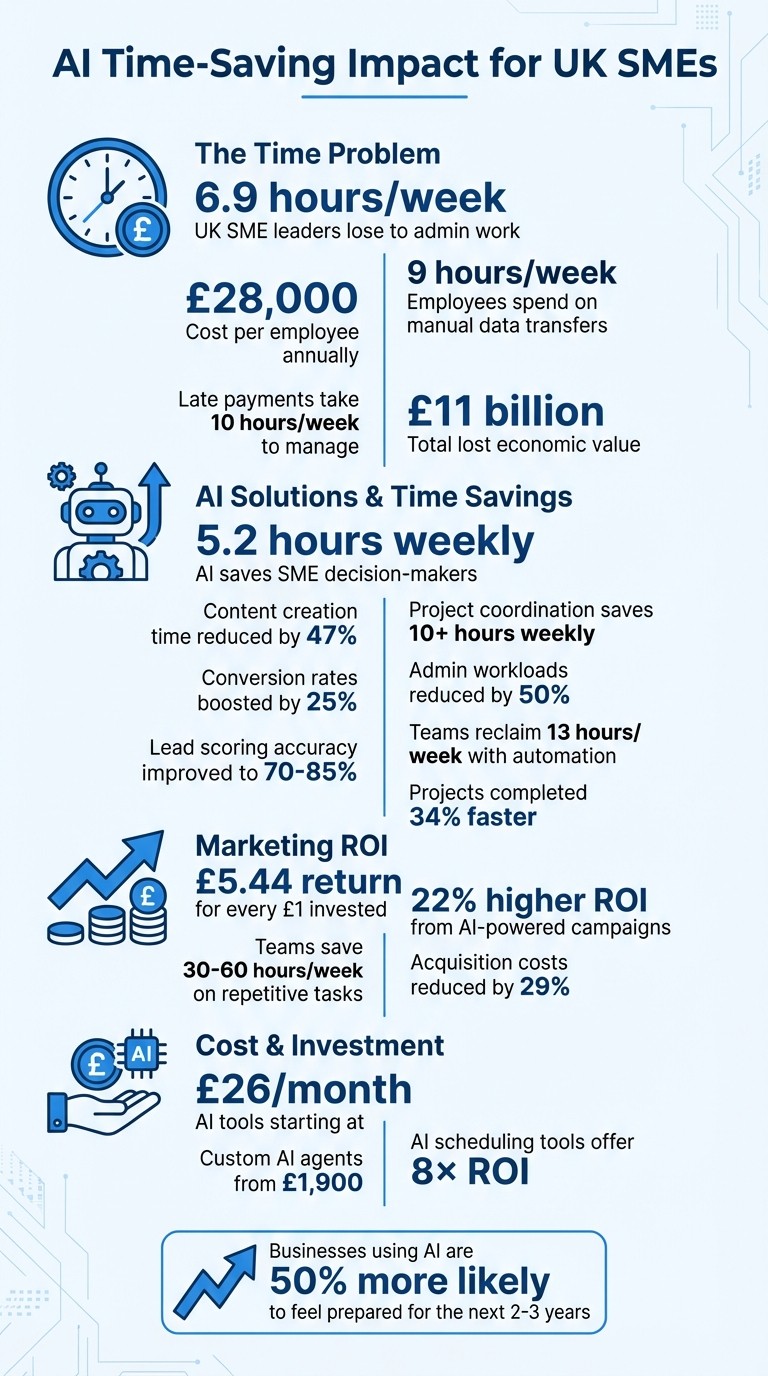
Running a small business often feels overwhelming, especially when repetitive tasks consume so much time. UK SME leaders lose 6.9 hours a week to admin work, while employees spend 9 hours weekly on manual data transfers, costing businesses £28,000 per employee annually. Late payments alone take 10 hours per week to manage, contributing to £11 billion in lost economic value.
AI can help reclaim this time. It saves SME decision-makers 5.2 hours weekly by automating tasks like invoicing, scheduling, and reporting. Marketing workflows also benefit, with AI cutting content creation time by 47%, improving lead scoring accuracy to 70–85%, and boosting conversion rates by 25%. AI-powered tools even reduce project coordination issues, saving 10+ hours weekly and improving organisation.
To start, focus on your biggest time-draining tasks. AI tools, costing as little as £26 per month, can handle admin, marketing, and workflow management, freeing up hours for growth planning. For tailored solutions, custom AI agents can align with your business needs, starting at £1,900. Training sessions and workshops, such as those from AgentimiseAI, provide practical guidance to implement AI effectively.
The bottom line: AI offers a practical way to save time, reduce errors, and focus on growing your business without adding extra hours to your day.
How AI Saves Time for UK SME Leaders: Key Statistics
Repetitive Admin Tasks Taking Too Much Time
Repetitive admin work eats into the productivity of SME leaders and their teams. Studies reveal that about 31% of the workday - roughly 2.5 hours - is lost to tasks like scheduling appointments, manual data entry, file organisation, sending reminders, and creating status reports.
For a small business with 10 employees, this translates to 25 hours of lost productivity every day - the equivalent of three full-time staff members. The problem worsens when tasks are spread across multiple systems. For instance, updating a customer record often means entering the same details across several platforms, wasting even more time. Something as routine as chasing an overdue invoice can involve checking bank feeds, cross-referencing payment dates, drafting reminders, and sending follow-ups when the first message is ignored. These inefficiencies highlight the need for AI-driven automation to recover lost hours.
AI Automation for Admin Work
AI can reduce administrative workloads by as much as 50%. For example, instead of manually keying in invoice details, AI-powered tools use Optical Character Recognition (OCR) to extract the information automatically. Similarly, automated CRM updates eliminate the need to duplicate data entry across systems, saving hours of effort.
Automated reporting tools can pull real-time data from various systems - like CRMs, accounting software, and warehouse management platforms - to create self-updating dashboards. These dashboards often include narrative summaries and trend insights, delivered straight to your inbox.
AI scheduling tools, many of which cost under £400 per month, can offer an impressive 8× ROI by saving businesses thousands in labour costs. On average, teams using automation reclaim around 13 hours per week - equivalent to nearly a third of a full-time role - and complete projects up to 34% faster. This shift not only simplifies workflows but also frees up resources for initiatives that drive growth.
Slow Marketing and Content Workflows
Admin tasks aren't the only time drain for businesses - marketing workflows often face their own set of challenges. For UK SMEs, content creation alone eats up 20 hours a month - time that could be better spent on strategy, client engagement, or expanding the business. The issue isn't just the sheer workload; it's the scattered nature of the process. Many SMEs rely on multiple marketing tools, leading to siloed data and forcing teams to spend 8+ hours a week manually piecing together information from different systems.
Creating content is another major bottleneck. Each blog post, social media update, or newsletter requires separate drafting, formatting, and publishing steps. This fragmented process slows everything down. Meanwhile, manual lead scoring - based on basic criteria - only achieves 30–40% accuracy when predicting potential conversions. This inefficiency means sales teams waste hours chasing unpromising leads while missing out on high-potential prospects.
On top of that, fragmented campaign data forces teams to manually track and reconstruct customer journeys. For small teams, this kind of inefficiency isn't just inconvenient - it’s unsustainable.
AI for Content Creation and Lead Scoring
AI tools are changing the game for marketing workflows, cutting marketing time by 47%. Instead of spending hours drafting social media posts or email campaigns, AI can generate first drafts that team members can tweak to fit the brand’s tone and style. Advanced content tools take this even further. For example, a single long-form blog post can be repurposed into 100+ formats, including video scripts, LinkedIn updates, and email newsletters. Platforms like Blaze AI, which starts at just £26 per month, streamline this process - turning one piece of content into a month’s worth of multi-channel material.
AI also revolutionises lead scoring. By analysing diverse behavioural data, machine learning tools can predict conversions with 70–85% accuracy. This precision leads to a 25% boost in conversion rates and shortens sales cycles by 30%. UK SMEs using AI-driven marketing automation see impressive results, including a £5.44 return for every £1 invested, and teams reclaiming 30–60 hours a week from repetitive tasks. Additionally, AI-powered campaigns deliver 22% higher ROI and reduce acquisition costs by 29% compared to traditional methods. These efficiencies allow business leaders to focus their time and energy on strategies that drive growth.
Poor Task and Project Organisation
Disorganised workflows are a silent productivity killer for UK SMEs, costing them dearly in both time and revenue. On average, SMEs in the UK lose around £35,880 in annual revenue capacity due to poor project coordination and task management. For industries like construction and administrative services, the problem is even more acute, consuming 37–38% of operational time.
The signs are easy to spot: impromptu meetings with no clear agenda, casual chats that stretch into hours, and clunky invoicing processes that keep teams stuck in a reactive loop. Instead of focusing on growth or innovation, business leaders often find themselves chasing overdue payments or scrambling to piece together fragmented updates. This lack of organisation doesn’t just cost time - it pulls resources away from strategic priorities. And the financial consequences can be dire: 38 UK businesses shut down every day, often due to cash flow problems linked to poor credit control and outdated manual tracking systems.
Duplication of effort is another major issue. One team member might update a spreadsheet while another sends a follow-up email about the same task, completely unaware of each other’s actions. This kind of inefficiency traps already stretched teams, stifling growth. But there’s a solution: AI tools can streamline these fragmented processes, creating a more cohesive and efficient approach to project management.
AI for Workflow Organisation
AI-powered project management tools are transforming how businesses approach workflow organisation. Platforms like Asana can automatically generate project timelines and identify risks before they spiral into bigger problems. Meanwhile, tools like Motion take it a step further, dynamically adjusting team schedules to eliminate the need for manual coordination. Users of these tools report saving over 10 hours per week just on project planning.
To implement AI effectively, consider a phased approach:
Draft Mode: Start by allowing AI to draft tasks for your review.
Oversight Mode: Gradually transition to routine AI management with human oversight.
Autonomy Mode: Eventually, let AI handle tasks independently, with only occasional spot-checks.
It’s also crucial to set boundaries for your AI tools. For example, you can specify rules like “no meetings on Friday afternoons” or “no projects below a certain profit margin.” This ensures that AI supports your priorities without disrupting focus or deep work.
For workflow automation, tools like n8n offer flexible pricing between £16–£40 per month, while fully integrated AI agent systems can cost around £3,300 annually. These investments can pay off significantly by freeing up time and resources, allowing your team to focus on what truly matters.
Not Enough Time for Growth Planning
Even with improvements in automating admin and marketing tasks, many SME leaders in the UK still find it hard to carve out time for strategic growth. They often remain bogged down in daily operations, leaving little room to focus on activities that could drive long-term success - like identifying new revenue opportunities, revisiting pricing strategies, or building partnerships.
This lack of focus on growth comes at a high cost. Routine admin eats up hours that could be better spent elsewhere. However, using AI to automate these tasks can free up time for more impactful work. For example, 73% of hiring managers report that AI enables cross-training of team members, and 61% say it allows for better strategic personnel management.
Here’s a tip: audit your weekly schedule and reallocate 2–3 hours saved by AI to activities like customer engagement or growth planning. To make these gains more tangible, track your AI Leverage Ratio (ALR) - a measure of how much faster tasks like sales call summaries are completed - and tie this to a key business metric like revenue or turnaround time. Turning these efficiency gains into measurable outcomes often requires focused AI training and workshops.
AI Leadership Training and Discovery Workshops
Understanding that AI can help is one thing; knowing how to implement it effectively is another. Many SME leaders lack the technical expertise to identify which processes are suitable for AI or where to invest for the greatest impact.
That’s where AgentimiseAI's AI Leadership Training steps in. Designed for non-technical teams, this half-day session (£1,050 for up to 10 participants) provides practical insights into how AI can directly benefit your business. To complement this, the AI Discovery Workshop (£1,050 per half-day, in-person) focuses on pinpointing high-return AI opportunities within your existing workflows, providing a clear implementation roadmap.
For those looking to maximise value, the Training + Workshop bundle is available for £1,800 - a 15% discount - and includes a free AI policy template. With straightforward pricing and no hidden fees, these sessions ensure you leave with both the knowledge and an actionable plan to integrate AI confidently into your operations.
Using Custom AI Agents to Save Time
Custom AI agents bring a personalised touch to automation, making them a step up from generic AI tools. While off-the-shelf solutions can handle broad tasks, they often fall short when it comes to the specific needs of your business. Custom AI agents are designed to align closely with your workflows, whether it's managing enquiries, organising sales pipelines, or keeping track of deliverables. This approach builds on earlier discussions about using AI to streamline workflows.
By automating repetitive tasks, custom AI agents free up valuable time for your team. Instead of forcing your team to adapt to one-size-fits-all software, these agents integrate seamlessly with your existing systems. For instance, they can handle lead scoring, send follow-up emails automatically, schedule appointments, and even manage up to 80% of routine customer service interactions.
The key to maximising impact lies in focusing on high-volume tasks - those repeated at least 50 times a week and following consistent patterns 80% of the time. A typical implementation follows a 90-day roadmap:
Days 1–15: Discovery and design phase
Days 16–45: Development and integration
Days 46–75: Testing and optimisation
Days 76–90: Deployment and team training
Benefits of Custom AI Agent Development
Custom AI agent development, like that offered by AgentimiseAI, goes beyond basic automation by aligning with your specific processes. Starting at £1,900 for fixed-scope, fixed-price agreements, these tailored solutions eliminate hidden costs. For most SMEs, implementation costs range from £12,000 to £28,000 depending on complexity, with ongoing monthly maintenance (covering platform licences and updates) costing between £400 and £1,600.
Every custom AI agent includes built-in human escalation features. If the AI struggles to resolve an issue or senses user frustration, it automatically escalates the matter to a human team member. Post-launch, you’ll receive continuous support to ensure the agent evolves alongside your business needs. Instead of vague claims about "better efficiency", you’ll establish SMART goals upfront - like cutting response times from four hours to 15 minutes - allowing you to measure ROI and justify the investment.
Conclusion: Better Time Management with AI
Time management will always be a challenge, but AI provides a practical way for SME leaders to tackle it. By automating admin work, simplifying workflows, and handling project management, the strategies in this article offer solutions to the tasks that often drain your time and energy. The key is to start small: focus on your biggest time sink and introduce an AI tool to handle it.
"AI isn't about replacing your team - it's about supercharging it. Saving time, reducing errors, delighting customers, and growing faster than your competitors."
1nexus
This insight highlights how quickly AI can make a difference. When you prioritise high-impact areas, results can show up in days instead of months. Even reclaiming a few hours each week can significantly boost both productivity and revenue. Track the time you save and assess the results to ensure the benefits are clear before committing to further investments. Businesses that adopt AI are 50% more likely to feel prepared for the next two to three years, giving them an edge without needing to expand their teams or work longer hours.
These time savings open up opportunities for growth-focused initiatives, backed by structured AI services like those from AgentimiseAI. Their offerings include AI Leadership Training (£1,050 for up to 10 people), Discovery Workshops (£1,050), and custom AI agents (starting at £1,900), all designed to deliver measurable results. For added value, their bundle of Training + Workshop is available for £1,800 and includes a free AI policy template, equipping your team with the tools to implement AI effectively.
Start with a pilot programme, track its impact, and then scale your success. AI doesn’t demand an overnight transformation - small, steady improvements can add up over time, freeing you to concentrate on growing your business and staying ahead of the competition.
FAQs
Which tasks should I automate first with AI?
When it comes to automation, begin with tasks that are repetitive, take up a lot of time, and are a natural fit for AI solutions. For example, you could use chatbots to handle customer enquiries, automate stock or inventory management, streamline billing processes, or set up systems to respond to routine emails. These kinds of tasks often eat into staff productivity, but automating them can free up your team to concentrate on more meaningful and strategic work.
How do I measure AI ROI beyond time saved?
When evaluating the return on investment (ROI) for AI, it's essential to look beyond just the time saved. Broader impacts, like cost savings (e.g., lower labour or operational expenses) and customer-focused metrics such as satisfaction and retention, play a crucial role in determining its true value.
A structured approach can help:
ROI (%) = (Total Benefits – Total Costs) / Total Costs × 100
This formula ensures you account for both tangible benefits, such as cost reductions or revenue growth, and intangible benefits, like improved decision-making or enhanced processes. By considering these elements together, you can get a more rounded understanding of AI's impact on your organisation.
When do I need a custom AI agent instead of a tool?
When your business faces unique challenges that standard AI tools can't tackle, a custom AI agent becomes essential. This might involve integrating with your existing systems, managing specialised workflows, or delivering bespoke functionality. While off-the-shelf tools are great for routine tasks, custom agents shine when it comes to handling complex, highly specific processes. They offer tailored, scalable solutions designed to meet your exact requirements.
Of course, this level of customisation comes with a higher initial investment - starting at around £15,000. However, for businesses looking to align AI capabilities with their strategic objectives, this can be a smart move.