10 AI Insights for Resilient Leadership
12 Mar 2026
Practical AI strategies for SME leaders to build resilience—mindset, analytics, automation, training and predictive tools for faster, smarter decisions.
In 2026, small and medium-sized enterprise (SME) leaders face ongoing challenges like supply chain disruptions and market unpredictability. AI tools are proving to be a game-changer, offering cost-effective solutions to detect early market shifts, optimise processes, and improve decision-making. Here’s a quick look at how AI is reshaping leadership:
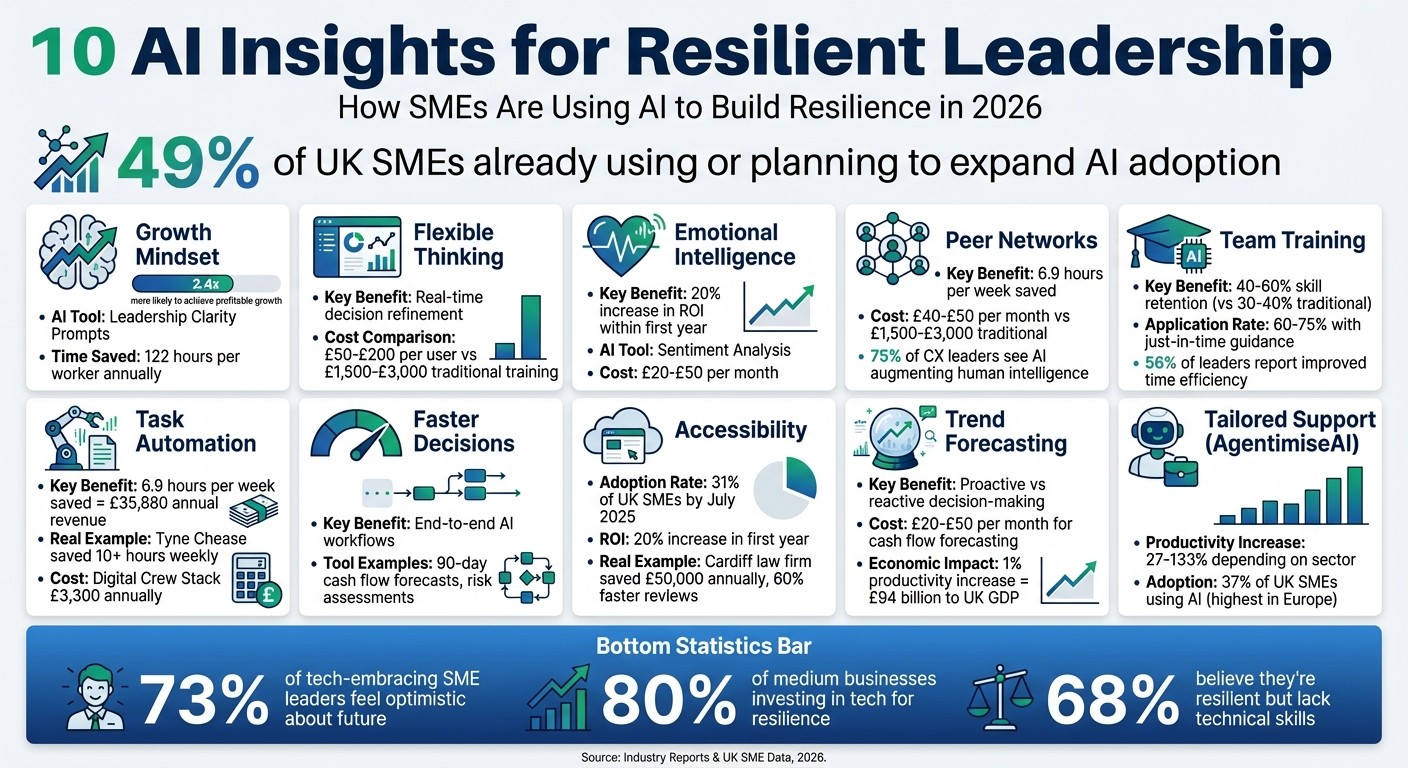
Growth Mindset: AI identifies limiting beliefs and provides actionable feedback to align decisions with company values.
Flexible Thinking: AI analytics automate change detection and refine decision-making processes.
Emotional Intelligence: Sentiment analysis tools help leaders improve communication and team engagement.
Peer Networks: AI-powered peer groups enhance collaboration and knowledge sharing.
Team Training: Personalised AI-driven training improves skill retention and adaptability.
Task Automation: Automating repetitive tasks saves time and ensures operational consistency.
Faster Decisions: AI tools streamline data analysis, enabling quicker, well-informed choices.
Accessibility: User-friendly AI tools empower teams without requiring technical expertise.
Trend Forecasting: Predictive AI anticipates risks and opportunities, improving preparedness.
Tailored Support: Agentic AI provides leadership assistance, automating routine tasks and offering strategic insights.
With 49% of UK SMEs already using or planning to expand AI adoption, these strategies offer practical ways to strengthen resilience and efficiency. Start small by focusing on specific challenges, and scale AI integration gradually to maximise its potential.
10 AI Leadership Strategies for SME Resilience in 2026
1. Use AI to Develop a Growth Mindset
Actionable AI-driven Strategies
Developing a growth mindset is what sets thriving leaders apart, especially in uncertain times. For SME leaders, the real hurdle isn't understanding its importance - it's uncovering the beliefs that hold them back. This is where AI steps in, acting as a strategic partner to identify these blind spots before they become obstacles.
Start by using a Leadership Clarity Prompt. Present a current challenge to an AI tool, which can help pinpoint limiting beliefs, align them with your core values, and suggest a more constructive way forward. For example, if you're struggling with delegation, AI might reveal a belief like, "I have to handle everything myself." By training AI with your company's values, it can also provide real-time decision audits, ensuring your rapid growth doesn't stray from what truly matters.
Relevance to SME Leadership
The numbers speak volumes: leaders with a growth mindset are 2.4 times more likely to achieve profitable growth compared to their peers. For SMEs, where resources and margins are often stretched thin, this approach isn't optional - it’s essential. With 74% of SME leaders already valuing feedback as a cornerstone of resilience, AI becomes a natural extension of what great leaders already do: reflect, adapt, and improve. By focusing on growth through data-driven insights, SMEs can position themselves to outperform competitors.
Potential for Improving Resilience
AI doesn't just support strategic thinking - it reduces mental strain by automating repetitive tasks, saving an average of 122 hours per worker annually. This freed-up time allows leaders to focus on strategies that foster growth and build resilience. It’s about creating the mental bandwidth needed to adapt and thrive, even in challenging circumstances.
2. Apply AI Analytics for Flexible Thinking
Actionable AI-driven Strategies
Flexible thinking involves recognising shifts, taking decisive action, and adjusting systems effectively. AI analytics supports this process by automating change detection, offering actionable insights, and enabling system adaptability. This method transforms leadership from being reactive to strategic and forward-thinking.
Think of AI as a collaborative partner in decision-making. It can help create decision matrices and uncover blind spots. To maximise its potential, use the CRAFT Prompt Structure (Context, Role, Action, Format, Tweaks) for refining AI support. For instance, instead of a broad query like, "What should I do about declining sales?", try: "As a marketing director for a £2M turnover SME, analyse our Q1 sales data, identify three root causes, and present actionable fixes in a table." This approach makes the output more targeted and practical.
Relevance to SME Leadership
While a growth mindset is essential, flexible, data-driven thinking ensures businesses can adapt quickly. AI analytics offers SMEs a cost-effective way to refine decision-making, which is particularly valuable for organisations with tighter budgets.
Consider the cost comparison: traditional leadership training can range from £1,500 to £3,000 per participant, while AI analytics tools cost £50 to £200 per user. These tools adapt in real time to your specific workflows. For SMEs, this affordability can be a game-changer, making advanced tools accessible without straining resources.
To make AI analytics more impactful, frame your goals as testable hypotheses. For example, ask, "If AI improves forecasting accuracy by 15%, how will profit margins change?". This ties AI usage directly to measurable outcomes, moving it from a vague concept to a practical tool for improving financial resilience.
Potential for Improving Resilience
To implement AI responsibly, establish clear boundaries. Develop a concise, one-page AI policy that requires human oversight of AI outputs and restricts sensitive financial data from being entered into public tools. This ensures businesses can experiment confidently with AI while protecting critical information. Balancing innovation with caution is key to building resilience and trust in these systems.
3. Improve Emotional Intelligence with AI Sentiment Analysis
Actionable AI-driven Strategies
AI sentiment analysis serves as an "honest mirror" for leaders, offering insights into tone, inclusivity, and engagement across different communication formats like meetings, emails, and presentations. This technology provides real-time feedback, helping you understand how your communication style resonates with your team. Instead of relying solely on instinct or waiting for annual performance reviews, these tools allow you to pinpoint and address issues as they arise.
For instance, AI tools can analyse your communication channels to detect shifts in tone or engagement. If sentiment scores drop during virtual meetings - perhaps due to time zone challenges - you’ll know there’s a gap that needs attention. These insights help you address potential frustrations or morale issues before they escalate.
Relevance to SME Leadership
Traditional emotional intelligence training can cost between £1,500 and £3,000 per participant, making it a significant expense for smaller organisations. In contrast, AI tools designed for sentiment analysis are far more budget-friendly, with prices starting at just £20–£50 per month. This affordability opens the door for founder-led businesses and SMEs to access advanced emotional intelligence development without breaking the bank. In fact, small businesses leveraging AI have reported a 20% increase in return on investment within the first year.
"AI shouldn't make us less human. It should give us the freedom to be more human." - Real Resilience
Potential for Improving Resilience
Automating sentiment tracking not only helps leaders spot issues earlier but also reduces stress by freeing up mental energy for strategic decision-making. This can help prevent burnout while maintaining strong human connections within teams. However, it’s essential to ensure compliance with UK GDPR regulations and store data securely within the UK or EU. Taking these precautions builds trust and fosters a leadership style known as "Agentic Leadership", where AI is used to enhance empathy and sharpen judgement rather than replace human qualities. By adopting this balanced approach, leaders can strengthen their emotional intelligence while preparing for more AI-driven strategies in the future.
4. Create Peer Support Networks with AI
Actionable AI-driven Strategies
AI isn't just about boosting individual performance - it’s also a game-changer for collaborative leadership. By integrating AI into peer networks, SME leaders can connect and learn in entirely new ways. Imagine peer sessions where AI creates interactive environments, helping leaders apply tools in practical, everyday scenarios. For example, AI can simulate perspectives from thought leaders like Simon Sinek or conduct role-reversal exercises, adopting an employee’s viewpoint to foster empathy and uncover fresh leadership insights. These approaches transform raw data into shared knowledge, turning collaboration into a source of collective intelligence.
Relevance to SME Leadership
Traditional peer networks often come with hefty price tags, ranging from £1,500 to £3,000 per participant. In contrast, AI-driven alternatives are far more affordable, starting at just £40–£50 per month. Beyond cost savings, these tools can reclaim precious time - up to 6.9 hours a week - that UK business owners typically lose to administrative tasks. This cost-effective and time-saving model enhances collaboration while building resilience. It’s no wonder that 75% of CX leaders see AI as a way to augment human intelligence, not replace it.
"AI-driven peer group dynamics are transforming executive coaching by equipping leaders with innovative tools to navigate complex challenges and foster deeper collaboration." – Severin Sorensen, CEO, The AI Whisperer
Potential for Improving Resilience
AI-driven peer groups don’t just connect leaders - they create a "shared memory" of lessons learnt, reinforcing resilient practices throughout an organisation. This approach amplifies performance and speeds up feedback loops. Unlike human facilitators, AI maintains consistency, with process definitions encoded to ensure reliability even if sessions are paused and resumed later. However, as leadership expert Leo Bottary highlights:
"AI without peer context risks misapplication; peers provide the ethics, judgement and accountability needed for responsible use"
5. Use AI to Train and Develop Your Team
Actionable AI-driven Strategies
AI has revolutionised training by shifting from generic approaches to personalised, dynamic learning experiences. Think of AI as your team’s personal guide, tailoring content to match individual learning needs. Instead of enduring static seminars, employees can now access on-demand training, with AI delivering relevant materials exactly when they’re needed for quick upskilling. Behind the curtain, AI handles tasks like skill mapping, curriculum creation, and assessments, streamlining the entire process.
For Small and Medium-sized Enterprise (SME) leaders, frameworks like CRAFT - Context, Role, Action, Format, Tweaks - can help refine AI outputs. Start small by using AI for low-stakes tasks like summarising meeting notes or drafting documents. To encourage consistent learning, try introducing a simple 30-minute weekly learning habit. This not only boosts skill development but also prepares teams to adapt to the evolving demands of AI-enhanced leadership.
Relevance to SME Leadership
For SME leaders, ensuring accessible and flexible training is a priority, especially when 90% of organisations express concerns about employee retention. In the UK, traditional AI workshops led by experts can cost around £1,050 for a half-day session for up to 10 participants. In contrast, AI-powered training is available 24/7, adapts in real time to individual needs, and eliminates the constraints of fixed schedules and trainer availability. Plus, 56% of business leaders have already reported that generative AI has helped improve employee time efficiency.
Potential for Improving Resilience
AI-driven training doesn’t stop at learning; it focuses on building resilience through continuous reinforcement. Studies show that skill retention rates can jump to 40–60% with ongoing support, compared to 30–40% with traditional methods like social learning. When teams receive just-in-time guidance, the application of new skills can rise to 60–75%. To get started, pilot an AI-driven programme with a diverse group, gather feedback, and tweak as needed.
Governance is equally important. Develop a concise, one-page AI policy to outline clear boundaries. For example, prohibit entering sensitive client data into public AI tools and require human oversight for external AI-generated outputs. These steps help ensure that AI is used responsibly and effectively.
6. Automate Routine Tasks to Focus on Strategy
Actionable AI-driven Strategies
Building on the idea of strengthening teams and networks, automating repetitive tasks can help leaders focus on strategic priorities.
Instead of relying on basic chatbots, consider Agentic AI - tools that act autonomously by responding to triggers, keeping context, and integrating seamlessly with platforms like Xero or HubSpot. This kind of automation allows you to delegate routine tasks to digital agents, saving significant time.
Imagine a digital team tailored to your business needs. For instance:
A Researcher tracks updates from HMRC and competitors, saving up to 90 minutes daily.
A Finance Agent connects to Open Banking to chase invoices, cutting average payment times from 45 to 28 days and potentially recovering £12,000–£16,000 in working capital.
A Project Manager enforces goals, blocks Friday meetings, and organises your inbox, freeing up 3–5 hours each week.
For meetings, tools like Fireflies.ai or Otter.ai can join calls to record, transcribe, and create actionable tasks that sync with platforms like Trello or Asana. Meanwhile, Zapier with OpenAI can eliminate manual data entry, and tools like Loom or Claude 3.5 Sonnet make creating standard operating procedures quick and easy.
Relevance to SME Leadership
For SME leaders, automation addresses the inefficiencies that consume valuable time and energy.
On average, UK SME owners lose 6.9 hours a week to admin tasks - equivalent to about £35,880 in annual revenue for those billing £100 per hour. Late payments add to the problem, costing the UK economy around £11 billion each year. These challenges not only impact cash flow but also limit leadership capacity.
Real-world examples show how automation can make a difference. Tyne Chease, a plant-based cheese producer in the North East, used Sage Copilot to automate purchase invoicing and supplier tracking. This saved over 10 hours a week, allowing the team to focus on R&D and product innovation. Similarly, Axioma, a car repair network, implemented Tidio's Lyro AI to manage customer queries. The result? An 89% resolution rate, 24/7 lead capture, and even Sunday evening bookings.
Potential for Improving Resilience
Automation doesn’t just save time - it ensures consistency and builds operational resilience.
By embedding processes into code, automation ensures continuity even when key staff members leave. This reduces the risk of knowledge gaps, minimises disruptions from sick days, and maintains steady execution around the clock.
To ease into automation, follow the Confidence Ladder:
Start with Draft Mode, where AI drafts actions, and a human finalises them.
Move to Oversight Mode, where AI takes action and copies a human for oversight.
Transition to full Autonomy, with weekly audits to ensure quality.
Set clear rules, such as avoiding Friday meetings or rejecting projects with margins under £5,000. This transforms AI from a simple assistant into a strategic decision-maker.
"If you spend your day manually scheduling calls... you aren't the CEO. You are the expensive admin assistant." - Innovate 24-7
Ease of Implementation for SMEs
Automation doesn’t have to be expensive or complex, making it accessible even for SMEs with limited budgets.
A complete Digital Crew Annual Stack costs approximately £3,300, including tools like n8n automation (£600), Voice AI (£1,200), and API usage (£600). Individual solutions are even more affordable: Xero JAX starts at £1.60 per month (Ultimate plans cost around £65 per month), Sage Copilot is roughly £20 per user monthly, and Tidio's Lyro AI ranges from £19 to £29 per month.
Begin with a simple 60-minute process mapping exercise. Identify a daily workflow and break it into four columns: Trigger, Steps, Decision Points, and Evidence. Introduce governance thresholds - for example, automate refunds under £25 while reviewing those above £150 - or allow AI to draft responses for standard complaints while humans handle sensitive cases. This approach ensures that critical decisions remain human-led, while routine tasks are efficiently handled by AI.
7. Make Faster Decisions with AI Data
Actionable AI-driven Strategies
Once routine tasks are automated, the next step is to use AI for quicker decision-making. Instead of manually handling every detail, leaders can oversee AI-driven processes that analyse data and manage repetitive tasks. The key is to let AI handle the groundwork while reserving crucial, high-stakes decisions for human judgement.
A practical approach is to implement threshold-based governance. This means allowing AI to operate independently for low-risk tasks while flagging higher-risk decisions for human review. For example, AI could automatically approve refunds under £25 but flag anything over £150 for a manager to review. Similarly, AI could manage simple customer inquiries but direct sensitive contractual issues to a human team member. This balance ensures efficiency without losing control and allows leaders to focus on strategic goals.
Relevance to SME Leadership
For small and medium-sized enterprise (SME) leaders who often juggle multiple responsibilities, faster decision-making through AI can be a game-changer. Instead of combing through endless data, AI tools can identify trends, detect anomalies, and present actionable options. This allows leaders to concentrate on decisions that genuinely require their expertise.
AI-powered workflows are reshaping how decisions are made. Modern tools can now handle end-to-end processes, such as responding to customer inquiries, checking inventory, or generating invoices, rather than merely offering suggestions. For SMEs, advanced features like predictive analytics and real-time insights - once exclusive to large enterprises - are now more accessible. These tools can provide valuable insights, such as 90-day cash flow forecasts or risk assessments, helping leaders make informed choices.
"SMEs that treat AI agents as 'a clever intern' will get much further than SMEs that treat them as 'a magic brain.' Interns need briefs, guardrails, and review points." – 3L3C.ai
Potential for Improving Resilience
Quicker, data-informed decisions also boost resilience, especially during uncertain times. When markets shift or unexpected challenges arise, having access to real-time AI analysis allows leaders to adapt swiftly instead of waiting for time-consuming manual reports.
Consistency is another advantage. By embedding decision rules into AI systems, routine tasks can be handled reliably - even if key staff are unavailable. High-value decisions remain human-led through Human-in-the-Loop (HITL) processes, ensuring careful oversight for critical areas like customer relations, contracts, or reputational risks.
However, speed must be tempered with safeguards. As 3L3C.ai aptly notes, "Automation without thresholds is just speed-running mistakes". A cautious approach - where AI drafts actions for human review before gradually increasing its autonomy - helps minimise risks while building trust in the system.
Ease of Implementation for SMEs
Adopting AI-driven decision-making doesn’t require advanced technical skills. Start with straightforward, profitable tasks like predictive maintenance, automated compliance checks, or invoice matching. These areas often deliver quick returns with minimal risk.
To ease the transition, appoint a "translator" within your team. This person bridges the gap between business needs and AI capabilities, ensuring that the AI receives clear instructions and its outputs are translated into actionable insights. Begin with a single workflow, set clear governance thresholds, and expand gradually. This step-by-step approach enables SMEs to embrace AI confidently while maintaining the human oversight necessary for sound leadership.
8. Make AI Accessible Across Your Organisation
Actionable AI-driven Strategies
To make AI truly accessible, focus on tools that are simple enough for teams to pick up in just a few days. Here’s a quick test: if the demo takes longer than 45 minutes, the tool might be too complicated for widespread use across your organisation. Instead, opt for cloud-based platforms with straightforward interfaces that employees can start using almost immediately.
User-friendly platforms are a great starting point. Many cloud-based solutions offer easy deployment across departments without requiring significant upfront investment. These tools are versatile enough to support various functions, from customer service to project management, and they don’t demand extensive technical expertise. This simplicity ensures that AI can make an impact across your organisation in no time.
Relevance to SME Leadership
For leaders of small and medium-sized enterprises (SMEs), making AI accessible means empowering your team to do more with fewer resources. By July 2025, 31% of UK SMEs had already adopted AI tools. Early adopters reported seeing around a 20% boost in ROI within the first year. Take the example of a Cardiff-based law firm: by automating contract reviews and compliance checks, they cut document review time by 60% and saved £50,000 annually in administrative costs.
However, compliance can’t be overlooked. Almost half of non-adopters cite privacy concerns as a barrier. To address this, ensure that any AI tool you choose is UK GDPR-compliant and clearly states where data is stored. Transparency like this not only builds trust but also encourages broader adoption within your organisation. By choosing accessible AI tools, SME leaders can achieve greater efficiency while strengthening their overall strategy.
Potential for Improving Resilience
The more accessible AI tools are across your organisation, the more adaptable your business becomes. For example, a Birmingham-based manufacturing SME introduced AI sensors for predictive maintenance. These sensors were easy enough for floor managers to use, allowing them to identify potential equipment failures before they happened. This reduced unplanned downtime by 30% and saved the company approximately £100,000 annually. Because the system was simple to use, the company wasn’t reliant on a single specialist to keep things running smoothly during absences or busy periods.
9. Forecast Trends and Personalise with Predictive AI
Actionable AI-driven Strategies
Predictive AI is changing the game when it comes to anticipating what’s next. Unlike traditional data analysis that reacts to past events, predictive AI keeps a constant pulse on market trends, helping to identify potential risks and opportunities before they arise. This proactive approach turns raw numbers into insights you can act on, giving you a competitive edge.
For example, in operations, predictive analytics can flag potential machine breakdowns or predict traffic disruptions. In finance, AI-powered tools can forecast cash flow for up to three months, with services available for as little as £20–£50 per month.
Relevance to SME Leadership
The evolution of AI in 2026 is all about moving from simply answering questions to taking action. Agentic AI is now stepping into roles like managing invoicing or scheduling, freeing up leaders to focus on bigger-picture decisions.
Predictive analytics, once seen as a luxury for large enterprises, has become a critical tool for small and medium-sized businesses (SMEs). It’s now used for everything from assessing risks to making smarter investment choices. Small retailers, for instance, are leveraging AI to create highly tailored shopping experiences. Websites and email campaigns now reference individual customer interactions, making every shopper feel like a VIP - all without the manual work it used to take. This means SMEs can now compete with larger companies in terms of customer engagement and market agility, all while staying within budget.
Potential for Improving Resilience
Predictive AI strengthens resilience by enabling businesses to adapt quickly to market shifts. It helps leaders seize opportunities, refine strategies in real-time, and adjust workflows based on actionable data. This shift from relying on intuition to embracing data-driven decision-making is becoming crucial in today’s unpredictable markets.
The potential impact is enormous. A mere 1% increase in productivity across UK SMEs could add £94 billion to the annual GDP. By widely adopting these tools, businesses not only boost their own resilience but also contribute to broader economic growth. Predictive AI lays the foundation for smarter, more tailored leadership strategies, which will be explored further in the next section.
10. Use AgentimiseAI for Tailored Leadership Support
Actionable AI-Driven Strategies
Building on earlier points about automation and data-driven decision-making, AgentimiseAI offers leadership support tailored to your business. Instead of generic advice, it adapts to your specific workflows, turning leadership from a hands-on role into a more strategic one by delegating routine tasks to AI systems.
For example, you can map out a repetitive workflow in just an hour by identifying its trigger, steps, decision points, and evidence. This allows for seamless integration of an AI agent. You can also set up governance rules, such as permitting the agent to auto-refund amounts up to £25 while requiring human approval for anything higher.
"SMEs that treat AI agents as 'a clever intern' will get much further than SMEs that treat them as 'a magic brain.' Interns need briefs, guardrails, and review points." – 3L3C AI
Relevance to SME Leadership
AgentimiseAI doesn’t just streamline operations; it also provides strategic insights at a boardroom level. Through GuidanceAI, leadership teams gain access to virtual C-suite advisors and coaches trained by real business experts. This offers high-level guidance without the expense of hiring full-time executives. It’s also compatible with tools like HubSpot, Xero, and Mailchimp via platforms like Zapier or Make.com.
For founder-led SMEs dealing with growth pressures, this tool is particularly helpful. It automates routine leadership tasks and manages growing complexities, all while mitigating the risk of losing critical knowledge during staff turnover. This ensures continuous leadership support, even for smaller teams.
Potential for Improving Resilience
AI agents enhance resilience by enabling businesses to sense market changes, seize opportunities through agile action, and reconfigure workflows based on outcomes. These capabilities allow SMEs to adapt quickly to shifts in the market while maintaining smooth operations. Depending on the sector, integrating AI into workflows can increase SME productivity by 27% to 133%.
To maximise these benefits, train your team using a 3-stage progression model: start with junior staff checking AI-generated drafts ("Assisted Execution"), move to handling exceptions, and finally, let them oversee AI workflows entirely ("Orchestration Ownership"). This ensures your team grows alongside the technology, with human oversight where it’s most critical.
Ease of Implementation for SMEs
Criteria | AI-Driven Training (AgentimiseAI) | Traditional Leadership Training |
|---|---|---|
Customisation | Designed to fit specific workflows | Standardised, generic modules |
Scalability | Grows with your business | Limited by trainer availability |
Accessibility | 24/7 remote access with ongoing support | Fixed schedules and locations |
Cost | £50–£200 per user annually | £1,500–£3,000 per participant |
Reinforcement | Continuous, on-demand support | Often lacks follow-ups |
Before diving into a custom implementation, check whether your current software already includes "agent-like" features that can integrate with AgentimiseAI. Always review AI outputs carefully and establish clear rules to keep digital agents aligned with your goals and ethics. With 37% of UK SMEs already using some form of AI - the highest adoption rate in Europe - the infrastructure for support is already well-established.
Conclusion
Leading with resilience in 2026 isn't about grinding harder; it's about making smarter moves by partnering with AI. The ten strategies outlined in this article highlight how AI can refine decision-making, carve out time for meaningful work, and help teams respond swiftly to market changes. Whether it's fostering a growth mindset or leveraging predictive analytics, these approaches lay the groundwork for long-term success.
The statistics back this up: 73% of SME leaders who embrace technology feel optimistic about their company's future, while 80% of medium-sized businesses are now investing in technology to strengthen resilience. However, there's a twist - 68% of SME leaders believe their organisations are resilient, yet many struggle with the technical skills needed to implement AI effectively. This gap presents both a hurdle and a chance to evolve.
Closing this gap starts with a process-first mindset. Instead of chasing every shiny AI tool, focus on addressing specific operational challenges. Begin by reviewing your top 5–10 core processes to pinpoint repetitive, high-volume tasks where AI can make a tangible difference. Use the 10-20-70 framework: allocate 10% of your attention to algorithms, 20% to technology and data, and 70% to people and processes. This ensures AI supports your team rather than overwhelming them.
Tools like AgentimiseAI make this shift feasible for founder-led SMEs. By offering virtual C-suite advisors trained by both business experts and AI, and tailoring AI agents to your workflows, these platforms provide high-level strategic insights without the expense of full-time senior hires. This levels the playing field, enabling smaller businesses to tap into the kind of marketing and customer insights that were once the domain of large corporations.
Start small. Test, measure, and expand on what works. Whether you're automating meeting notes or using sentiment analysis to interpret customer feedback, every step strengthens your organisation's ability to detect market shifts, seize opportunities, and adjust workflows as needed. The future will belong to leaders who see AI not as a substitute for human judgment, but as a trusted partner - one that allows them to lead with greater strategy, empathy, and ultimately, humanity.
FAQs
Where should an SME start with AI for resilience?
To kick things off, an SME should take a close look at its existing processes and pinpoint the specific challenges that AI could help tackle. This means auditing workflows, checking the quality of your data, and assessing your team's familiarity with AI. These steps will help set practical, achievable goals.
It's smart to start small. Begin with pilot projects and experiment with easy-to-use AI tools that don't require a steep learning curve. Keep a close eye on progress and focus on clear, measurable goals - like cutting down on repetitive tasks or making smarter decisions. This way, you can ensure that AI adoption stays aligned with your business priorities and helps strengthen your operations in the long run.
How can SMEs use AI safely under UK GDPR?
For SMEs navigating AI use while adhering to UK GDPR, strong governance practices are key. Here's what you should focus on:
Data classification: Clearly categorise the types of data your organisation processes to ensure proper handling and protection.
Conducting Data Protection Impact Assessments (DPIAs): These assessments help identify and mitigate risks associated with data processing, particularly when using AI tools.
Encryption and anonymisation: Safeguard sensitive data by encrypting it and, where possible, anonymising datasets to protect individual privacy.
Vendor compliance: Evaluate AI vendors thoroughly to ensure they meet GDPR requirements and align with your organisation's data protection standards.
Additionally, keep detailed records of the AI tools you use and the decisions they influence. This documentation not only supports compliance but also reinforces accountability in your AI governance practices.
What tasks should AI automate first?
AI is best suited to tackle tasks that are repetitive, time-intensive, and have the potential to significantly boost efficiency. For SMEs, this means taking a close look at workflows to spot bottlenecks in areas such as customer service, financial reporting, inventory management, invoicing, and data entry. Automating these high-volume, rule-based processes not only saves time but also streamlines operations. In fact, some SMEs have reported annual savings exceeding £20,000 by leveraging automation.
The best way to start? Launch small pilot projects. These allow businesses to measure the impact and determine whether the solution can scale effectively.