FAQs on AI Leadership for SMEs
12 Feb 2026
How SME leaders assess readiness, choose AI tools, control costs and risks, and build a culture that delivers measurable AI outcomes.

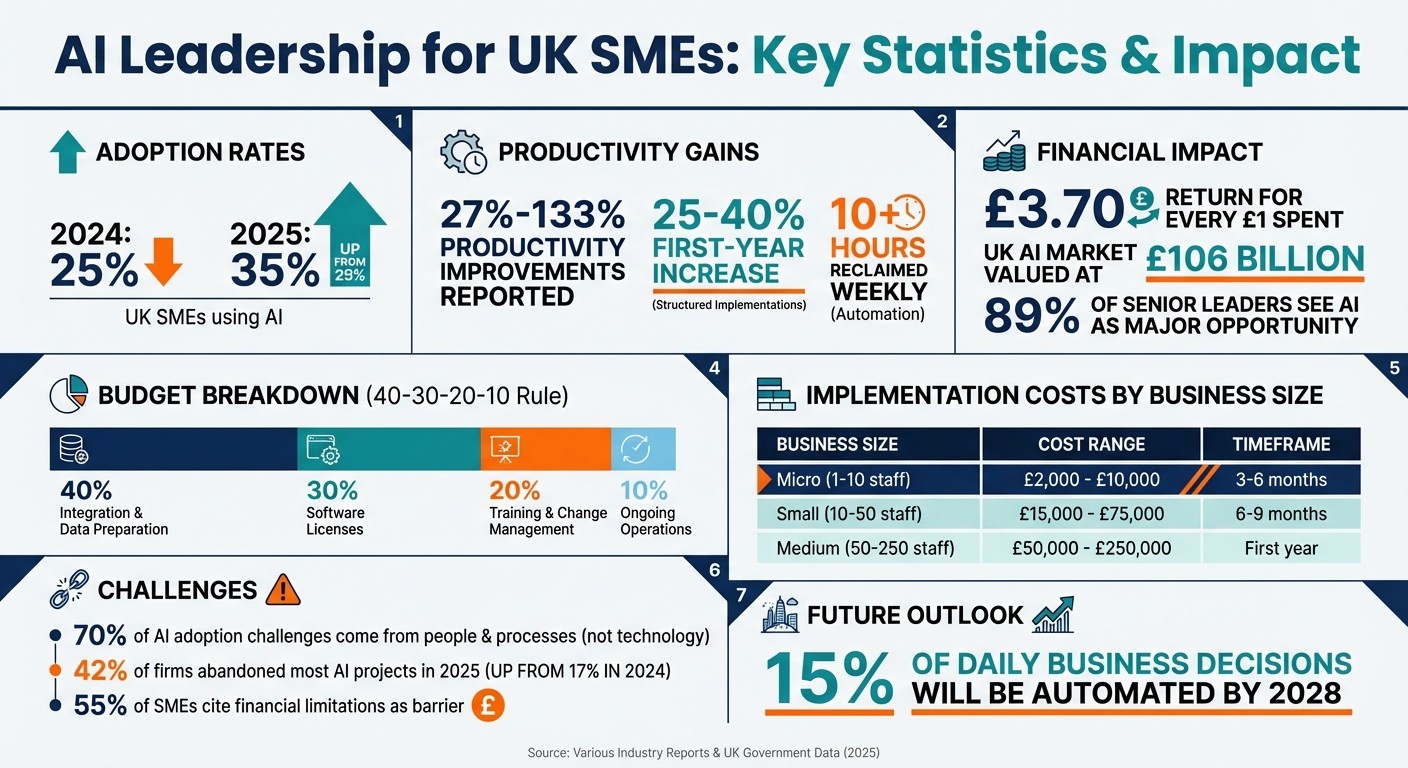
AI leadership is transforming how small and medium-sized enterprises (SMEs) in the UK operate by using tools to make decisions faster, reduce costs, and improve efficiency. By 2025, 35% of UK SMEs were using AI, up from 25% in 2024. However, many still use AI for basic tasks like email drafting rather than integrating it into core operations.
Key takeaways:
What is AI Leadership? It involves using AI tools for decision-making, optimising processes, and scaling without increasing staff. AI-driven systems like Sage Copilot and Xero have saved SMEs time and shifted focus to growth tasks.
Why SMEs Need AI Leadership: AI helps address common challenges like limited resources and talent shortages. Productivity gains of 27%-133% have been reported.
How to Implement AI Leadership: Start small with clear goals, assess readiness (data quality, infrastructure, team knowledge), and align AI initiatives with business strategies. Focus on solving specific problems, not chasing trends.
Training and Costs: Leadership training and small-scale pilots (costing £5,000–£20,000) can help ensure successful adoption. Integration and data preparation often take up 40–60% of AI budgets.
Challenges and Risks: Common issues include employee resistance, poor data quality, and compliance risks. Mitigation strategies include transparent communication, strong data governance, and human oversight.
Adopting AI leadership requires a clear plan, team alignment, and a focus on solving real business challenges. Tools like GuidanceAI offer cost-effective solutions for SME leaders to make better decisions and scale operations efficiently.
AI Adoption Statistics and ROI for UK SMEs in 2024-2025
Building the Foundation for AI Leadership
Before diving into AI adoption, it’s crucial to take stock of where your organisation stands, set clear goals, and prepare for the changes ahead. A solid foundation ensures that transitioning to AI-driven leadership aligns with your growth plans and stays on track for the long term. Interestingly, 70% of challenges in adopting AI come from people and processes - not the technology itself. Getting these basics right can make all the difference.
Assessing Your SME's AI Readiness
To gauge how ready your organisation is for AI, focus on four key areas: the quality and accessibility of your data, the state of your technical infrastructure (whether cloud-based or on-premise), the level of AI knowledge within your team, and your overall strategy and readiness for change. Leadership in this context isn’t about mastering AI technology - it’s about owning the direction and strategy.
One pressing issue to tackle early is "Shadow AI." This happens when employees use unauthorised AI tools without oversight, creating risks around security and GDPR compliance. The penalties for breaches can be severe, with fines reaching up to £17.5 million or 4% of global turnover. Start by conducting a thorough data audit to catalogue your data sources and address any inconsistencies or silos. Then, identify any gaps in leadership skills to decide if you need to hire specialists or train your existing team. To guide your strategy, consider these three questions:
Where can AI deliver the most value in the next 12–18 months?
What safeguards are essential for safety and ethics?
How will you measure success in tangible terms?
Businesses that approach AI with a structured plan often see productivity increases of 25–40% within the first year. Shifting from a "tools-first" mindset to focusing on solving real business challenges is key to achieving lasting results. Once you’ve assessed your readiness, the next step is to align AI initiatives with your overall business strategy.
Aligning AI with Business Strategy
The best way to align AI with your business goals is to start with the problems you want to solve, rather than chasing the latest tech trends. Review your core processes in areas like HR, operations, and sales to identify tasks that are repetitive, data-heavy, or prone to delays. An "AI-first scorecard" can help you evaluate potential use cases based on factors like impact, feasibility, data readiness, and organisational fit. This approach lays the groundwork for an AI-friendly culture.
Alignment at the executive level is a strong predictor of successful AI scaling. Make sure your leadership team is on the same page and consider forming a cross-functional steering group. This team - bringing together representatives from marketing, sales, operations, and IT - can ensure that AI projects serve the organisation as a whole, not just isolated departments.
"The organisations that will gain the most from AI over the coming year will not be those chasing every new tool, but those grounding their approach in strategy, leadership alignment and practical outcomes." – Ellen Bishop, Founder, Alcea Consulting
Develop a phased roadmap for the next 1–3 years, outlining project scopes, timelines, resources, and milestones. Define clear KPIs - like time saved, cost reductions, or faster insights - before launching any initiatives. Focus on small, early wins, such as automating repetitive marketing tasks or improving lead scoring. These quick successes can help build confidence and demonstrate ROI early on. Keep in mind that 42% of firms abandoned most of their AI projects in 2025, up from 17% in 2024, often due to a lack of clear business cases.
Creating a Culture That Supports AI
Once the technical and strategic groundwork is set, the next challenge is fostering a culture that embraces AI. Senior leaders should lead by example, sharing their own experiences with AI to signal that experimenting and learning are encouraged. Shifting from a rigid, top-down approach to one that values clear guidelines, shared values, and decision-making rights can help organisations navigate the disruptions AI may bring.
Businesses with a culture ready for AI are 2.3 times more likely to see tangible benefits from their investments. Building this type of culture means creating an environment where employees feel safe to ask questions, admit when they’re unsure, or challenge AI outputs without fear of judgement.
"Employees won't trust AI if they don't trust their leaders." – Harvard Business Review
Involve teams in designing new workflows to ensure AI complements human skills rather than replacing jobs. This "Human-in-the-Loop" approach helps manage resistance before it takes root. Foster a sense of psychological safety and use innovation sandboxes to allow for safe experimentation and rapid prototyping. Establish clear guidelines for responsible AI use, covering areas like data privacy, quality standards, and accountability. Encourage feedback through premortems and after-action reviews to learn from both successes and failures. Collaborative workshops can also help bridge the gap between boardroom strategies and day-to-day operations.
How to Implement AI Leadership in Your SME
Once you've laid the groundwork, it’s time to move from planning to action. Implementing AI doesn’t have to feel daunting - it’s about picking the right tools, training your team, and keeping an eye on the budget. Start small, adapt quickly, and expand on what works.
Selecting the Right AI Tools
Don’t jump on the AI bandwagon just because it’s trendy. Focus on tools that solve real operational issues. Pinpoint areas where your business struggles - like manual invoicing, high customer turnover, or repetitive data entry - and find technology that addresses those specific problems. A time audit can help you uncover inefficiencies.
Prioritise tools that can act independently, like those automating tasks, rather than just content creators. Many UK SMEs have reclaimed over 10 hours weekly by automating tasks such as invoicing, supplier tracking, and financial reconciliation.
When choosing tools, ensure they integrate smoothly with your existing systems, such as older versions of Sage or Xero, to avoid hidden costs. Compliance is equally important - opt for tools that meet UK GDPR standards and offer UK-based data storage. Start small with a pilot project. For instance, try a customer service agent before rolling out AI across the entire company.
Here are some AI "starter stacks" tailored to different business types:
Business Type | Tools Included | Estimated Cost |
|---|---|---|
Solopreneur | Xero Ignite, Tidio, ChatGPT Plus, Calendly, Dext | £46–£90/month |
Independent Retailer | Shopify, Tidio+Lyro, Xero+A2X, Canva Pro, Klaviyo | ~£160/month |
Boutique Agency | Xero Ultimate, CharlieHR, Slack Pro, Otter.ai | ~£195/month |
Before investing in new software, explore whether your current platforms - like HubSpot, Employment Hero, or Microsoft 365 - already include AI features. Additionally, UK initiatives like the Digital Growth Grant or Made Smarter (for manufacturers) can help offset implementation costs.
Once you’ve chosen the right tools, the next step is ensuring your leadership team is ready to use them effectively.
Training Leadership Teams to Use AI
Selecting tools is just the beginning - your leadership team needs the skills to use them confidently. Start with hands-on experimentation. Encourage leaders to try tools like ChatGPT, Microsoft Copilot, or DALL-E to understand their strengths and limitations before driving company-wide changes.
"The sessions were real eye openers and have got the conversation started." – George, DLF Seeds
Alignment within the leadership team is essential. Ensure everyone understands AI’s potential, risks, and role in your business strategy. This shared perspective prevents fragmented adoption, where teams use different tools independently without a cohesive plan.
Training should also emphasise how AI works alongside human decision-making rather than replacing it. For example, while AI can handle workflows like approvals in finance, the final decisions should still rest with people. Establish a cross-functional steering committee, led by senior leaders, to oversee AI adoption and policies.
Workshops can be an effective way to build practical skills. In the UK, half-day on-site workshops are available from £595 + VAT for up to 20 participants, while full transformation programmes (three workshops) start at £1,495 + VAT. Facilitated sessions often achieve higher completion rates - 95% compared to the 15–25% typical of online training.
Workshop Phase | Audience | Outcome |
|---|---|---|
Boardroom Alignment | Owners, Board, Senior Leaders | Strategic clarity and a unified leadership plan |
AI as a Teammate | Managers, Team Leads | Practical skills and confidence in daily tasks |
Adoption Sprint | Dept Heads, Operations Leaders | A 90-day roadmap and identification of key AI opportunities |
Focus on one or two areas, such as customer service or data entry, to showcase quick wins. Employees using AI tools at least weekly are 23% more likely to report making a meaningful impact at work.
Managing AI Implementation Costs
A common myth is that software licences make up the largest share of AI costs. In reality, integration and data preparation often consume 40–60% of an SME’s AI budget, with licences accounting for 30–50%, and the rest going to training and ongoing operations.
"Successful AI adoption is fundamentally an organisational transformation challenge, not a technology procurement exercise." – gigCMO
To maximise returns, follow the 40-30-20-10 Rule: allocate 40% of your budget to integration and data, 30% to software, 20% to training and change management, and 10% to ongoing operations. This approach ensures most of your investment focuses on people and processes - key factors in successful adoption.
Expect a temporary dip in productivity during the initial 3–6 months of integration. Leadership should dedicate 2–4 hours weekly for the first 8–12 weeks to steer the process. On average, successful implementations yield a £3.70 return for every pound spent.
Start with low-risk pilots costing between £5,000 and £20,000 to build confidence and measure outcomes before scaling. Target "quick win" functions like customer service automation, software development, or marketing content creation, which typically deliver results within 3–8 months. For example, Axioma, a UK car repair network, used Tidio's Lyro AI to handle customer queries. The result? An 89% resolution rate and 24/7 lead capture, even outside business hours.
Here’s a breakdown of typical investments by business size:
Business Size | Estimated Investment | Timeframe |
|---|---|---|
Micro (1–10 staff) | £2,000–£10,000 | 3–6 months |
Small (10–50 staff) | £15,000–£75,000 | 6–9 months |
Medium (50–250 staff) | £50,000–£250,000 | First year |
For SMEs looking for cost-effective solutions, platforms like GuidanceAI from AgentimiseAI offer tailored AI tools, such as virtual C-suite advisors, at a fraction of traditional costs. These services typically range from £50–£200 per user annually, far below the £1,500–£3,000 per participant charged for traditional training programmes.
"Cost versus value perception has become the defining barrier for SMEs. It isn't resistance to AI itself; it's resistance to unclear outcomes." – Ellen Bishop, Founder, Alcea Consulting
Keep an eye out for red flags like vague success metrics, underestimating system integration challenges, or delegating the project entirely to technical staff. Up to 70% of SME AI projects are abandoned due to budget overruns, often exceeding initial estimates by 20–70%. To avoid this, implement a 30-day action plan to deliver a working AI-powered task within a month, proving early value and building momentum.
Addressing Challenges and Risks
Adopting AI comes with its fair share of challenges, and if these aren't handled carefully, the process can become expensive and ineffective. Small and medium-sized enterprises (SMEs) often encounter obstacles like employee pushback and technical hurdles, but these risks can be tackled with the right strategies.
Common Risks of AI in Leadership
One of the biggest hurdles is employee resistance. Many employees worry that AI will replace their jobs, leading to pushback or even active resistance. This fear stems from the perception of machines as competitors, and without open communication, even the most well-planned AI initiatives can fail.
Another issue is data quality and infrastructure. SMEs often deal with fragmented, poor-quality data and inconsistent standards, which can complicate cloud-based AI implementations. Low-quality data not only limits AI's effectiveness but can also lead to inaccurate outputs that undermine decision-making.
The "black box" problem is another significant concern. Advanced AI models often lack transparency, making it hard for leaders to explain AI-driven decisions to stakeholders. This lack of clarity can create legal and ethical challenges, especially under UK regulations.
Algorithmic bias poses a further risk. If training data isn't properly audited, AI systems can perpetuate or even amplify discriminatory patterns. This can lead to legal troubles and damage an organisation's reputation.
Financial constraints also contribute to the "digital paradox" - where higher revenues from digital services don't necessarily lead to increased profits due to the high costs of AI infrastructure and upkeep. For SMEs, 55% of which cite financial limitations as a major barrier to AI adoption, balancing investment with returns can be a daunting task.
How to Mitigate AI Challenges
Understanding these risks allows SMEs to develop targeted strategies to address them. One effective approach is implementing right-sized governance. SMEs don't need to set up large ethics committees; instead, they can focus on practical measures tailored to their scale. As Christina Catenacci, Co-founder and Chief AI Officer at voyAIge strategy, puts it:
"For SMBs, [governance] does not require creating new departments or hiring ethicists and lawyers. Rather, it calls for a practical approach suited to the organisation's scale".
Maintaining human oversight is also critical. Human intervention at key decision points can prevent AI from making flawed decisions based on poor data. For high-stakes scenarios like hiring or lending, using interpretable models or tools such as LIME and SHAP can help ensure transparency. As Muhammad Jefry Fantoni from Riau University explains, AI should act as:
"a cognitive partner that broadens leaders' strategic horizon".
Clear communication and inclusive training are essential for addressing employee concerns. Involving staff early in the process ensures that AI tools enhance, rather than disrupt, their roles. For instance, after the "Midnight Blizzard" attack in early 2024, Microsoft updated its protocols to focus on model security and tightened access to sensitive data.
Embedding ethics by design from the beginning is crucial. This includes auditing training data for biases before deployment and continuously monitoring for "model drift" as AI systems evolve over time. For SMEs that rely on third-party AI tools, rigorous vetting is necessary to ensure these tools meet ethical and security standards.
Data hygiene is another key area. Standardising data formats and eliminating duplicates before training AI models can improve results. A well-planned data governance strategy ensures that information is clean and organised, as AI systems inherit biases from their training data. For budget-conscious SMEs, scalable cloud solutions with pay-as-you-go options can help reduce upfront costs and eliminate the need for expensive in-house hardware.
Finally, creating a cross-functional team to manage AI risks can be highly effective. This team can include existing staff with expertise in areas like security, AI technology, legal compliance, and business operations. By focusing on high-risk applications like hiring, lending, or pricing, SMEs can manage risks more efficiently.
Challenge Category | Specific Risk | Mitigation Strategy |
|---|---|---|
Organisational | Resistance to change / Fear of job loss | Transparent communication and early staff involvement |
Financial | High upfront costs / "Digital Trap" | Scalable cloud solutions and government grants |
Technical | Algorithmic bias / "Black Box" | Bias audits and Explainable AI (XAI) tools |
Legal/Ethical | Data privacy (GDPR) / Compliance | Strong cybersecurity and "Ethics by Design" frameworks |
Strategic | Lack of AI expertise in leadership | Collaborations with consultants and leadership training |
How GuidanceAI Supports AI Leadership
What is GuidanceAI?
GuidanceAI, created by AgentimiseAI, serves as a virtual C-suite advisor designed for SME leaders who want expert advice without the expense of hiring a full-time executive. It doesn’t rely on generic templates; instead, it emulates the judgement and methods of real business experts, creating an interactive digital version of their expertise.
The platform is built with privacy at its core, giving advisors control over the tone, boundaries, and scope of their guidance. This ensures leaders receive boardroom-level insights whenever they need them. As GuidanceAI describes it:
"GuidanceAI makes your expertise available, even when you're not".
This tool is designed to empower leaders with flexible, on-demand decision-making support.
How GuidanceAI Helps with Decision-Making and Scaling
GuidanceAI is particularly valuable for leaders who need agile and cost-effective solutions for both daily operations and long-term planning. By automating routine decision support, it helps address the common issue of limited executive capacity.
Leaders can use the platform to validate decisions, navigate complex challenges, and receive guidance comparable to expert coaching. With forecasts suggesting that 15% of daily business decisions will be automated by 2028, GuidanceAI reduces the mental strain on leaders, giving them more time to focus on areas like fostering workplace culture and making ethical choices.
For SMEs aiming to grow without increasing staff, GuidanceAI offers a practical solution. By handling routine guidance and decision-making, it allows leadership meetings to focus on strategic planning rather than day-to-day problem-solving. Leaders can try the platform risk-free with a 14-day free trial that doesn’t require a credit card.
What’s more, GuidanceAI tracks digital interactions between sessions, ensuring that leaders begin meetings with an up-to-date understanding of the business. This seamless integration into daily workflows reflects a growing trend in agentic AI, where virtual tools act as team members, connecting processes across the organisation.
Conclusion: Growing Your SME with AI Leadership
In today’s fast-changing market, weaving AI into your leadership approach is no longer optional - it’s how SMEs stay ahead. Businesses that embrace AI are seeing real gains, from cutting down time spent on repetitive tasks to delivering better customer experiences. It’s about solving real problems, not just following trends.
But here’s the thing: technology alone isn’t enough. Leadership drives this shift. As Ellen Bishop, Founder of Alcea Consulting, explains:
"Execution is not primarily a technology challenge. It is a leadership one".
Your job as a leader is to set clear goals, establish success benchmarks, and guide your team from testing ideas to implementing them strategically. Tools like GuidanceAI can make this process smoother. For founder-led SMEs, GuidanceAI offers 24/7 access to virtual advisors, trained by experienced business professionals. This means you can make informed decisions, tackle obstacles, and scale your business - all without the hefty cost of hiring full-time executives.
With the UK AI market now valued at £106 billion, and 89% of senior leaders seeing AI as a major opportunity, the message is clear: the time to act is now. By integrating AI into your leadership, you can keep your SME competitive and set the stage for long-term success.