AI Workflow Automation for Scale-Ups: Guide
16 Feb 2026
Practical guide for scale-ups to implement AI workflow automation to boost productivity, cut costs, reduce errors and scale with AI agents and integration tools.
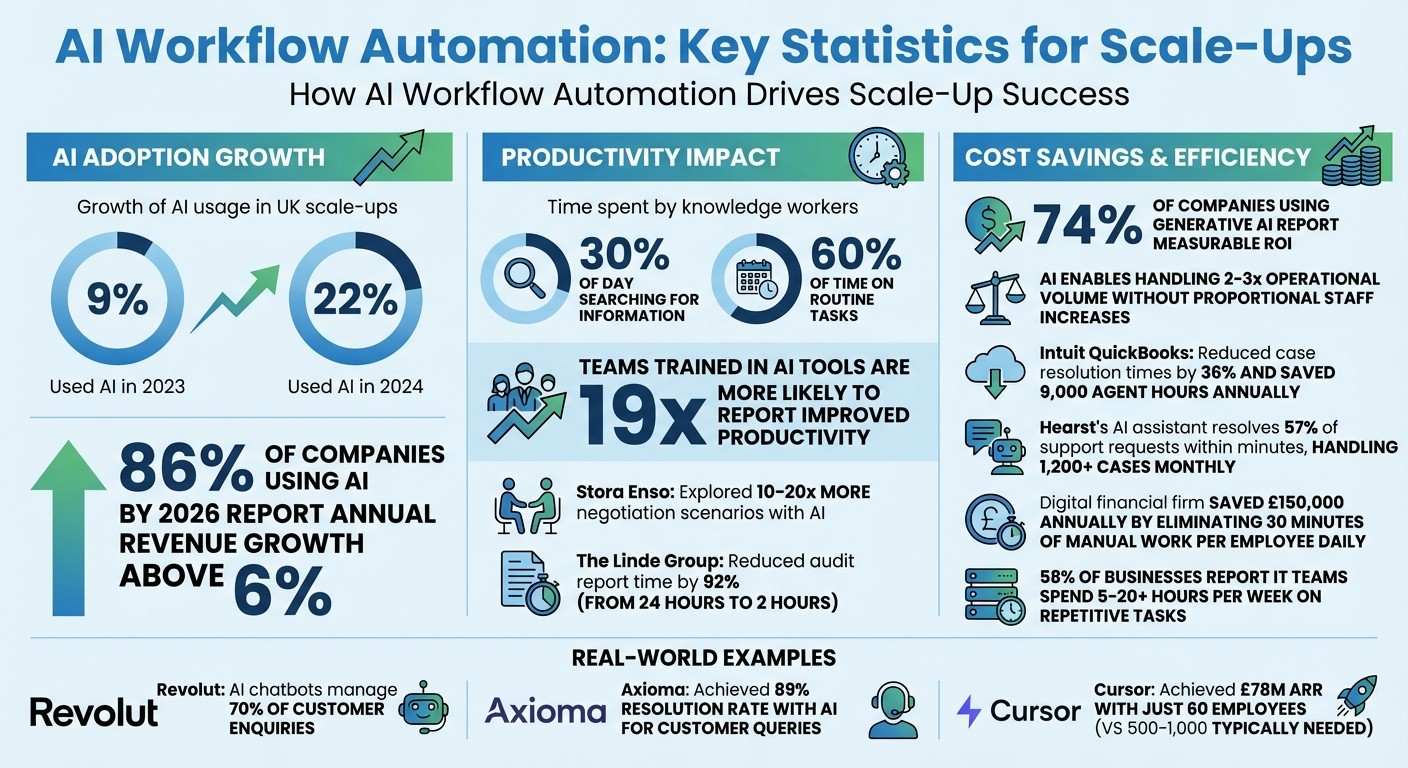
AI workflow automation helps scale-ups handle growth challenges by automating repetitive tasks, improving efficiency, and reducing costs. In the UK, AI adoption among scale-ups increased from 9% in 2023 to 22% in 2024, with 86% of companies using AI by 2026 reporting annual revenue growth above 6%. Key benefits include:
Increased productivity: AI tools can reduce manual work, such as customer support or data entry, saving time and improving focus on strategic goals.
Cost savings: Automating processes can handle 2–3 times more workload without proportional increases in staff costs.
Improved accuracy: AI reduces errors through consistent data processing and decision-making.
Enhanced collaboration: Unified workflows eliminate silos between teams, improving coordination.
Examples include Revolut’s AI chatbots managing 70% of customer enquiries and Stora Enso’s sales AI enabling teams to explore 10–20 times more negotiation scenarios. Tools like machine learning (ML), natural language processing (NLP), and AI agents power these efficiencies, while platforms like Zapier and Slack integrate AI into existing systems. By starting small with pilot projects and scaling gradually, businesses can achieve measurable ROI and operational improvements.
AI Workflow Automation Benefits and ROI Statistics for Scale-Ups
Benefits of AI Workflow Automation for Scale-Ups
Higher Efficiency and Productivity
AI workflow automation empowers scale-ups to move beyond automating individual tasks, enabling them to streamline entire systems. This shift allows small teams to perform at a level comparable to organisations many times their size. Consider this: knowledge workers spend a staggering 30% of their day searching for information and 60% on routine tasks.
Take Stora Enso, for example. Between 2025 and 2026, this renewable materials leader introduced AI agents to its B2B sales team. The result? Sales teams could explore 10–20 times more negotiation scenarios, freeing them to focus on strategy rather than data gathering. Similarly, The Linde Group transformed its internal safety audit process with a multi-agent system known as AuditGPT. This innovation slashed the time required for initial audit reports from 24 hours to just 2 hours - a 92% reduction - while also improving the accuracy of the reports through consistent standards. These examples from established companies highlight how AI can deliver scalable, impactful results for growing businesses.
"You can automate entire processes - scaling what your team does best and unlocking 'infinite time' for the work only humans can do." - Rachel Woods, Founder, DiviUp
The difference between teams trained in AI tools and those that aren’t is striking. Trained teams are 19 times more likely to report improved productivity. Companies like Cursor demonstrate this potential, achieving £78 million in annual recurring revenue with just 60 employees, compared to the 500–1,000 employees typically needed by traditional software companies to reach similar levels.
These productivity gains also translate into cost savings and enhanced collaboration within teams.
Cost Savings and Fewer Errors
AI workflow automation enables scale-ups to handle 2x to 3x the operational volume without increasing staff costs proportionally. The financial benefits are clear: 74% of companies using generative AI report measurable ROI, and 86% report annual revenue growth exceeding 6%.
For instance, Intuit QuickBooks integrated conversational AI bots with Slack, enabling users to retrieve information from a searchable knowledge base. This reduced case resolution times by 36% and saved 9,000 agent hours annually. Similarly, Hearst introduced "Herbie", an AI assistant that handles IT and finance support requests. By June 2025, Herbie was resolving 57% of support requests within minutes, addressing over 1,200 cases monthly and saving the company tens of thousands of hours annually.
Automation also reduces errors by standardising data across sources. For example, a digital financial firm saved over £150,000 annually by eliminating 30 minutes of manual work per employee daily. Additionally, 58% of businesses report that IT teams spend 5–20+ hours per week on repetitive tasks like password resets - tasks that AI can manage automatically.
Better Collaboration Across Teams
Beyond improving efficiency and reducing costs, AI enhances teamwork by breaking down silos and simplifying coordination. Automated workflows unify platforms like CRM, ERP, and communication tools into a single source of truth, reducing friction between departments. AI agents can even interpret requests - distinguishing between billing issues and IT problems - and route them to the appropriate team, eliminating manual coordination.
Take Axioma, a UK-wide car repair network. They implemented Tidio's Lyro AI to handle customer queries about pricing and booking. The AI agent achieved an 89% resolution rate without human intervention, enabling the business to capture leads and book repairs 24/7, even outside standard hours. Similarly, RBC Wealth Management used Slack's Workflow Builder to automate CRM processes, allowing financial advisors to manage cases from a single dashboard. This reduced the time spent on administrative tasks by 20%.
"AI workflow automation can break this pattern [of coordination chaos] completely. You can grow without drowning in coordination overhead." - Superhuman Team
AI tools also help teams stay aligned by summarising long conversations, meeting notes, and complex data sets. This eliminates the need for time-consuming debriefs, allowing cross-functional teams to get up to speed quickly. For scale-ups, this means AI can take on the heavy lifting of determining "who should do what", reducing the need to hire additional staff for alignment and project management.
Key Technologies and Tools for AI Workflow Automation
Machine Learning and Predictive Analytics
Machine learning (ML) is reshaping how scale-ups make decisions by analysing historical data to predict outcomes and enabling workflows to adjust in real time. For example, predictive analytics can estimate inventory requirements, forecast support ticket volumes, or spot risks in sales pipelines before they become problems.
Unlike traditional tools that falter with unexpected inputs, ML-powered workflows make context-aware decisions, adapting to changes as they happen. Predictive observability takes this a step further by helping teams identify potential bottlenecks, latency issues, or failure points before they disrupt operations. This adaptability is critical for scale-ups aiming to increase efficiency and stay agile as they expand.
While ML excels at data-driven forecasting, natural language processing (NLP) brings another layer of capability by making sense of unstructured data.
Natural Language Processing (NLP) and AI Agents
NLP complements ML by turning unstructured data - like emails, call transcripts, PDF invoices, or social media mentions - into structured, actionable tasks. This technology enables features like sentiment analysis to prioritise urgent customer queries or extract critical information from documents that would otherwise require manual effort.
AI agents take these capabilities further by managing complex, multi-step workflows autonomously. Unlike traditional automation, which follows rigid, linear paths, AI agents can reason, plan, and execute tasks across multiple systems. Using semantic routing, they determine the best course of action based on task intent and confidence levels.
A real-world example comes from Popl, which in December 2025 used Zapier and OpenAI to handle hundreds of daily form submissions. Their AI-driven workflow checked lead details in Google Sheets, notified teams via Slack, and routed leads based on region and company size. By automating email triage and spam filtering, Popl saved £20,000 annually.
"AI agents have opened new horizons of robotic process automation (RPA) through their ability to understand context, learn dynamically, and make decisions autonomously." – Deloitte
Integration with Existing Systems
Modern integration tools are the glue that connects AI capabilities to existing business systems. Platforms like Zapier, Make, and Gumloop allow businesses to link CRM, ERP, and messaging tools using low-code interfaces, drag-and-drop actions, or even natural language prompts. These tools also offer modular AI Blocks for tasks like summarisation, translation, and data extraction, which can be embedded directly into workflows. This seamless integration ensures that businesses can unify their systems and maintain a single source of truth across departments.
For instance, Remote, a company with over 1,800 employees, used Zapier and ChatGPT to manage 1,100 monthly IT support tickets with just three staff members. The AI system classifies and prioritises tickets from Slack and email, while Zapier Agents search past tickets for solutions. This setup handles 28% of tickets autonomously, saving the team over 600 hours each month.
How to Implement AI Workflow Automation
Assess Current Processes and Identify Bottlenecks
Start by visually mapping out your main business processes. Lay out each step, decision point, input, and output to uncover where manual tasks are causing delays. To understand the financial impact, use this formula: (Time Spent per Task) × (Hourly Rate) × (Frequency). This helps turn inefficiencies into clear monetary terms.
Focus on tasks that are repetitive, follow set rules, occur frequently, and are prone to errors. Rate each bottleneck on a scale of 1–5, where 1 is a minor inconvenience and 5 is a major issue. Use an impact-versus-effort matrix to pinpoint "quick wins" - those tasks that have a big impact but are relatively easy to automate.
Instead of automating entire workflows all at once, take a step-by-step approach. Start with small but valuable parts of a process. Document everything in an "AI Playbook" that isn't tied to specific tools. Once you’ve identified inefficiencies, move forward by testing AI with focused pilot projects.
Pilot AI Solutions in High-Impact Areas
To see immediate benefits, launch AI pilots in areas identified as high-impact during the process mapping. Good starting points include customer support triage, lead qualification, or internal approvals - tasks that are predictable but still need some human oversight. Design these systems to work alongside humans, where AI provides context and suggestions, but people make the final decisions.
Set a confidence threshold for AI actions. For instance, AI could operate automatically only when it reaches 95% certainty, with less certain cases sent to humans for review. Run these AI workflows alongside your manual processes to compare performance and identify any gaps. Don’t shy away from testing the system with messy or imperfect data - this ensures it can handle real-world challenges.
For example, in 2024/25, Tyne Chease, a North East-based manufacturer, adopted Sage Copilot to automate financial workflows. This saved the founding team over 10 hours weekly, allowing them to focus on product development.
Scale and Monitor for Continuous Improvement
Once pilot projects prove successful, move on to scaling and monitoring the workflows. Treat these systems like software infrastructure - ensure proper documentation, version control, and clear ownership. Break down complex processes into smaller modules, such as intake, qualification, and routing. This makes it easier to audit, troubleshoot, and expand these systems across different parts of the business.
Use automated alerts to flag when model accuracy drops by over 5%, and schedule retraining every 4–12 weeks based on how quickly your data changes. Middleware can help track AI decisions, log data exchanges, and allow human intervention when needed. Monitoring API token usage is also essential to manage costs effectively.
Don’t forget to revisit failed automation attempts every six months. AI technology evolves quickly, and what didn’t work before might now be achievable. Studies show that SMEs using AI have seen productivity increases ranging from 27% to 133% compared to those that haven’t adopted it.
AgentimiseAI: Tailored Solutions for Scale-Ups
AgentimiseAI builds on the benefits of AI-driven efficiency by offering solutions designed to support leadership teams and improve operational scalability for growing businesses.
GuidanceAI for Leadership and Workflow Optimisation
GuidanceAI provides leadership teams with AI-powered virtual C-suite advisors, developed with input from business experts. These advisors act like research assistants, processing unstructured data to deliver insights in seconds, cutting down decision-making time significantly. For scale-ups, where growth often brings challenges like increased meeting loads and coordination complexity, this kind of tool can make a real difference.
What sets this platform apart is its ability to offer boardroom-level advice without the need to hire additional senior executives. The AI analyses documents, market trends, and performance metrics to provide strategic recommendations, enabling founders to focus on more critical tasks. Essentially, the AI takes care of the time-consuming research and context-gathering, letting leaders dedicate their energy to driving their business forward.
Custom AI Agents for Founder-Led SMEs
AgentimiseAI also creates custom AI agents tailored to fit specific workflows. These agents allow businesses to manage significantly more tasks without increasing their team size. They deliver real-time insights, sentiment analysis, and operational guidance, complementing earlier productivity improvements. With 24/7 multi-channel support, they’re always ready to assist.
Rather than replacing human teams, these AI agents streamline processes and improve task quality, enabling founders to rethink how work is done. By handling repetitive tasks, the AI acts as a digital teammate, freeing up the core team to focus on strategic initiatives and building stronger relationships.
Fast Rollout and Ongoing Support
AgentimiseAI uses a phased rollout process that begins with an audit and progresses through MVP development, AI integration, and full deployment. The initial focus is on simple, high-impact tasks like lead qualification or automating meeting notes, before expanding to more complex workflows.
During implementation, the AI agents compare their outputs with human decisions to ensure accuracy before gaining full autonomy. This human-in-the-loop method uses confidence thresholds, where the AI only acts independently when highly certain, escalating unclear cases to human oversight. Businesses adopting this approach have reported saving 10–15 hours per manager per week on routine tasks, and fully integrated AI agents are expected to reduce operational costs by 31%. This structured process ensures that AI adoption boosts both efficiency and strategic focus across the organisation.
Conclusion
For growing businesses, integrating AI-driven workflow automation has become a crucial step towards achieving long-term growth. The data speaks volumes: 86% of companies leveraging AI report annual revenue growth exceeding 6%. Additionally, the rise of agentic AI - where systems can autonomously manage complex tasks - allows organisations to scale operations significantly without a corresponding rise in staffing costs.
However, the key to success lies in strategic automation, not blanket replacement of processes. As Cflow aptly puts it, "The real advantage will not come from automating everything. It will come from knowing where intelligence belongs". This means pinpointing which tasks are ripe for automation - such as IT support or invoice processing - and starting with impactful pilot projects. Treat workflows as foundational infrastructure by ensuring proper documentation, continuous monitoring, and data readiness before rolling out automation solutions.
While technology itself is rarely the bottleneck, leadership understanding and execution often are. For founder-led SMEs, the challenge is less about access to AI tools and more about knowing how to implement them effectively. Only 1% of companies consider themselves AI-mature, and 35% of UK SMEs cite a lack of expertise as their biggest hurdle. This is where AgentimiseAI steps in, offering tailored AI solutions and strategic support. Their approach helps teams reclaim 10–15 hours per week while cutting operational costs by up to 30%.
The goal is to build a forward-thinking business model where humans, AI, and automation work in harmony to drive growth. Companies adopting this mindset can achieve the speed, precision, and adaptability that today’s markets demand, making workflow automation a cornerstone of sustainable success.
FAQs
Which workflows should we automate first?
Start with automating tasks that are repetitive, high-volume, and follow clear rules - things like data entry, invoicing, or answering straightforward customer questions. These processes are simple to standardise, making them ideal for quick implementation with minimal impact on your workflow.
Once you've got the basics running smoothly, you can move on to automating more complex tasks. For example, handling unstructured data or managing meeting schedules. These advancements can boost efficiency in areas like sales, customer service, and operations, laying the groundwork for scalable growth.
How do we measure ROI from AI automation?
Measuring ROI from AI automation involves looking at specific outcomes like cost savings, improved productivity, revenue growth, and better experiences for both customers and employees. Key metrics to track include:
Time saved: How much manual effort has been reduced?
Error reduction: Are processes becoming more accurate and reliable?
Increased throughput: Is more being accomplished in less time?
Using a structured framework to monitor these metrics can help you clearly quantify the benefits AI brings to your operations, making it easier to evaluate its overall impact on your workflows.
How do we keep AI accurate and safe over time?
To ensure AI operates accurately and safely, it's essential to put strong governance measures in place. This includes conducting regular audits and maintaining continuous monitoring. Incorporating human-in-the-loop methods can help identify errors early and minimise potential risks. Additionally, retraining models frequently and verifying data quality are crucial steps to keep up with changing conditions and requirements.
Platforms such as GuidanceAI by AgentimiseAI offer valuable support for growing businesses. They provide AI agents trained by experts, helping organisations scale while maintaining dependable decision-making and operational safety.