
Top Challenges in AI Leadership for SMEs
2 Feb 2026
SME AI projects fail when leaders lack AI fluency, plans, clean data and change management — start small, prioritise high-impact tasks and measure ROI.

AI is reshaping how small and medium-sized enterprises (SMEs) operate, but many face hurdles in adopting it effectively. Key challenges include:
Leadership Knowledge Gaps: Many leaders lack a clear understanding of AI, leading to stalled projects and poor implementation.
Implementation Issues: Without clear plans, AI investments often fail to deliver results. Starting with small, focused projects can help.
Team Resistance: Employees fear job losses or struggle with unfamiliar tools. Open communication and training can ease these concerns.
Data and Process Problems: Poor data quality and unclear workflows hinder AI success. Clean data and well-documented processes are essential.
Budget Constraints and Vendor Selection: Tight budgets and choosing the wrong tools can derail AI efforts. Prioritising affordable, off-the-shelf solutions often works best.
Scaling and Measuring Results: Many SMEs struggle to expand AI use and prove ROI. Setting clear KPIs and tracking progress is crucial.
Success lies in starting small, prioritising high-impact areas, and ensuring leaders and teams are equipped to integrate AI effectively. SMEs that act decisively can stay competitive and improve productivity.
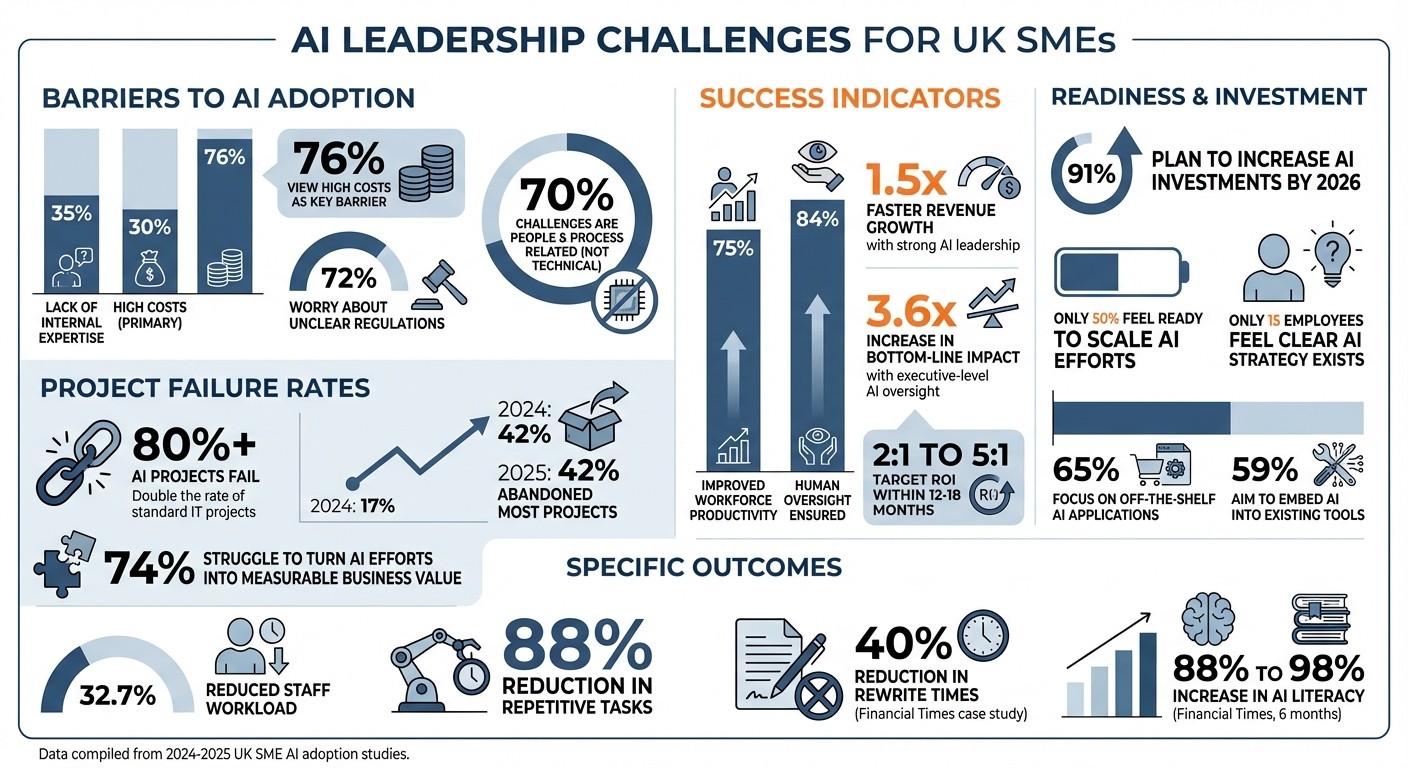
AI Adoption Challenges and Success Metrics for UK SMEs
Challenge 1: Limited AI Knowledge Among Leaders
For UK SMEs, the biggest hurdle isn't the technology itself - it’s the knowledge gap at the leadership level. Without a solid understanding of AI, leaders struggle to evaluate initiatives, measure outcomes, or allocate resources effectively. This lack of insight often leads to stalled or failed AI projects.
The numbers paint a stark picture. 35% of UK SMEs cite a lack of internal expertise as their main barrier to AI adoption, and 74% of organisations find it difficult to turn AI efforts into measurable business value. Even more worrying, 42% of businesses abandoned most of their AI projects in 2025, a sharp increase from 17% the previous year. As McKinsey aptly put it:
"The biggest barrier to scaling AI is not employees - who are ready - but leaders, who are not steering fast enough."
This isn’t about a shortage of data scientists or tech specialists. The real issue lies in the lack of leaders who understand how to integrate and manage AI within their businesses. Without this knowledge, investments often result in "shallow adoption", where tools remain isolated rather than becoming part of core operations.
Building Basic AI Skills
To close this gap, leaders must move from basic awareness to actionable expertise.
They don’t need to learn coding, but they do need to grasp AI’s capabilities and limitations. This means developing "AI fluency" - the ability to assess AI applications, ask the right questions of vendors, and identify areas where automation can genuinely add value.
By 2025, AI won’t just be another software tool; it represents "cognitive labour", capable of handling complex workflows that once required human expertise. For example, tasks like financial reconciliation, supplier tracking, or resolving customer queries can now be managed by AI systems, freeing up employees to focus on strategic initiatives.
A practical framework for leaders is the 4Ds Competency Framework:
Delegation: Identifying tasks suitable for automation.
Description: Crafting clear and effective prompts.
Discernment: Evaluating AI outputs critically.
Diligence: Ensuring ethical and responsible AI use.
Before diving into new technology, SME leaders should also conduct a time audit. By tracking employee tasks over a week, they can pinpoint inefficiencies and ensure AI solutions address real operational challenges rather than becoming solutions in search of problems.
Closing Skill Gaps with Training Programmes
Both self-learning and structured training are essential for leaders to gain the confidence and skills needed to drive AI transformation.
Formal training programmes provide a fast track to building AI expertise. For instance, the LSE AI Leadership Accelerator is a six-month online course tailored for senior professionals managing AI transformations without a technical background. It focuses on strategic leadership, organisational change, and responsible AI implementation - skills crucial for SME leaders.
For those seeking a quicker option, Coursera offers "Generative AI & AI Agent Organizational Strategy for Leaders", a beginner-level course developed with Vanderbilt University. This 7-hour programme, priced at £199 (discounted from £399), focuses on viewing AI as cognitive labour and designing agentic workflows. With a 4.5/5-star rating, participants have found it "immediately applicable" and praised its practical approach to AI leadership.
Government-backed initiatives also provide valuable support. Barclays Eagle Labs offer subsidised accelerator programmes, mentoring, and AI workshops for regional SMEs through the Digital Growth Grant. Similarly, Made Smarter provides up to 50% matched funding and tailored digital roadmaps for manufacturing SMEs adopting AI in quality control or predictive maintenance. Meanwhile, Innovate UK's Growth Catalyst programme allocates £100 million to scale AI applications in sectors like digital and advanced manufacturing.
One standout example of leadership commitment comes from the Financial Times. Between late 2024 and mid-2025, under Senior Finance Director Darren Joffe, the organisation launched an "AI Immersion Week" and "Lightning Talks" initiative. They developed "Tone of Voice GPT", a tool trained on their editorial style, which reduced rewrite times for executive communications by 40%. Over six months, company-wide AI literacy rose from 88% to 98%.
For SMEs looking for bespoke guidance, AgentimiseAI (https://agentimise.ai) offers AI-driven leadership training tailored to the unique needs of founder-led businesses. Their GuidanceAI platform connects leadership teams with virtual C-suite advisors - AI agents trained by human experts - providing high-level guidance without the cost of hiring full-time executives.
Developing AI fluency among leaders is essential for transforming business models. As Dr. Dorottya Sallai of the LSE Department of Management explains:
"AI adoption is a cultural transition, one that requires overcoming psychological and leadership barriers more than technical ones."
The evidence supports this: organisations with strong AI leadership see revenue growth 1.5x faster than those without. For UK SMEs, building leadership knowledge is the first step to unlocking AI’s full potential and tackling broader implementation challenges.
Challenge 2: Missing AI Implementation Plans
Many SMEs recognise the potential of AI but stumble due to one critical issue: a lack of a clear implementation plan. This often leads to wasted budgets, frustrated teams, and AI tools gathering dust instead of delivering results.
One common pitfall is falling into the "Tool-First Trap" - investing in AI software before clearly defining a business problem. As Jake Holmes, Founder & CEO of Grow Fast, highlights:
"If you can't clearly describe how something gets done today, you can't automate it. AI amplifies what you have. If what you have is chaos, you'll get automated chaos."
The statistics are stark. Over 80% of AI projects fail, a failure rate double that of standard IT projects. For UK SMEs, where 35% cite lack of expertise and 30% cite high costs as the main barriers, rolling out AI without a plan can result in automated inefficiencies instead of productivity gains. A well-thought-out plan can turn potential AI hurdles into opportunities.
Starting Small and Scaling Smart
The most successful SMEs avoid overhauling entire operations at once. Instead, they begin with small, focused pilot projects that deliver measurable results in a short time.
Take the example of a £2 million UK marketing agency. By targeting a specific pain point - manual client reporting - they implemented AI tools like Zapier and GPT. This reduced the time spent on reporting from 12 hours to 2 hours per week, saving over £100,000 annually.
Another case is a £3 million property management firm that automated its maintenance request process in late 2025. By introducing an AI-powered intake and scheduling system, they cut average resolution times from 6.2 days to 2.1 days and reduced admin time per request from 45 minutes to 8 minutes. The result? £45,000 in annual labour savings and a 12% boost in tenant retention.
What ties these successes together is a methodical approach: start with one specific process, test it thoroughly, and scale up only after proving the results. This step-by-step strategy reduces risks and builds internal confidence in the technology.
To identify where to start, conduct a one-week time audit. Look for tasks where inefficiencies exceed 30%, such as repetitive emails or data entry. These often yield the highest returns, far outpacing more complex projects like predictive modelling.
Building an AI Implementation Plan
Once a pilot project succeeds, the next step is creating a detailed AI roadmap. Start by mapping core processes. Break down roles into individual tasks, analysing them step-by-step to identify inefficiencies or error-prone areas. Then, evaluate AI suitability: prioritise tasks that are repetitive, high-volume, digital, and have measurable outcomes.
Data quality is critical. Audit your data for accuracy, completeness, and consistency, and form a cross-functional AI steering group to define automation priorities and set clear KPIs. High-quality data is the backbone of AI performance.
When calculating ROI, take a cautious approach. If you anticipate 80% time savings, base your business case on achieving 50%. Estimate the payback period by dividing implementation costs by monthly savings. Simple automations using existing tools typically cost between £500 and £2,000, while more advanced systems can range from £5,000 to £20,000.
The Government Digital Service offers a practical framework for implementation:
Phase | Focus | Key Action |
|---|---|---|
Discovery | User Needs & Data | Audit data quality and identify friction points. |
Alpha | Prototyping | Build a simple baseline model and test it on a small dataset. |
Beta | Deployment | Integrate the model into live workflows and monitor its performance. |
Scaling | Expansion | Roll out successful pilots to other areas based on proven ROI. |
A "human-first" approach is key. AI should enhance human capabilities, not replace them. As Sally Shuttleworth, Regional Director at The Marketing Centre, explains:
"Treated as a team-mate rather than a replacement, AI works best when humans stay firmly in the driving seat."
This perspective helps reduce resistance and accelerates adoption. Employees using AI tools at least weekly are 23% more likely to report a significant impact at work, and organisations with AI in place feel 50% more prepared for the next few years.
For SMEs looking for tailored guidance, platforms like AgentimiseAI (https://agentimise.ai) offer AI-driven leadership training and tools like GuidanceAI, which connects leadership teams with virtual C-suite advisors. These AI agents, trained by human experts, provide strategic support tailored to founder-led businesses - without the cost of hiring full-time executives.
As Ged Leigh, Regional Director at The Marketing Centre, puts it:
"AI isn't a quick fix; it's a long-term transformation. Without a plan, businesses risk wasted investment and missed opportunities."
The shift from generative AI (content creation) to agentic AI (task execution) in 2025–2026 makes planning even more critical. Tools like Xero's JAX and Sage Copilot now handle complex workflows, moving beyond drafting text to executing multi-step operations. Without a roadmap, these tools can overwhelm rather than empower. A clear implementation plan is the foundation for SMEs aiming to lead with AI.
Challenge 3: Team Resistance and Poor Change Management
Even with a solid plan in place, many SMEs face a significant hurdle when it comes to team resistance. This can derail AI adoption, making change management just as important as the technical aspects. Nearly half of CEOs admit their employees show resistance - or even outright hostility - towards AI. Interestingly, the issue often isn't the technology itself. Around 70% of AI adoption challenges are tied to people and processes, not technical barriers.
Why does this happen? The reasons are fairly straightforward. Employees fear losing their jobs, feel unsure about how AI will fit into their daily roles, and worry about making mistakes with unfamiliar tools. Poor communication only amplifies these concerns. As Dr Dorottya Sallai from the LSE Department of Management puts it:
"Employees won't trust AI if they don't trust their leaders".
Without open and honest communication, resistance can harden into outright opposition.
Still, there’s good news. A substantial 71% of employees trust their employers to use AI responsibly. Research also shows that when leaders involve their teams early in AI initiatives, this trust can lead to active participation and quicker adoption. While many leaders (70%) believe their teams aren’t ready for AI, the real issue often lies in leadership not moving fast enough, rather than employees being unwilling. Understanding these concerns is the first step towards reshaping the conversation around AI to build team support.
Building Support for AI Adoption
The key to winning over sceptical employees is to reframe AI as a helpful partner, not a job-stealing replacement. Present it as a tool that takes care of repetitive tasks - like data entry, routine emails, or paperwork - freeing employees to focus on more meaningful work, such as strengthening customer relationships. This shift in perspective matters: 75% of businesses using AI report improved workforce productivity, with 84% ensuring human oversight and regularly checking AI outputs.
Creating a sense of psychological safety is equally important. Employees need the freedom to experiment with AI tools without fear of repercussions if they make mistakes. For instance, in 2025, IKEA formed a multidisciplinary AI governance team, including technologists, legal experts, and designers, to align AI projects with business goals while maintaining transparency. This visible commitment to ethical AI use helped ease employee concerns, especially as 80% of businesses view ethical risks as a major barrier to adoption.
Hands-on involvement also plays a huge role. During the change management process, give employees opportunities to shape how AI tools are integrated into their workflows, rather than imposing pre-made solutions. Appoint "AI champions" within the team - colleagues who can demonstrate how to use AI in practical, day-to-day scenarios. When employees see their peers succeeding with AI, adoption tends to accelerate. Interestingly, 48% of employees actively want formal training to help them use AI effectively, showing a willingness to embrace the technology when given the right support.
Managing Change Successfully
Clear communication and well-structured training are at the heart of effective change management. Tailor training to different roles: executives should focus on governance and risk, managers on redesigning workflows, and frontline staff on hands-on scenarios. Studies indicate that teams need at least five hours of formal training to start using AI consistently, and individual employees typically take two to three months to become proficient in AI-related tasks.
Publish a transparent "pilot-to-scale" roadmap that outlines decision-making processes and role changes. This eliminates ambiguity, which is often a key source of hesitation. SMEs with clear internal policies on AI use see better engagement and adoption rates. As Tim Creasey from Harvard Business Review explains:
"Change management is the process, tools, and techniques to manage the people side of change to achieve a required business outcome".
Leadership accountability is non-negotiable. Senior leaders need to actively use and advocate for AI tools, signalling that this transformation is a priority for the organisation. During the initial six-month intensive phase, leaders should dedicate one to two hours daily to AI initiatives. It's also crucial to manage the pace - aligning AI-driven strategies with the team’s capacity to implement them prevents burnout. Tracking "implementation debt", or the gap between AI strategies and their execution, can help keep the process on track.
Start with areas that promise high returns but face minimal resistance. For instance, automating customer service can deliver results within one to three months, while workflow automation can cut repetitive tasks by up to 88%. These early successes build confidence and create momentum. For SMEs seeking additional support, platforms like AgentimiseAI offer AI-driven leadership training, while GuidanceAI provides virtual C-suite advisors for strategic guidance without the expense of hiring full-time executives.
Shifting the perception of AI from a threat to an ally takes effort. As gigCMO highlights:
"The 87% failure rate for AI implementations isn't a technology problem - it's a leadership framework problem".
Challenge 4: Poor Data and Process Preparation
Even when leadership and teams are aligned on adopting AI, many SMEs face a critical hurdle: their data and processes simply aren’t ready. This isn’t just a minor inconvenience - it’s a major roadblock. Over 80% of AI projects fail, which is double the failure rate of typical IT projects, and much of this stems from inadequate preparation. A staggering 40% to 80% of a data engineer's time is spent cleaning and organising data before AI can even begin to work. As Jake Holmes, Founder & CEO of Grow Fast, aptly summarises:
"If what you have is chaos, you'll get automated chaos".
The issue boils down to two main problems: SME data is often scattered, inconsistent, and stored in formats that AI struggles to process, and workflows are unclear or poorly documented, leaving no clear path for AI integration. Only 11% of firms report using technology extensively to streamline operations, highlighting a significant gap. On top of that, 37% of SMEs manage between 5 and 10 different software tools, creating data silos that prevent AI from accessing a complete dataset. Without addressing these foundational issues, AI investments are likely to underperform - or fail entirely.
Checking Data Quality and Access
AI thrives on clean, well-organised data. Unfortunately, many SMEs wrestle with basic data quality issues like missing values, outdated information, and inconsistent formatting. A large chunk of SME data also exists in unstructured formats - think emails, PDFs, and contracts - that are harder for AI to process compared to structured databases. When data is fragmented across offices, factories, or disconnected systems, AI simply can’t deliver meaningful insights.
To determine if your data is AI-ready, consider these questions: Do you have enough data for AI models to learn from? Is the data representative of your target audience? Where is it stored, and is it accessible across teams? Is it structured (like tables) or unstructured (like documents)?. Evaluate your data using nine key dimensions: accuracy, completeness, uniqueness, timeliness, validity, relevancy, representativeness, sufficiency, and consistency.
Start by consolidating data from various sources into a centralised location, like a data warehouse. Set clear standards for dates, measurements, and categories to maintain consistency throughout the organisation. Implement automated validation tools that flag errors or impossible values in real time. As Ankur Patel, Founder, advises:
"If there's a lot of data that's hard to work with, maybe it's noisy and incomplete, then it's better not to use this data. Let's work with the remaining data, which is much cleaner".
It’s better to work with a smaller, high-quality dataset than to rely on messy, inconsistent data. Once your data is clean, the next step is to prepare your workflows for AI integration.
Preparing Workflows for AI
Good data alone isn’t enough - your workflows need to be ready as well. Many SMEs struggle because they haven’t mapped their processes in detail. Before introducing AI, document your key processes step-by-step. Identify triggers, data inputs and outputs, and the time required for each action. Instead of trying to automate entire roles, break them down into specific tasks. This "task-first approach" makes it easier to identify where AI can make the most impact.
Take the example of a UK-based property management company in 2025. With a turnover of £3 million, they automated their maintenance request workflow. Initially, manually logging requests and matching contractors took 45 minutes per request, with a resolution time of 6.2 days. By introducing an automated intake form and AI-driven contractor matching, admin time dropped to 8 minutes per request, and resolution time fell to just 2.1 days. This saved the company £45,000 annually and boosted tenant retention by 12%. Their success was rooted in mapping the entire workflow, identifying bottlenecks, and applying AI strategically.
Focus on automating repetitive, high-volume tasks like data entry, invoice processing, or meeting scheduling - these offer quick returns. Calculate the current cost of these tasks (time multiplied by hourly rates) and compare it against the AI implementation costs to ensure a payback period of under six months. Audit your tech stack to spot data silos and manual processes that are slowing down operations. As the British Chambers of Commerce aptly puts it:
"A collection of disconnected apps is the opposite of what an AI agent needs".
For SMEs looking for extra support, platforms like AgentimiseAI offer custom AI agents tailored to specific workflows, while GuidanceAI provides virtual C-suite advisors to guide you through process preparation without the cost of hiring full-time executives. Additionally, the UK government’s "AI Management Essentials" (AIME) tool offers a self-assessment for SMEs to evaluate their data and process readiness.
Challenge 5: Budget Limits and Choosing Vendors
Even when SMEs streamline their data and workflows, they often hit a major roadblock: tight budgets and the daunting task of selecting the right AI partner. Research shows that 76% of businesses view high costs as a key barrier to AI adoption, while 70% of SMEs cite resource constraints as a primary issue. Compounding these challenges, 80% of AI projects fail without proper planning. As Joe Phelan, Business Finance Editor at Money.co.uk, highlights:
"The true role of AI is in supporting, not replacing, business fundamentals".
The problem isn't just about finding the funds - it's about using them wisely. Many SMEs worry that investing in AI could divert resources away from critical areas like cash flow management or customer relationships. On top of that, choosing the wrong vendor can lead to wasted money, technical mishaps, and tools that fail to integrate with existing systems. The SME Digital Adoption Taskforce captures this concern perfectly:
"Adoption often looks too hard and costly... switching from one technology to another can feel too high risk".
Once SMEs have tackled data and process readiness, managing budgets and selecting the right partner become the final hurdles. The secret lies in knowing where to focus your investment and finding a vendor who genuinely understands your needs.
Getting the Best Return on AI Investment
After addressing foundational challenges, SMEs must ensure their limited budgets deliver maximum value. The smartest approach? Start small. Instead of diving into a full-scale AI transformation, SMEs can test the waters with pilot projects that are low-cost yet high-impact. These "quick wins" - like automating repetitive tasks such as data entry, invoice processing, or customer service queries - can provide immediate benefits and fund future expansions.
Data shows that 65% of businesses investing in AI plan to focus on off-the-shelf applications, while 59% aim to embed AI into existing tools, avoiding the costs of custom development. Pre-built solutions are especially appealing because they’re faster to deploy and more affordable. Take Medigold Health’s 2024 launch of "Paradigm", an AI-powered module for medical reporting. Under Clinical Innovations Director Jonathan Behr, this tool produced over 70,000 case reports and boosted clinician retention by 58%, thanks to reduced admin workloads.
To make the most of their investment, SMEs should first assess their readiness and set clear, measurable goals. For example, aim to cut customer response times by 30% or reduce invoice processing time by half - these benchmarks justify the spend and help track ROI. As Ellen Bishop, Founder of Alcea Consulting, puts it:
"The biggest returns from AI are typically not found in new tools but in clarity, simplification and the removal of friction, waste and duplication".
Compare the cost of manual processes with the price of AI solutions to ensure a payback period of six months or less. Phased scaling can also help spread costs, allowing teams to adapt gradually while minimising disruptions. For SMEs without in-house expertise, working with external consultants, tech providers, or universities can provide the necessary skills without the expense of hiring full-time staff. Once investment priorities are clear, the next step is finding a reliable partner to bring those plans to life.
Selecting Trustworthy AI Partners
Choosing the right vendor is critical. A poor choice can lead to compliance headaches, technical failures, and tools that don’t meet your needs. SMEs should look for vendors who address specific pain points rather than offering one-size-fits-all solutions. For example, if reconciling invoices is a major drain on resources, seek AI tools built specifically for financial automation.
Compliance and data sovereignty are especially important, particularly in regulated industries like finance, health, and legal. Vendors must comply with UK GDPR and store data in UK-based centres. With 72% of businesses worried about unclear AI regulations and 34% of larger SMEs delaying decisions due to "compliance chill", it’s vital to audit providers to ensure sensitive data isn’t processed on US-hosted models, which could breach UK GDPR.
Another key factor is choosing vendors offering "grounded" AI models. These systems rely solely on your company’s data - like FAQs or internal knowledge bases - to produce accurate outputs. Trustworthy partners also support "human-in-the-loop" models, where AI complements staff efforts but human oversight remains central. Seamless integration with existing platforms like Xero, Sage, or Shopify is equally important to ensure a smooth transition.
Examples from real businesses highlight the rewards of selecting wisely. A UK-based manufacturer saved over 10 hours per week through financial automation. Similarly, James Scott, an accounting firm in Manchester, used Xero and A2X in 2025 to automate the processing of complex sales data from clients’ e-commerce stores. What used to take days each month was reduced to a 30-minute review, allowing the firm to focus on high-value advisory services.
For SMEs needing tailored solutions, platforms like AgentimiseAI offer AI agents customised to specific workflows, while GuidanceAI provides virtual C-suite advisors trained by industry experts. These tools deliver expert advice without the cost of hiring full-time executives - perfect for founder-led SMEs with tight budgets. Additionally, the UK government’s "AI Management Essentials" (AIME) tool helps businesses evaluate their readiness before committing to a vendor.
Challenge 6: Measuring Results and Scaling AI
After overcoming the initial hurdles of selecting an AI partner and securing funding, SMEs face a critical challenge: proving the value of AI and scaling it effectively. For businesses aiming to remain competitive, demonstrating clear returns on investment and expanding AI usage beyond pilot projects is essential.
The reality is, many AI pilots fall short of delivering tangible results. This often happens because AI isn't fully integrated into a company's core operations. In fact, while over 91% of businesses plan to increase their AI investments by 2026, only about half feel ready to scale their efforts. The issue isn't the technology itself - it’s the absence of clear metrics and strategic direction. Without measurable goals, AI risks becoming an expensive trial rather than a transformative tool. As Ged Leigh, Regional Director at The Marketing Centre, aptly puts it:
"AI isn't a quick fix; it's a long-term transformation. Without a plan, businesses risk wasted investment and missed opportunities".
To move forward, SMEs must focus on defining success and setting clear performance metrics.
Setting Clear Performance Measures for AI
Before rolling out AI solutions, it’s crucial to establish what success looks like. This means creating a mix of financial, operational, and technical KPIs that align with the business's overall goals. Here are some key metrics to consider:
Financial ROI: Aim for a return of 2:1 to 5:1 within 12–18 months, calculated as [(Net Return – Cost of Investment) / Cost of Investment] x 100.
Time saved: Measure reductions in manual work hours, such as those spent on invoice processing or handling customer queries.
Error reduction: Track quality metrics to ensure that accuracy and reliability are maintained.
Technical performance: Monitor metrics like model accuracy, precision, and standard error.
Customer satisfaction: Use NPS (Net Promoter Score) and CSAT (Customer Satisfaction) scores to evaluate the impact on customer experience.
For example, research shows that 32.7% of SMEs report a reduced staff workload after adopting generative AI, while 14.3% have decreased their reliance on external contractors by handling tasks in-house. However, these results only emerge when businesses establish a clear starting point. Identifying one to three operational bottlenecks - such as manual data entry or report generation - and calculating their current financial impact (e.g., the cost of errors or lost revenue) makes it easier to measure improvements and justify further investment.
Tracking progress quarterly is also crucial. While AI provides both tangible benefits (like cost savings and revenue growth) and intangible ones (such as improved employee morale), focusing on measurable outcomes is key to securing ongoing support and funding.
Using Expert Advice to Scale AI
With clear metrics in place, expert guidance can help SMEs scale AI effectively. Expanding from a single pilot project to an organisation-wide deployment often presents more strategic challenges than technical ones. Without proper direction, businesses risk investing in low-impact projects, expanding AI into unsuitable areas, or encountering resistance from employees. Consulting with professionals to validate business cases and assess potential risks can prevent costly missteps.
A successful approach involves shifting from a "tool-first" to a "process-first" mindset. Instead of asking, "What AI tools should we buy?" businesses should focus on identifying their most pressing problems. Repetitive, high-volume, and digital processes are ideal candidates for AI, while tasks requiring nuanced human judgement may not be suitable.
For SMEs without in-house expertise, platforms like GuidanceAI can provide virtual C-suite advisors trained by real-world experts. These advisors help businesses create structured AI roadmaps, detailing use cases, required data, and realistic timelines to transition from experimentation to full-scale implementation.
Scaling AI successfully also requires a human-centred approach. High-performing organisations prioritise AI education, ensuring that teams acquire the necessary skills to collaborate with AI rather than view it as a threat. Frameworks like "Adopt, Sustain, Optimise" encourage upskilling and position AI as a supportive tool, which helps reduce resistance and boost adoption rates. As Corinne Thomas, an Agency Founder and Growth Consultant, explains:
"The SMEs that thrive in 2026 may not be the most technologically advanced. They will be the ones who turned curiosity into capability".
Conclusion: Converting Challenges into Opportunities
The journey to AI leadership for SMEs is rarely straightforward, with obstacles often rooted in people and processes rather than technology itself. True success lies not in the number of tools acquired but in how effectively AI is integrated into the organisation. This focus on strategic deployment shapes every step of the adoption process.
Leadership plays a pivotal role in this transformation. According to McKinsey, companies with executive-level AI oversight experience a 3.6x increase in bottom-line impact. Yet, only 15% of employees feel their organisation has a clear AI strategy. This disconnect highlights the need for leaders to actively engage with AI - championing its adoption and crafting a clear narrative that ties each use case to tangible strategic outcomes. This leadership focus is essential to complement the structured planning and team involvement discussed earlier.
The risks of standing still are now equalled by the opportunities for those who act decisively. In the UK, 75% of businesses using AI report improved workforce productivity, and 76% of leaders are willing to give AI projects at least 12 months to demonstrate ROI. This patience and momentum create the perfect environment for transformation. The smartest approach? Start small, target high-impact areas, and build on early successes rather than attempting sweeping changes without a solid foundation.
For SMEs ready to move forward, AgentimiseAI offers a bridge from experimentation to execution. With 43% of SME leaders expressing the need for clearer guidance on adopting AI effectively and securely, expert support provides the frameworks and virtual C-suite advice necessary to turn challenges into sustainable business improvements. By combining strategic planning with hands-on leadership, SMEs can unlock lasting success. As Ellen Bishop, Founder of Alcea Consulting, aptly puts it:
"The biggest risk isn't that competitors will adopt more tools, but that they will adopt AI more coherently".
SMEs that embrace this mindset can transform obstacles into competitive advantages, turning curiosity into capability.
FAQs
How can SME leaders better understand AI to successfully implement it in their business?
For SME leaders, understanding AI starts with grasping its core concepts and identifying how these can address specific business challenges. AI offers tools to streamline operations, enhance decision-making, and spark new ideas, making it a valuable asset for businesses of all sizes.
To build this knowledge, leaders can take practical steps like enrolling in tailored training programmes or exploring AI roadmaps designed to align with their industry. Implementation guides can also help translate AI strategies into actionable plans. Additionally, online courses and workshops focusing on practical applications of AI provide ongoing learning opportunities.
By blending education with thoughtful planning, SME leaders can take charge of AI initiatives that deliver tangible outcomes for their businesses.
What are the best steps for SMEs to begin using AI effectively?
For small and medium-sized enterprises (SMEs) venturing into AI, it’s all about taking it one step at a time. Start by pinpointing specific, repetitive tasks in your business that rely on data and could benefit from automation. Think along the lines of customer support, marketing efforts, or routine administrative duties. The goal is to focus on areas where AI can make a clear difference without adding unnecessary complexity to your operations.
Develop an AI roadmap that ties directly to your business objectives, but make sure it keeps people at the centre. This means investing in staff training, setting up clear guidelines for AI use, and beginning with small pilot projects. These initial projects should target high-impact areas, giving you a chance to test AI solutions without taking on too much risk. As your team gains confidence and skills, you can gradually expand your AI initiatives. By starting small and focusing on practical, real-world applications, SMEs can sidestep expensive missteps and ensure AI delivers meaningful results.
How can SMEs address employee concerns about adopting AI?
SMEs can ease employee concerns about AI adoption by focusing on open communication, education, and showing clear benefits. Start by involving employees early in the process. Explain how AI will enhance their roles, making tasks simpler and workflows smoother, rather than replacing them. This approach can help reduce fears about job security.
Offering tailored training programmes is equally important. These help employees gain confidence and adapt to AI tools effectively. Highlighting quick wins - like saving time or improving accuracy - can further build trust and enthusiasm. For example, solutions like AgentimiseAI provide leadership-level AI tools along with customised training, ensuring employees feel equipped and aligned with the company’s AI goals.
By staying transparent, investing in skill development, and showcasing real benefits, SMEs can foster a workplace culture where AI is seen as a helpful tool rather than a threat.