AI in Leadership: Benefits for SME Growth
22 Jan 2026
AI helps SME leaders make better decisions, automate repetitive tasks, cut costs and scale operations — start small with audits, pilots and tailored AI agents.

AI is transforming leadership in small and medium-sized enterprises (SMEs), helping businesses grow without increasing staff costs.
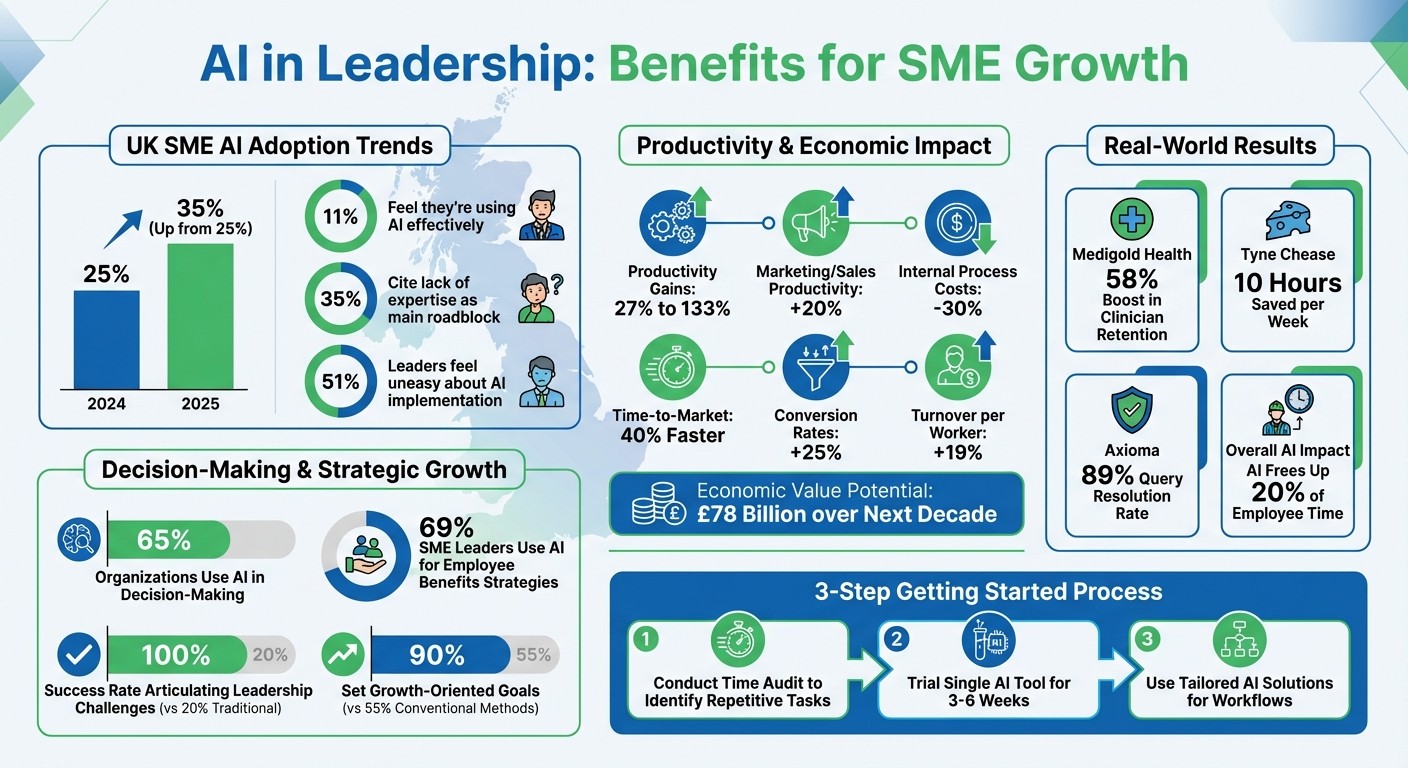
In 2025, AI adoption among UK SMEs rose to 35%, up from 25% in 2024. Leaders are using AI not just to automate tasks but to improve decision-making and streamline operations. Tools like Sage Copilot and AgentimiseAI's GuidanceAI are making financial management, customer service, and strategic planning more efficient. For example, Medigold Health's AI tool reduced administrative workloads, boosting clinician retention by 58%, while Tyne Chease saved 10 hours per week by automating invoice management.
Key takeaways:
Productivity gains: SMEs using AI report improvements of 27% to 133%.
Cost efficiency: AI allows businesses to scale without proportional staff increases.
Real-time insights: AI helps leaders make data-driven decisions, forecast trends, and identify risks.
Economic impact: AI adoption could add £78 billion to the UK economy over the next decade.
To get started, SMEs should:
Conduct a time audit to identify repetitive tasks.
Trial a single AI tool for 3–6 weeks.
Use tailored AI solutions to match specific workflows.
AI is no longer optional for growth - it’s a tool that helps SMEs stay competitive while reducing operational burdens.
AI Adoption Impact on UK SMEs: Key Statistics and Benefits
How AI Benefits SME Leadership
Better Decisions Through Data Analysis
AI is shifting leadership from relying on gut instinct to embracing data-driven strategies by offering real-time insights and predictive analytics. With AI, leaders can view everything from market trends to performance metrics in one place, such as a centralised dashboard. This capability allows SME leaders to forecast customer behaviour, spot operational issues early, and identify market opportunities with far greater accuracy.
Currently, 65% of organisations have integrated AI tools into their decision-making processes, and 69% of SME leaders are using AI to design employee benefits strategies. Businesses adopting generative AI at scale have reported up to 40% faster time-to-market, while small businesses using AI-powered recommendation systems have seen conversion rates jump by as much as 25%. AI also enhances risk management by identifying potential problems - whether in financial transactions or equipment performance - before they escalate. These capabilities naturally feed into improvements in operational efficiency.
Improved Operations and Workflow Efficiency
AI is transforming how SMEs handle their day-to-day operations. Many administrative tasks, such as invoicing and payment tracking, are now automated with tools like Xero JAX and Sage Copilot, which can also flag irregularities in ledgers. The evolution from generative AI, which focuses on content creation, to agentic AI, which executes tasks, has enabled automation of more complex workflows, including financial reconciliations, supply chain management, and compliance monitoring.
Take Axioma, a UK-wide car repair network, as an example. They implemented Tidio's Lyro AI to handle customer queries about pricing and bookings. The AI agent resolved 89% of queries and continuously captured leads, even outside of regular business hours, securing additional revenue. SMEs adopting AI have reported productivity gains ranging from 27% to 133%, with marketing and sales productivity alone increasing by over 20% and internal process costs dropping by around 30%.
Supporting Business Growth and Scalability
Beyond streamlining operations, AI plays a key role in driving growth by allowing businesses to expand without needing a proportional increase in staffing costs. By automating high-volume tasks, AI frees up about 20% of employees’ time, enabling them to focus on strategic projects. This shift allows leadership to prioritise innovation, strategy, and relationship-building rather than getting bogged down in daily operational challenges. In sectors like logistics and agri-food, AI can optimise up to 50% of current work activities, making it a game changer for high-demand industries.
Adopting AI technology has been linked to a 19% higher turnover per worker, showcasing its potential to support scalable growth. The economic impact could be enormous - AI adoption among UK small businesses is projected to add £78 billion in value over the next decade. For founder-led SMEs that need strategic guidance but can’t afford full-time senior executives, platforms like AgentimiseAI's GuidanceAI offer virtual C-suite advisory services. These AI agents, trained by experienced business professionals, provide tailored advice to help businesses navigate growth and overcome unique challenges.
AI as a Virtual Leadership Advisor
AI Agents for Leadership Support
By 2025, the progression from generative AI to agentic AI has opened up a world of possibilities for SME leaders, offering them strategic guidance like never before. These AI agents go beyond simply generating content - they now operate autonomously, taking on tasks as if they were part of the leadership team. Tools such as Xero JAX and Sage Copilot have emerged as financial powerhouses, delivering CFO-level insights by analysing cross-ledger data. They can pinpoint cash flow issues and highlight market trends, making them invaluable for founder-led SMEs that may not have the resources to hire full-time senior executives.
AgentimiseAI's GuidanceAI takes things a step further, providing leadership teams with virtual C-suite advisors. These specialised AI agents are trained by seasoned business professionals to offer expert guidance. They don’t just address surface-level symptoms; they help leaders dig deeper to uncover the root causes of business challenges. This evolution allows AI to play an active role in advising leadership teams in real time.
The impact is clear: leaders using AI thinking companions reported a 100% success rate in articulating high-quality leadership challenges, compared to just 20% in traditional settings. Additionally, 90% of these leaders set growth-oriented, leadership-focused goals, a significant jump from the 55% achieved through conventional methods.
Real-Time Support and Flexibility
Beyond strategic guidance, AI agents shine in providing real-time operational support. These modern tools are proactive, continuously scanning for issues and offering solutions. For example, Sage Copilot monitors ledgers to spot anomalies, late payments, or rising supplier costs, then suggests immediate actions. A Manchester-based accounting firm, James Scott, leveraged Xero's AI and A2X to automate e-commerce data ingestion during 2024/25. What used to take days - monthly reconciliation - was reduced to a quick 30-minute review. This freed up partners to focus on offering strategic growth advice instead of routine tax reporting.
Leigh Thomas from Intuit describes the potential of these tools:
Imagine an AI agent as a tireless, proactive member of your team, who can automatically reconcile your accounts, send a perfectly timed invoice, and even flag a potential cash flow problem - all without you lifting a finger.
The versatility of these AI agents doesn’t stop at the office door. Axioma, a UK-based car repair network, adopted Tidio's Lyro AI agent to handle customer estimates and bookings. The AI achieved an impressive 89% resolution rate, even capturing leads at 9 PM on a Sunday. This ensured revenue that might have otherwise slipped through the cracks.
Addressing AI Adoption Challenges in SMEs
Building AI Knowledge and Skills
For many SME leaders, the real challenge in adopting AI isn't about finding data scientists - it's about having managers who know how to integrate AI into everyday business operations. While 35% of UK SMEs are now using AI, only 11% feel they’re leveraging it effectively to streamline their processes. This points to a bigger issue: 35% of businesses cite a lack of expertise as their main roadblock, and over half (51%) of small business leaders admit they feel uneasy about implementing AI in their organisations.
The solution lies in practical, hands-on learning rather than abstract theory. A good starting point for leadership teams is a time audit. By having employees track their tasks for a week, businesses can uncover where hours are being wasted on repetitive tasks like data entry, invoice matching, or answering FAQs. This simple exercise can highlight where AI could make an immediate impact.
SMEs can also benefit from tapping into regional support networks. Initiatives such as Made Smarter (focused on manufacturing) and Barclays Eagle Labs provide subsidised workshops and mentoring to help companies explore AI implementation. Mark Di-Toro, Director at iwoca, offers a crucial piece of advice:
Defining AI's applications for your business and identifying specific areas for its use are key to demystifying it.
Starting small is essential. Launch a pilot project targeting the most time-consuming task, track results over 3–6 weeks, and then gradually expand.
Once a basic understanding of AI is in place, the next step is adapting these tools to fit the unique workflows of the business.
Tailoring AI to SME Workflows
Off-the-shelf AI tools often fall short because they don’t account for the specific processes and data structures unique to each SME. The problem is further complicated by fragmented technology setups: 37% of SMEs rely on 5 to 10 different software systems, creating data silos that make it hard for AI to access and integrate the information it needs. As John Clancy, CEO of Galvia, explains:
AI is most effective when it's applied within a system that's bespoke to each firm's data, culture, and decision-making habits - not when it's seen as a ready-made tool to be bought off the shelf.
The first step to overcoming this challenge is a tech stack audit. This involves identifying where data is siloed and pinpointing repetitive tasks that slow the business down.
One solution addressing this issue is AgentimiseAI's GuidanceAI, which offers bespoke AI agents tailored to the workflows of founder-led SMEs. Instead of forcing businesses to adapt to rigid, generic software, these agents are trained by experienced professionals to align with the company’s specific operations. This makes AI feel like a natural extension of the leadership team, offering strategic insights that fit seamlessly with the firm’s decision-making style - without requiring extensive adjustments or workarounds.
Conclusion
Main Points for Leadership Teams
Studies reveal that AI adoption among UK SMEs could contribute an impressive £78 billion to the economy over the next decade, with productivity gains ranging between 27% and 133%. For leadership teams, AI presents three major benefits: it sharpens decision-making through real-time data insights, streamlines operations by automating tasks like invoicing and payroll, and enables scalable growth by reducing the dependence on headcount for revenue generation.
The evolution from generative AI, which focuses on content creation, to agentic AI, which executes tasks, has opened up new possibilities. Leadership teams can now rely on virtual team members capable of handling complex workflows - such as financial reconciliations or round-the-clock customer support - without requiring constant human intervention.
These capabilities lay the groundwork for seamlessly introducing AI into business operations.
Next Steps: Implementing AI for Growth
To harness AI for sustainable growth, businesses don’t need to overhaul their entire tech infrastructure. Start small. Conduct a time audit to pinpoint where staff hours are being drained by repetitive tasks. Then, trial a single high-impact AI tool - whether it’s for automating invoicing, capturing leads, or generating financial reports - and monitor its impact over 3–6 weeks. For example, AgentimiseAI's GuidanceAI offers tailored AI agents that act as virtual C-suite advisors, aligning with your organisation's processes without the cost of hiring full-time executives.
The potential is enormous. As Phil Smith CBE, Chair of the SME Digital Adoption Taskforce, puts it:
By 2035, the UK's SMEs should be the most digitally capable and AI confident in the G7.
The businesses that begin now - by building AI knowledge, embedding tools into their workflows, and adopting customised solutions - are the ones poised to lead their industries into the next decade and beyond.
FAQs
How can SMEs begin using AI to drive growth and efficiency?
SMEs can make the most of AI by first identifying where it can genuinely help their business. Think about areas like automating time-consuming tasks, improving decision-making processes, or making customer service more efficient. Start by reviewing your current operations and workflows to spot where AI could step in and make a difference.
Once you've identified these opportunities, look into AI tools designed specifically for smaller businesses. It's important to find solutions that fit seamlessly into your existing systems. For example, platforms like GuidanceAI provide tailored AI support, offering leadership teams access to virtual advisors and coaches who deliver insights and guidance on both strategic and operational levels.
To make the transition smoother, invest in training your team to understand what AI can do and address any concerns they might have early on. Begin with small pilot projects to test how AI tools perform in your business, track the results, and build confidence in the technology. By starting small and scaling up gradually, SMEs can use AI to streamline their operations and support steady, long-term growth.
What challenges do SMEs face when implementing AI technologies?
Small and medium-sized enterprises (SMEs) face a range of hurdles when it comes to adopting AI. One major concern is uncertainty and fear of disruption - many business leaders worry about how AI might affect their operations or even upend their existing business models. On top of that, knowledge gaps pose a challenge, as not all SMEs fully understand how to incorporate AI into their day-to-day processes effectively.
Another obstacle is the overwhelming variety of AI tools available. This lack of cohesion can make implementation tricky and prevent businesses from achieving the efficiency improvements they’re aiming for. Moreover, some SMEs struggle with management practices that aren’t yet aligned with the demands of digital transformation. To make things even more challenging, there’s often a shortage of customised advice and support, leaving many SMEs without the guidance they need to tackle AI adoption confidently.
Addressing these issues calls for clear, accessible information, personalised support, and AI solutions designed to work seamlessly within their existing operations. With the right resources, SMEs can harness AI to drive growth and streamline their processes.
How can AI help SME leaders make better decisions?
AI gives SME leaders the tools to make smarter decisions by offering real-time insights grounded in data, customised to their specific business needs. These tools enable leaders to swiftly analyse trends, identify opportunities, and tackle potential challenges before they become major issues.
AI-driven virtual advisors step in as specialised agents, offering proactive suggestions to optimise operations and boost efficiency. With these capabilities, SMEs are equipped to make well-informed decisions that fuel growth and set the stage for expansion.