
AI-Driven Vision: 7 Steps for SMEs
26 Jan 2026
Seven practical steps for SMEs to adopt AI: audit processes, set measurable goals, prepare data, run pilots, and scale with ongoing monitoring for real ROI.

AI can transform small businesses, but only if used wisely. Many founder-led SMEs struggle to grow without drowning in operational tasks. While 74% of UK SMEs planned to adopt AI by 2025, over 80% of AI projects fail due to poor planning. The key? Start with your processes, not the tools. Successful AI adoption focuses on solving specific problems like reducing repetitive tasks or improving decision-making. Here's a quick overview of the steps to build an AI-driven vision:
Assess readiness: Audit your processes and evaluate your team's AI knowledge.
Define goals: Align AI initiatives with measurable business objectives.
Identify use cases: Target areas with high potential for cost or time savings.
Prepare data: Ensure your data is clean, organised, and accessible.
Set milestones: Use SMART goals to track progress and ROI.
Plan implementation: Start with small pilot projects and scale gradually.
Monitor and refine: Continuously improve AI systems based on feedback.
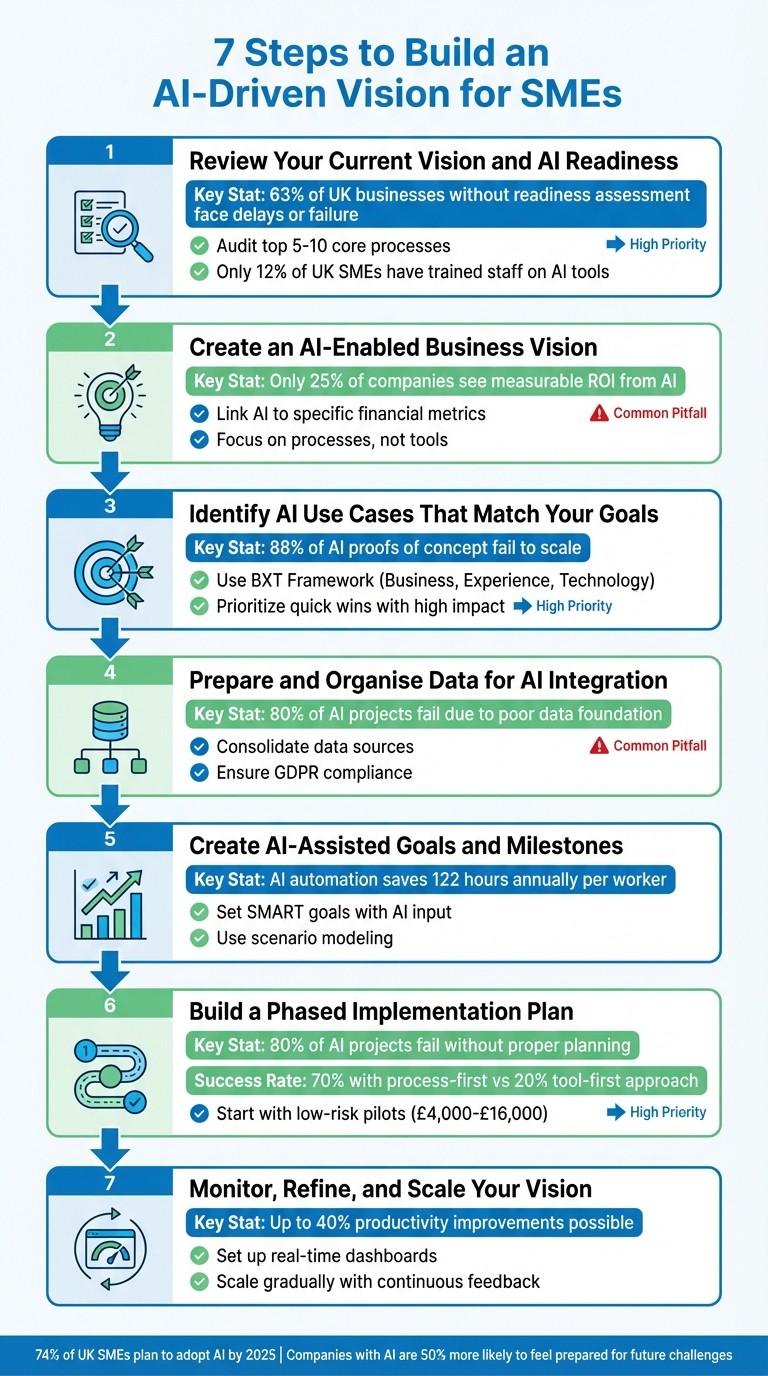
7-Step AI Implementation Framework for SMEs
Step 1: Review Your Current Vision and AI Readiness
Before diving into AI projects, take a step back and evaluate your organisation's readiness. Skipping this step can be costly - 63% of UK businesses that launched AI initiatives without a readiness assessment faced delays in ROI or outright project failure. Success often hinges on addressing key questions upfront: Which tasks are the most time-consuming? Where are errors hitting your bottom line the hardest? Which decisions would benefit from better data?
Audit Your Business Processes
Start by mapping out your top 5–10 core processes. Pay attention to triggers, data flows, timeframes, and common error points. For example, a UK-based property management company with £3 million in revenue reviewed its maintenance request workflow in 2025. They found that each request took 45 minutes of manual effort and an average of 6.2 days to resolve. By switching to an AI-powered system for intake and contractor matching, they cut resolution times to 2.1 days and reduced admin work to just 8 minutes per request. This change saved them £45,000 annually in labour costs and boosted tenant retention by 12%.
AI thrives in handling repetitive, high-volume, and rule-based tasks that are already digitised. On the other hand, tasks that require nuanced judgement or depend heavily on relationships are less suited for automation. Take the case of a £2 million marketing agency: their account managers were spending 12 hours a week manually compiling client reports from seven platforms. By automating data collection and using AI to draft initial commentary, they slashed reporting time to just 2 hours per week, saving over £100,000 annually in labour costs.
For AI to work effectively, your systems need to be in order. Consolidate platforms, standardise naming conventions, and ensure your data is structured and high-quality. Check if your existing tools - such as your CRM or ERP - offer open APIs for integration. Scalable cloud storage is also essential for handling the demands of AI processing.
Once you've audited your processes, the next step is evaluating whether your team and technology are prepared to support AI.
Check AI Knowledge and Team Readiness
A process audit should go hand-in-hand with assessing your team's AI expertise. The numbers are telling: only 12% of UK SMEs have trained their staff on AI tools, and 56% of SMBs cite a lack of internal skills as a major barrier to adoption. Identify gaps in areas like data analysis, model monitoring, and ethical governance.
To ensure alignment, form an AI steering committee with representatives from key departments such as marketing, sales, operations, IT, and leadership. Designate "AI champions" within your teams to lead adoption efforts and support colleagues. Framing AI as a tool that complements human skills can help build trust and engagement.
Follow the 10-20-70 framework: dedicate 10% of your focus to algorithms, 20% to technology and data, and 70% to people and processes. Start small with low-risk pilot projects, like using AI to summarise meeting notes. This approach not only builds team confidence but also lays the groundwork for broader implementation.
Step 2: Create an AI-Enabled Business Vision
After evaluating your readiness, the next move is to establish a vision that seamlessly integrates AI into your broader strategy. This isn't about adopting technology for its own sake - it’s about defining measurable goals that AI can help achieve. While 74% of UK small businesses plan to adopt AI by 2025, only 25% of companies are currently seeing measurable ROI from their AI investments. The difference? A clear connection between AI capabilities and key business objectives. This clarity ensures your AI vision is not just aspirational but actionable and aligned with your core goals.
Your AI-driven vision should focus on specific financial metrics that matter to leadership - such as revenue per customer, margin contribution, cost-to-serve, or forecast accuracy. Avoid vague statements like "improving efficiency." Instead, frame AI initiatives as testable hypotheses: for example, "If AI improves our forecasting accuracy by 15%, how will that impact our profit margins?" This kind of framing links AI efforts directly to measurable business outcomes.
Write an AI-Powered Vision Statement
Start by pinpointing the areas where AI can deliver tangible results. Look for slow, error-prone manual tasks or decisions made with insufficient data. Then, connect these opportunities to clear growth objectives. For example, instead of saying, "We aim to use AI to be more efficient", try something more specific: "We will reduce our cost-to-serve by 20% using AI-powered customer support automation, allowing us to expand into new markets without increasing headcount."
The most effective visions prioritise processes over tools. As Jake Holmes, Founder & CEO of Grow Fast, explains: "The businesses that succeed with AI aren't the ones with the biggest budgets. They're the ones who understand their processes deeply before selecting any technology." This means your AI vision should be informed by the process audit you conducted in Step 1, not by flashy vendor presentations or feature lists.
Use Virtual C-Suite Insights for Vision Alignment
Once your vision is defined, seek external expertise to validate and refine it. Many SMEs lack the in-house expertise needed to develop a robust AI strategy. That’s where platforms like AgentimiseAI's GuidanceAI come in. GuidanceAI connects leadership teams with specialised AI agents that act as virtual C-suite advisors, trained by real business experts. These virtual advisors assess readiness across three critical areas: adoption maturity, data infrastructure, and team capability.
Instead of hiring costly consultants or making expensive staffing decisions, SMEs can tap into expert-level advice to identify high-impact opportunities and build strong business cases. GuidanceAI helps transform abstract goals into actionable plans - prioritising processes, estimating potential savings (often exceeding £50,000 annually for SMEs), and outlining phased rollout strategies. This structured approach addresses a major challenge: while 81% of executives believe AI provides a competitive advantage, only 12% currently use it in day-to-day operations. Virtual C-suite insights bridge this gap, offering the strategic clarity needed to turn an AI vision into reality.
Step 3: Identify AI Use Cases That Match Your Goals
Once you've established your AI-driven vision, the next step is to pinpoint specific operational challenges where AI can make a meaningful difference. Focus on applications that can deliver measurable results - whether that's cutting costs, speeding up processes, or improving customer experiences.
Start by conducting a thorough review within your organisation. Speak with teams across finance, sales, and customer support to uncover where time is wasted or where errors lead to financial losses. Repetitive digital tasks, in particular, are ideal candidates for automation. For example, a UK-based property management firm significantly reduced response times and administrative burdens by implementing AI-powered process automation.
One key to success is avoiding what Jake Holmes describes as the "Tool-First Trap." This happens when businesses focus on buying AI tools without first identifying the problems they need to solve. Instead, take a "process-first" approach by asking, "What challenges cost us the most?" This mindset has been shown to achieve success rates of 70% or more, compared to just 20% for tool-first strategies. Once you've identified potential use cases, evaluate them systematically to prioritise high-value initiatives.
Prioritise Use Cases Based on ROI
To make informed decisions, use a structured method like the BXT Framework. This tool assesses opportunities based on three factors: Business viability (ROI and alignment with strategy), Experience (user demand and desirability), and Technology (feasibility and risks). This approach helps avoid a common pitfall - 88% of AI proofs of concept fail to transition into full-scale implementation.
For ROI calculations, use a straightforward formula: (Current cost - Potential savings) / Implementation cost. Be realistic in your estimates. For instance, if AI could theoretically save 80% of the time spent on a task, consider projecting a 50% improvement instead to account for practical challenges.
A prioritisation matrix can also help categorise use cases and guide your next steps:
Category | Description | Action |
|---|---|---|
Accelerate to MVP | High strategic impact, technically feasible, high demand | Immediate investment |
Incubate | Technically feasible but low current strategic impact | Test prototypes in controlled environments |
Research | High potential impact but currently unfeasible or low demand | Monitor for future developments |
Shelve | Low impact and high technical difficulty | Do not pursue |
Focus on quick wins - projects that offer high impact with minimal risk. For instance, automating tasks like customer service triage or data entry can yield immediate benefits. Take FigTree Financial as an example: in 2024, they integrated Salesforce Pro Suite to unify disconnected systems, leading to a 10% reduction in busywork, a 50% improvement in forecast accuracy, and automation of over 60 client touchpoints per month.
After prioritising based on ROI, the next step is selecting AI solutions tailored to your business needs.
Use Tailored AI Agents
Generic AI tools often fall short of meeting the unique demands of SMEs. Instead, look for tailored AI agents designed to align with your specific workflows. These customised solutions can handle tasks, streamline processes, and support decision-making, ensuring they integrate seamlessly into your operations.
The global market for AI agents was valued at around $5.40 billion in 2024 and is expected to grow to $50.31 billion by 2030. Organisations using these agents report a 66% boost in productivity and 57% in cost savings. However, success hinges on having reliable data - 84% of business leaders acknowledge that their data strategies need a complete overhaul to make AI work effectively.
AgentimiseAI, for example, offers tailored AI agents specifically for founder-led SMEs. These solutions are designed to mirror your business processes, providing leadership-level support for scalable operations. This is especially important given that, while 78% of small and medium business leaders believe AI has the potential to transform their operations, only 12% currently use AI in their daily workflows.
"AI can do the heavy lifting quickly, but it can't decide what matters alone. Treated as a team-mate rather than a replacement, AI works best when humans stay firmly in the driving seat." - Sally Shuttleworth, Regional Director, The Marketing Centre
Before deploying any AI agent, take the time to audit your data. Ensure it's accurate, accessible, and secure, as the effectiveness of AI depends entirely on the quality of the data it uses. Start with one high-impact pilot project, evaluate its ROI over 90 days, and then expand from there. Once your data foundation is solid, you're ready to proceed with planning the next stages of AI integration.
Step 4: Prepare and Organise Data for AI Integration
Once you've identified your AI use cases, the next step is to ensure your data is ready for action. The performance of AI systems hinges on the quality of the data they're fed. Here’s a sobering statistic: 80% of AI projects fail because companies lack a solid data foundation. Jumping into AI without addressing this can lead to wasted investments and frustration.
While 31% of UK SMEs were already using AI tools by July 2025, only 12% had trained their staff on these systems. This gap often results in rushed or overlooked data preparation, even though it accounts for the bulk of any AI project's budget and timeline.
Collect and Organise Your Data
Start by cataloguing all your data sources. This includes your customer databases, financial records, supply chain logs, and even those old spreadsheets still in use. What you’re aiming to identify is what experts refer to as "data gravity" - those high-quality datasets already within your organisation that can become the backbone of your AI models.
One of the biggest hurdles you'll encounter is data silos. When different departments rely on separate datasets, you’re likely to face redundant entries and conflicting information. To tackle this, consider implementing unified cloud systems that allow real-time updates across all teams. Centralised metadata repositories can also make it easier to locate and access datasets without unnecessary delays. Mapping your data lineage - tracking its journey from its source through processing to its final destination - can help ensure your infrastructure is ready to handle the demands of AI workloads.
For customer service, automated intake forms can be a game-changer. These forms can collect structured data like issue descriptions, photos, and timestamps, ensuring consistency from the start. As Marco Iansiti and Karim Lakhani from Harvard Business School put it:
"Firms designed around data, algorithms, and AI now lead markets".
Once your data is organised, the next step is to ensure its quality and relevance.
Check Data Quality and Relevance
Begin by conducting a thorough data audit. Evaluate your data based on accuracy, completeness, timeliness, and how well it represents your current needs, using established quality metrics. For example, if your sales records show 500 customer interactions last month but your CRM only logged 320, there's a clear quality issue that needs to be addressed.
Standardise formats across your systems and set up automated validation rules to catch inconsistencies early. Issues like mismatched date formats, inconsistent product codes, or varying currency notations can distort your AI's output.
Divide your datasets into training, validation, and test sets to ensure your AI models are properly trained. Collaborate with domain experts who understand the nuances of your data to confirm it aligns with your AI goals. Also, be mindful of bias in your data - historical trends might reflect outdated market conditions that no longer apply.
Finally, compliance is non-negotiable. Make sure your data handling adheres to UK GDPR and the Data Protection Act 2018. Document your data collection methods, secure explicit user consent, and maintain a clear record of decisions. This not only helps you avoid fines but also builds trust in the AI systems you’re developing. With careful preparation, your data will be ready to support effective AI deployment in the next stages.
Step 5: Create AI-Assisted Goals and Milestones
Now that your data foundation is solid, it’s time to turn your vision into clear, actionable goals. Many SMEs find it challenging to move beyond vague ambitions, like "cut costs" or "improve efficiency." This is where AI can step in as a valuable partner, helping you identify specific targets and measure progress effectively.
Set SMART Goals with AI Input
AI can help you refine your objectives by analysing your data and providing actionable insights. For instance, instead of setting a broad goal like "reduce costs", AI can dig into your operations to highlight specific inefficiencies - such as delays in invoice processing or customer support backlogs. From there, you can establish measurable benchmarks, like cutting invoice processing times by 40% within a year, based on data from similar implementations.
To guide AI in delivering useful insights, consider using the GCSE framework:
Goal: Define a clear objective.
Context: Provide relevant background information.
Source: Specify the data or documents AI should use.
Expectation: Clarify the desired output format.
This structure ensures AI delivers targeted recommendations rather than generic advice.
It’s also important to distinguish between raw metrics and strategic KPIs. While AI can easily track data points like bounce rates or processing speeds, it’s up to you to translate these into business-critical KPIs. For example, instead of focusing solely on bounce rates, align your goals with broader outcomes like "Increase conversion by 1% by Q2". Always tie your AI-driven goals to the financial metrics your leadership prioritises, such as revenue per customer, cost-to-serve, or lead-to-cash timelines.
Goal Component | AI's Role | Example Metric |
|---|---|---|
Specific | Identifies process inefficiencies | Reduce invoice processing time |
Measurable | Automates data collection and tracking | 40% reduction in processing time |
Realistic | Forecasts ROI and resource needs | Save 122 admin hours per year |
Relevant | Aligns tasks with user needs | 65% of users recommend a feature |
Time-bound | Sets deadlines using project history | Achieve target within one year |
Starting with small-scale pilots is a smart way to test assumptions and establish realistic baselines. For example, UK pilot programmes have shown that AI automation can save workers an average of 122 hours annually on administrative tasks. These early wins not only validate your goals but also build confidence among your team, paving the way for broader implementation.
Use Scenario Modelling for Goal Alignment
Once your SMART goals are set, scenario modelling can help you test their feasibility under different conditions. Instead of locking yourself into rigid targets, frame your objectives as hypotheses. For example: "If AI forecasting improves accuracy by 15%, what impact will that have on profit margins?". This approach ties technical improvements directly to financial outcomes.
Platforms like GuidanceAI are particularly useful for this. They can simulate various scenarios by analysing historical data and forecasting potential outcomes. For instance, if you aim to boost average order value by 10% through AI-driven upselling, scenario modelling can reveal whether this goal remains realistic as market dynamics shift.
To keep your goals aligned with reality, establish quarterly reviews. Compare actual results with your forecasts and use real-time dashboards to monitor AI performance. Automated alerts can flag when adjustments are needed, especially as data patterns evolve. This is critical because up to 60% of AI projects may be abandoned by 2026 if their infrastructure isn’t properly maintained.
When calculating ROI milestones, don’t overlook the total cost of ownership. This includes expenses for compute resources, data maintenance, and model retraining. Many companies fall short of their ROI goals - only 25% report measurable success - because they underestimate these ongoing costs.
Finally, structure your milestones across different timeframes. Aim for short-term wins within 6–12 months to demonstrate early value, while setting longer-term goals over 1–5 years. This phased approach allows you to build momentum and lay the groundwork for more ambitious achievements. With these milestones in place, you’ll be ready to create a step-by-step implementation plan.
Step 6: Build a Phased Implementation Plan
Now that you’ve outlined your goals and milestones, it’s time to create a practical roadmap to turn your AI vision into reality. Many SMEs falter at this stage, rushing into tools without a clear plan. The result? A staggering 80% of AI projects fail - double the failure rate of typical IT projects. A phased and structured approach significantly increases your chances of success, building on your earlier groundwork to ensure measurable progress.
Create a Roadmap for AI Integration
Using insights from your process audit and pilot projects, it’s time to develop a phased implementation plan. Start with a process-first mindset: identify the challenges that drain the most time or money. This approach has a far higher success rate - over 70% - compared to the 20% success rate of tool-first strategies. Begin by thoroughly mapping your core processes, documenting every step, trigger, data input, and time requirement. This detailed view helps you pinpoint where AI can make the biggest impact.
Structure your roadmap into three key phases: Foundation, Implementation, and Scale.
Foundation Phase: Focus on assessing your data and ensuring readiness. Conduct audits to evaluate the quality and availability of the data you’ll need.
Implementation Phase: Start small with a low-risk pilot project. Select something repetitive, digital, and easy to measure - like meeting transcription or customer service triage. This allows you to build confidence and gather insights without disrupting your entire operation.
Scale Phase: Expand AI adoption across functions and refine models through continuous retraining.
To minimise disruptions, take advantage of AI features already built into platforms you’re using, such as Microsoft Copilot, Google Workspace, or your CRM system. These tools are cost-effective, with setup fees typically ranging from £500 to £2,000 and small pilot projects costing between £4,000 and £16,000. Calculate the ROI by dividing the implementation costs by the projected monthly savings - such as time saved multiplied by hourly rates.
It’s also crucial to assemble a cross-functional steering group, including leadership, IT, and process owners. This ensures your AI initiatives align with business goals and are implemented safely across departments. As Ged Leigh, Regional Director at The Marketing Centre, explains:
"AI isn't a quick fix; it's a long-term transformation. Without a plan, businesses risk wasted investment and missed opportunities. A roadmap provides structure, helping SMEs prioritise initiatives, allocate resources effectively, and manage change across the organisation."
Track Progress with AI Metrics
Once your roadmap is in place, setting up robust metrics is essential to measure success. During pilot phases, track quick-win metrics such as time saved, error reduction, and faster task completion. For example, UK pilot programmes have shown that AI automation can save workers an average of 122 hours annually on administrative tasks.
As your AI initiatives move into production and scaling, shift your focus to operational metrics like model accuracy, error rates, decision speed, and cost per transaction. Tools like MLflow or Neptune.ai can automate the monitoring of model performance and detect "data drift" - when model predictions deviate due to changing data patterns. Establish clear KPIs and review them quarterly to compare actual outcomes with your forecasts. Real-time dashboards with automated alerts can help you spot and address issues promptly.
Keep in mind that only 25% of companies currently report a measurable ROI from their AI investments. This is often due to underestimating ongoing costs such as compute resources, data maintenance, and retraining. To stay on track, platforms like GuidanceAI can provide virtual C-suite insights, allowing you to continuously monitor progress against your strategic objectives.
Step 7: Monitor, Refine, and Scale Your Vision
Now that your AI roadmap is live, its long-term success hinges on ongoing refinement. With only 25% of companies achieving a measurable return on investment (ROI) from their AI efforts, creating robust feedback mechanisms and scaling smartly is crucial to staying ahead.
Set Up Continuous Feedback Loops
To ensure your AI initiatives hit their targets, you need a monitoring system that flags when things are on track - and when they’re not. Real-time dashboards are a must. These should track KPIs directly tied to your business objectives, such as revenue per customer, profit margins, cost-to-serve, and decision-making speed. Regularly scheduled reviews, such as quarterly check-ins, allow you to compare actual outcomes to forecasts. This ensures you can retrain models or make adjustments as needed. Dashboards that visualise trends over time can help identify when AI performance starts to deviate from expectations.
In these reviews, look at both the numbers - like model accuracy and error rates - and qualitative input from employees and customers. Tools like Evidently AI or MLflow can automate performance tracking and alert you to potential issues early. As your business changes, regularly update your datasets to keep your models relevant. Be ready to retire algorithms that no longer deliver value.
"The key to successful AI implementation is starting small, learning fast, and scaling gradually. Don't try to transform everything at once – focus on one area where you can demonstrate clear value, then build from there."
Tie every AI metric to a financial KPI, whether it’s improving lead-to-cash cycles or boosting profit margins. This keeps your AI efforts aligned with business priorities. Once you’ve built a solid feedback system, you’re ready to expand these proven practices across your organisation.
Scale Operations with GuidanceAI Support
When it’s time to scale, it’s not just about copying what worked in your pilot projects. Scaling effectively requires strategic oversight to ensure your AI efforts stay aligned with your evolving goals. This is where tools like GuidanceAI can help. By offering access to AI agents trained by experienced business professionals, GuidanceAI provides boardroom-level advice without the cost of hiring full-time executives.
As you scale, focus on integrating AI into your existing systems - like your CRM, ERP, and financial tools - instead of creating standalone solutions. This integration ensures AI outputs become part of your day-to-day operations. Form a cross-functional steering group to oversee the expansion and ensure that technical performance supports your broader business strategy.
Empower internal "AI Champions" to lead by example, sharing successes and encouraging peer-to-peer learning. This approach positions AI as a tool to enhance, not replace, human efforts. Use automated CI/CD (continuous integration/continuous deployment) pipelines to manage version control and ensure stability as you scale up. With AI budgets predicted to increase by nearly 40% over the next two years, having the right systems and leadership in place will help you scale efficiently while staying true to your original vision.
Conclusion
Integrating AI into your business isn’t just about jumping on the latest tech trend - it’s about crafting a well-thought-out roadmap that ties AI directly to your business goals. The seven-step framework we've discussed provides a clear path to avoid common missteps. By beginning with a comprehensive readiness audit, identifying precise use cases, and scaling carefully with consistent feedback, your business could realise up to 40% productivity improvements through a successful AI transformation.
A "process-first" approach significantly boosts the chances of seeing meaningful results. This means focusing on specific challenges - like reducing operational costs or speeding up decision-making - before selecting any tools. Buying technology without a clear purpose rarely works. While 74% of UK small businesses aim to adopt AI by 2026, evidence shows that this structured approach yields far better outcomes. This strategy naturally leads to using virtual advisory tools, which are particularly valuable for bridging knowledge gaps.
For SMEs without dedicated C-suite executives, tailored AI solutions can act as virtual advisors, offering guidance that aligns with your unique workflows. Platforms such as AgentimiseAI provide access to virtual advisors trained by experienced professionals, ensuring AI becomes a collaborative partner that enhances human capabilities rather than replacing them.
The business landscape is evolving rapidly. Companies that have already adopted AI are 50% more likely to feel prepared for the challenges of the next two to three years. On the other hand, delaying adoption risks falling behind as competitors set new standards for speed and service. Treating AI as a long-term investment - constantly monitored, refined, and scaled - can drive sustainable growth without requiring a large increase in staff.
FAQs
How can SMEs determine if they are ready to adopt AI?
SMEs looking to adopt AI should start by evaluating critical areas like technical infrastructure, organisational culture, operational processes, and financial resources. Begin by examining whether your business goals align with AI applications, as this can help pinpoint relevant use cases and the investments they require.
It’s also essential to consider your organisation’s data maturity, how familiar your team is with AI concepts, and the overall openness to embracing new ideas. A readiness assessment can be a useful tool to uncover gaps in skills, processes, or technology that need attention before moving forward. Tools like AI readiness checklists can offer a structured way to assess your current state and plan your next steps effectively.
By taking these steps, SMEs can make well-informed decisions, prioritise their efforts, and transition more seamlessly into AI-powered operations that align with their specific business needs.
What are the key steps for SMEs to adopt AI effectively?
Successfully integrating AI into small or medium-sized enterprises (SMEs) calls for a well-thought-out strategy. Begin by pinpointing the specific areas where AI can make a difference - whether it's streamlining repetitive tasks or enhancing decision-making processes. Clear, measurable goals are essential to ensure your AI efforts align with your business objectives.
Take stock of your current capabilities, such as the quality of your data, the robustness of your technology infrastructure, and how prepared your team is for AI adoption. Assemble a cross-functional team to lead the charge, and look into AI tools that are tailored to your unique needs. A phased approach works best here - it helps minimise disruptions and provides valuable opportunities to learn along the way.
Developing a comprehensive AI roadmap is the next step. This should cover staff training, ethical considerations, and governance policies to keep everything on track. Make it a point to review and adjust your strategy regularly to stay aligned with both technological progress and your evolving business goals. With these steps in place, SMEs can leverage AI to boost efficiency, spark innovation, and achieve sustainable growth.
How can SMEs identify and prioritise the best AI opportunities?
To get started with AI, SMEs should align their efforts with their business goals. Begin by identifying areas where AI could tackle specific challenges or boost efficiency. Look for practical applications that can make a noticeable difference, such as automating repetitive tasks or analysing large datasets to uncover actionable insights. These types of projects can help drive progress towards your strategic objectives while delivering clear, measurable results.
Next, take a close look at your existing data and technology setup. This step is crucial to ensure that any AI solutions you choose will work effectively and can scale as needed. Opt for projects that integrate smoothly with your current systems, like CRM software or workflow tools, as this can simplify the adoption process and increase the potential return on investment.
Bringing together a cross-functional team to manage AI implementation is another smart move. By involving people from different parts of your organisation, you can make sure that the solutions you adopt address real-world challenges and support sustainable growth over time.