Common Resource Allocation Problems AI Solves
29 Jan 2026
AI helps UK SMEs replace manual spreadsheets with real‑time forecasting, smart scheduling and demand prediction to cut costs and boost productivity.

AI is helping UK SMEs overcome resource allocation challenges by replacing outdated, manual processes with precise, data-driven tools. Here's how AI addresses key issues:
Budget Planning: AI-powered forecasting tools reduce errors, save time, and provide real-time insights into cash flow, helping SMEs align spending with goals.
Workforce Management: Smart scheduling systems optimise staff allocation, cutting overtime costs by up to 20% and improving productivity.
Inventory Management: AI demand prediction models minimise stockouts and overstocking by analysing trends, external factors, and real-time data.
Capacity Planning: AI-driven algorithms improve forecast accuracy by 20–40%, enabling businesses to scale effectively and avoid resource bottlenecks.
Decision-Making: Unified AI platforms consolidate scattered data, providing actionable insights and streamlining business operations.
With 75% of SMEs investing in AI and reporting increased efficiency, these tools are transforming how businesses operate. Early adopters are seeing measurable gains, from cost savings to improved productivity. By starting small - like automating expense management or piloting AI forecasting - SMEs can unlock these benefits without significant upfront investment.
Poor Budget Planning and Financial Mismanagement
Many UK SMEs still rely on manual spreadsheets and guesswork when building their budgets. This outdated approach is not only slow but also prone to errors, often exposing financial issues far too late. With 92.7% of companies identifying poor data quality as a key obstacle to financial success, it's clear these traditional methods fall short.
The effects of such inefficiencies are far-reaching. Business owners spend 5–10 hours every week on financial admin - time that could be better spent on growing their businesses. On top of this, late payments from clients and high operating costs lead to cash-flow instability, forcing many SMEs into unnecessary borrowing or missed investment opportunities. Without real-time insights into spending patterns, aligning financial resources with business goals becomes nearly impossible.
A London accounting firm, for instance, introduced AI forecasting in August 2025 to help its SME clients predict cash flow trends. This initiative saved clients an average of £20,000 annually by avoiding unnecessary borrowing and improving investment decisions. The reliance on outdated methods highlights the urgent need for precise and automated forecasting tools.
Adding to the challenge, the administrative workload creates a vicious cycle. Limited budgets prevent SMEs from investing in better tools, while staff waste excessive time reconciling spreadsheets. With 30% of SMEs citing high costs as a barrier to adopting financial tools and 25% unsure of the return on investment, many continue with inefficient systems.
AI Solution: Predictive Budget Analytics
AI offers a way out of these budgeting challenges by transforming historical data into accurate, up-to-date forecasts. Unlike traditional methods that rely on static historical snapshots, AI continuously updates forecasts with fresh data, such as bank transactions, supplier invoices, and market trends. This enables SMEs to respond quickly to changes instead of discovering problems weeks or months later.
The technology works by analysing operational expenses, capital investments, and staffing costs against actual performance metrics. It identifies spending trends and flags anomalies, helping businesses spot areas where costs don’t align with expected returns. For example, in November 2024, Caterpillar Inc.'s Senior VP of Finance, Kyle Epley, implemented machine learning models that reduced the company’s quarterly forecasting process from three weeks to just 30 minutes.
"The real value of AI in budgeting isn't replacing your judgement - it's giving you better information to make decisions with, faster than you could manually."
– TopTenAIAgents.co.uk
AI-powered platforms can achieve 95%+ accuracy in auto-coding and categorising transactions, cutting down hours of manual data entry. Several UK business banks, including Starling, Tide, and NatWest, now offer integrated AI tools for categorisation and tax estimation, often at no extra cost. For SMEs aiming to scale, advanced forecasting tools allow for "what-if" scenario planning, helping businesses assess how changes in demand, pricing, or economic conditions might impact their budgets.
The benefits are clear: businesses using AI report an average return of £3.70 for every £1 invested. CFOs anticipate a 24% improvement in forecast accuracy and a 29% reduction in days sales outstanding by 2027 thanks to AI automation. Moreover, Gartner predicts that by 2028, half of all organisations will replace manual forecasting with AI-driven alternatives.
Tool Category | Key AI Benefit | Typical SME Cost |
|---|---|---|
Accounting Software | Auto-coding, cash flow forecasting, MTD integration | £10–£50/month |
Expense Management | Receipt scanning, VAT reclaim automation, policy checking | Scalable per user |
Dedicated FP&A | Conversational AI, "What-if" scenario modelling | £100+/month (Scaling) |
Business Banking | Tax estimates, automated categorisation, cash warnings | Often Free/Included |
These advancements reflect a growing shift towards smarter, data-driven financial management.
To get started, consider quick wins like AI-powered expense management or automated receipt scanning to immediately reduce admin time. Set up AI-driven alerts to flag unusual spending patterns or predict cash shortfalls 3–12 months in advance. Many SMEs have already saved thousands of pounds annually by using AI to identify reclaimable VAT on overlooked expenses.
Workforce and Task Allocation Problems
Many UK SMEs still rely on manual spreadsheets for managing staff schedules. While seemingly straightforward, this method is time-consuming and prone to mistakes. These outdated tools often fall short when juggling the complexities of scheduling - like individual skills, certifications, union rules, contractual work limits, mandatory rest periods, and employee preferences. Instead of planning ahead, managers often find themselves scrambling to deal with last-minute absences or unexpected surges in demand.
The fallout from poor scheduling can be severe. It’s estimated that 60% of operating hours are misallocated due to inefficient planning. Add to that the growing skills gap, with 36% of manufacturing vacancies being hard to fill, and rising labour costs - up by 40% in travel and logistics between 2018 and 2023 - and the problem becomes even clearer. Just as careful budgeting is crucial, making the most of every work hour is equally important.
"Only 31% of UK workers believe their employer genuinely focuses on being as productive as possible. This reflects the reality that many organisations are still managing their workforce with outdated approaches and reactive firefighting."
– Emma Parkin, Head of People Operations, The Access Group
Manual scheduling also introduces human bias, which can lead to unfair rotas and even compliance issues. When sudden changes arise - like employee no-shows, equipment failures, or unexpected order spikes - spreadsheets simply can’t keep up.
Ageing workforces add another layer of complexity. In UK manufacturing, 38% of workers are aged 50 or older, making succession planning essential as experienced staff retire. At the same time, voluntary resignations in larger organisations have jumped by 15% year-on-year as of 2024.
Clearly, smarter solutions are needed to address these challenges - this is where AI comes in.
AI Solution: Smart Scheduling and Automation
AI reshapes workforce scheduling by using real-time data to create optimised schedules on the fly. Unlike static spreadsheets, AI tools adjust automatically to changes like sick calls, demand spikes, or shifting priorities. By leveraging integer programming, these systems can balance staffing needs, set ideal shift patterns, and cut down on costs.
These tools consider multiple factors - such as skills, certifications, and even proximity - to ensure the best possible staffing decisions. With forecasting models that can predict staffing needs with over 90% accuracy in 15-minute intervals, businesses can avoid the guesswork that leads to overstaffing or understaffing. The result? Many companies report 15% to 20% lower overtime costs after adopting AI scheduling.
The benefits are evident in real-world examples. In late 2022, a US utility company used a machine learning-based scheduling tool at one of its service centres. By automating schedules and assigning crews based on geography and skills, the company achieved a 75% drop in emergency disruptions, a 67% reduction in job delays, and an 80% decrease in false truck dispatches. Field worker productivity soared by 20% to 30%, while schedulers saved one to two hours of manual work daily.
Another success story comes from a global logistics firm that, in September 2024, implemented AI-driven route optimisation for its drivers. By shifting from static routes to dynamic daily adjustments, the company cut driver travel times by 15%, significantly improving efficiency. Across industries, businesses using AI scheduling tools have reported a 66% rise in productivity and 57% savings in costs.
Modern AI scheduling systems also feature intuitive conversational interfaces, making them accessible even to non-technical users. Managers can simply ask questions - like what shifts are open - and receive instant responses.
"With generative AI, you can chat to your workforce management system like a person. You ask what shifts are available next Tuesday, and it replies, 'It's 3.30. Would you like me to book it?' That's the game changer."
– Oli Quayle, AI Evangelist, The Access Group
AI in scheduling shifts organisations from reactive problem-solving to proactive workforce management. This mirrors the broader trend of using AI to enhance operational efficiency across various business functions.
For SMEs looking to adopt AI scheduling, starting small is key. Test the system in one department to showcase its benefits and build trust among employees. Keep your data - like job durations, staff availability, and skill sets - updated regularly to ensure accuracy. Integrating scheduling tools with demand forecasting can further fine-tune workforce deployment. Some businesses even use AI to identify transferable skills in employees whose roles are becoming obsolete, allowing for retraining rather than redundancy.
Inventory and Supply Chain Management Issues
Many UK SMEs still rely on fragmented systems - mixing ERPs, spreadsheets, and outdated software. This patchwork approach creates major hurdles for real-time inventory visibility and coordinated decision-making. Without a clear view of inventory, businesses often find themselves reacting to problems instead of planning for growth.
Traditional demand forecasting methods depend heavily on human analysts reviewing historical sales data. These methods often fail to account for factors like market volatility, weather changes, or shifts in consumer habits. On top of that, manual inventory tracking and reordering leave room for errors, increase labour costs, and pull staff away from more strategic responsibilities. The result? Stockouts that frustrate customers or excess inventory that ties up cash and warehouse space unnecessarily.
"Supply chain teams are drowning in a sea of disconnected data."
– IBM Institute for Business Value
The numbers tell a striking story. As of 2023, only 9% of UK businesses had adopted AI. Yet, those that have seen a 19% boost in turnover per worker. Meanwhile, 39% of firms struggle to identify suitable AI use cases, 21% cite high costs as a barrier, and 16% lack the expertise to implement it effectively. Without predictive tools, many SMEs remain stuck in survival mode instead of driving strategic growth. This is where AI-driven demand prediction models can make a transformative difference.
AI Solution: Demand Prediction Models
AI isn’t just reshaping budgeting and workforce planning - it’s also revolutionising inventory and supply chain management. By analysing vast datasets, AI refines demand forecasting with insights that go far beyond traditional methods. These models consider everything from historical sales and consumer behaviour to competitor activity, website traffic, and even social media trends. They also factor in external influences like weather, holidays, economic shifts, and geopolitical events to sharpen their predictions.
Unlike traditional approaches, which often miss non-linear trends, AI excels at identifying intricate patterns that are crucial in volatile markets. AI-powered forecasting can cut errors by 20% to 50% and reduce product unavailability by as much as 65%. Companies that lead in AI adoption report 72% higher annual net profits and 17% faster revenue growth compared to their peers.
The results speak for themselves. Over the past decade, IBM transitioned from outdated systems to a cognitive supply chain powered by AI. Using tools like AI assistants and a "cognitive control tower", IBM automated routine tasks and enabled natural language queries for issues like part shortages. This shift saved the company approximately £307 million (around $388 million) in inventory costs and improved decision-making speed from days to seconds across 40 countries.
In another case, a global consumer goods company implemented an AI platform to optimise product lifecycles. The system recommended which legacy products to phase out, ensuring smoother launches for new items. So far, it has generated 300,000 automated recommendations, with 60% executed without human input, significantly boosting market responsiveness.
Modern AI systems allow businesses to adjust inventory, production schedules, and shipping in near real-time as market conditions shift. Advanced platforms can even score and rank inventory rebalancing options, helping businesses avoid overstocking or stockouts across different locations.
"AI's strength lies in its ability to crunch massive amounts of data rapidly, so that human demand forecasting specialists can focus on interpreting and communicating the results."
– Margaret Lindquist, Senior Writer, Oracle
For SMEs ready to explore AI demand prediction, the quality of data is critical - AI is only as good as the data it analyses. Start small by targeting specific inventory challenges, like persistent stockouts in particular product lines, and test AI solutions through focused pilots. Make sure sales, marketing, and finance teams are aligned and accountable for the data they provide. As confidence grows, expand these efforts to cover more product lines or geographic areas.
Capacity Planning and Scalability Bottlenecks
Scaling effectively is a common challenge for UK SMEs. Businesses often find themselves caught between two extremes: wasting resources or falling short in meeting customer demand. Traditional capacity planning methods, which rely on annual forecasts, quickly become outdated. When unexpected growth or seasonal demand fluctuations arise, spreadsheet-based models struggle to distinguish meaningful trends from one-off anomalies. This often leads to either underutilised resources or teams stretched too thin.
Manual planning processes add to the problem, taking weeks to complete and leaving room for human bias. Without real-time insights into resource usage, businesses are forced to react to bottlenecks instead of preventing them. The financial consequences can be severe. Poor resource alignment drives up labour and transport costs while eating into profit margins. On the flip side, underestimating demand can result in lost market share, especially to more agile competitors. For SMEs led by founders, such missteps could derail growth entirely. These challenges highlight the need for a smarter, more adaptive approach - one that AI is perfectly positioned to deliver.
AI Solution: Resource Optimisation Algorithms
AI offers a forward-looking solution to these challenges. By shifting capacity planning from reactive guesswork to a data-driven strategy, AI-driven resource optimisation tools provide a much-needed upgrade. These advanced algorithms analyse historical data to uncover intricate patterns of seasonality - whether weekly, monthly, or yearly - that traditional spreadsheets often overlook. They also filter out anomalies, ensuring that unusual events don’t distort forecasts. Businesses that integrate AI into their planning processes report 20% to 40% improvements in forecast accuracy and 30% faster planning cycles.
The results speak for themselves. For example, a US utility company implemented a machine learning-based scheduling optimiser over six weeks. The results? Emergency break-ins dropped by 75%, job delays were reduced by 67%, and unnecessary truck rolls fell by 80%, leading to a 20–30% boost in field productivity. Similarly, a global industrial goods manufacturer developed an AI-powered forecasting system that improved accuracy by 50%, enhancing operational margins through better scheduling and procurement savings.
"AI-driven schedule optimizers can alleviate age-old scheduling headaches - reducing employee downtime, improving productivity, and minimizing schedule-related service disruptions."
– McKinsey & Company
AI also enables "what-if" scenario planning, allowing SMEs to test various growth scenarios and adjust resources accordingly. Unlike static annual plans, AI-driven systems dynamically update forecasts, offering a flexible view that evolves with market conditions. For instance, a multinational company adopted an AI-enabled Integrated Business Planning platform tailored to specific product lines and regions. By consolidating data from more than 40 sources and training over 100 employees, the company boosted annual revenues by around £39 million and reduced working capital needs by £78 million.
For SMEs looking to overcome capacity planning challenges, starting small is key. Rather than tackling every issue at once, businesses can pilot AI solutions in focused areas - for example, revenue forecasting for a single product line or improved labour planning within one department. By combining internal data with external factors like weather patterns or foot traffic, forecast accuracy can improve even further. However, it’s important to remember that technology is only part of the equation. Around 70% of the transformation depends on how effectively employees use data to inform daily decisions. By leveraging AI tools like predictive budgeting and resource optimisation, SMEs can achieve high-level precision without incurring massive costs. Platforms like GuidanceAI make this transition accessible, offering executive-grade insights without requiring full-time senior staff.
Data-Driven Decision-Making Gaps
Many UK SMEs face a significant challenge: their critical data is scattered across different departments. This fragmented setup means teams often work in isolation, leading to conflicting goals and a lack of overall transparency within the business. Without a shared view of data, departments like marketing, sales, and R&D end up allocating resources based on guesswork rather than strategic planning.
Traditional methods of planning compound the issue. Relying on manual data collection is not only slow and prone to mistakes but also lacks the ability to predict future outcomes effectively. Forecasts often function as "black boxes", offering little clarity on which factors influence results the most - this can cause executives to lose confidence in the process. Sequential workflows between departments further add delays and inconsistencies, making it difficult for teams to coordinate effectively at scale. For founder-led SMEs, these inefficiencies can lead to missed opportunities, wasted budgets, and slower growth. The lack of transparency in these processes also fuels scepticism among leadership about the reliability of business forecasts.
"Functions and business units often continue to plan in silos, and the assumptions behind most forecasts still aren't transparent. So top management teams continue to find it tough to reconcile plans across organisational levels and time horizons."
– Lana Klein et al., Boston Consulting Group
Low adoption of AI in UK firms adds another layer to the problem. Many businesses hesitate due to unclear use cases, high costs, or limited expertise. Additionally, SMEs with low levels of digitalisation struggle to make the most of AI because their existing data infrastructure isn't equipped to support it. Without a unified data system, these businesses often find themselves stuck in reactive discussions rather than focusing on strategic innovation.
AI Solution: Analytics Platforms with GuidanceAI Integration
AI platforms offer a way to bridge these decision-making gaps by consolidating data into a unified, actionable system. These platforms can pull information from diverse sources - like CRM systems, spreadsheets, and external market signals - automating the process of data aggregation and enabling predictive analytics. This transforms planning into a dynamic, organisation-wide capability rather than a fragmented effort.
The benefits of such systems are evident in real-world examples. In 2023, a global beauty products company integrated data from 14 sources, including shipments, inventory, marketing campaigns, and even weather patterns. This approach improved demand forecasting, boosting the company’s annual profits by 2%. Similarly, in 2025, a European insurance provider revamped its commercial model using AI agents to personalise customer campaigns. This resulted in conversion rates two to three times higher and a 25% reduction in customer service call times.
GuidanceAI takes these capabilities a step further by acting as a virtual advisor for SMEs. By analysing thousands of data points, it provides natural-language recommendations on growth opportunities, sales trends, and resource allocation. This allows founder-led businesses to gain expert-level insights without needing to hire full-time executives.
"AI can do the heavy lifting quickly, but it can't decide what matters alone. Treated as a team-mate rather than a replacement, AI works best when humans stay firmly in the driving seat."
– Sally Shuttleworth, Regional Director, The Marketing Centre
For SMEs looking to close the gaps in data-driven decision-making, the first step is a thorough data audit. Reviewing existing customer and marketing data for accuracy, duplicates, and accessibility can set the stage for effective AI integration. Starting with pilot projects can help build trust and demonstrate results before scaling up. Crucially, AI should be seen as a tool to enhance human decision-making, not replace it. With AI-driven platforms improving forecast accuracy by 10–25 percentage points and cutting planning cycle times by 30–40%, SMEs have a real opportunity to scale efficiently. By unifying scattered data sources, AI strengthens the foundation for strategic resource allocation, paving the way for operational growth and success.
Traditional vs AI-Driven Resource Allocation
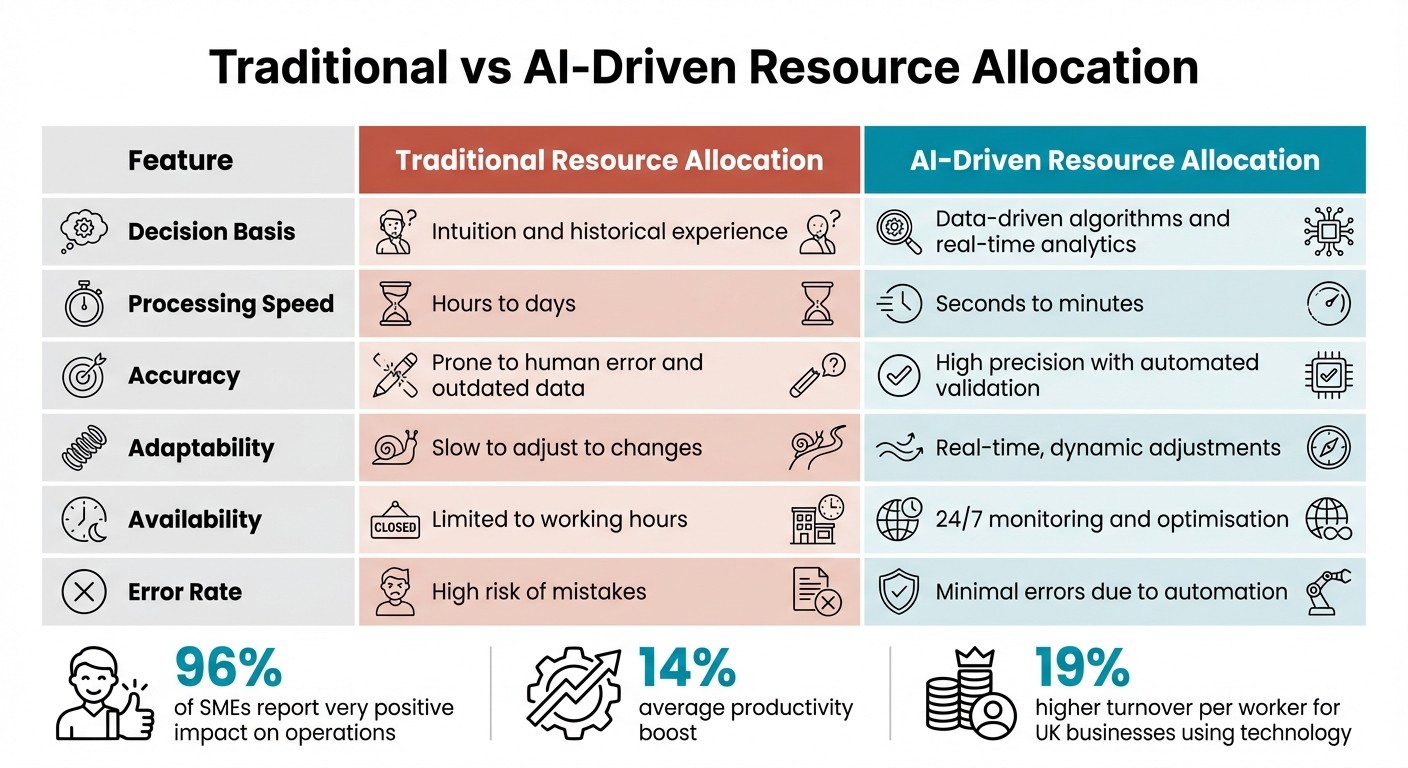
Traditional vs AI-Driven Resource Allocation: Key Differences for UK SMEs
When comparing traditional resource allocation methods to AI-driven approaches, the differences in speed, precision, and flexibility are striking. Traditional methods often depend on intuition and past data, which can introduce bias, errors, and slow responsiveness to changes. On the other hand, AI uses real-time data and predictive algorithms to provide instant, actionable insights.
One major drawback of manual planning is its susceptibility to errors like typos, missing data, and outdated information, all of which can lead to poor decisions. AI tackles these issues head-on by automating data validation and processing vast amounts of information at lightning speed. This difference is reflected in productivity gains - 96% of SMEs that have adopted AI report a very positive impact on their operations, with an average productivity boost of 14%. These improvements ripple across areas like budgeting, workforce management, and supply chain operations.
"AI can take the guesswork out of resource allocation." – TechRound Team
Another key advantage of AI is its ability to operate continuously and adapt swiftly. Traditional systems are limited by human working hours and often struggle to respond to sudden market changes or operational disruptions. In contrast, AI runs 24/7, constantly monitoring resources and making real-time adjustments. For instance, it can reallocate staff during peak times or adjust inventory levels to meet unexpected demand. This capability delivers tangible results: 87% of executives say AI improves employee efficiency, while 72% observe enhanced overall performance.
Feature | Traditional Resource Allocation | AI-Driven Resource Allocation |
|---|---|---|
Decision Basis | Intuition and historical experience | Data-driven algorithms and real-time analytics |
Processing Speed | Hours to days | Seconds to minutes |
Accuracy | Prone to human error and outdated data | High precision with automated validation |
Adaptability | Slow to adjust to changes | Real-time, dynamic adjustments |
Availability | Limited to working hours | 24/7 monitoring and optimisation |
Error Rate | High risk of mistakes | Minimal errors due to automation |
For UK SMEs, the financial benefits of AI are hard to ignore. By streamlining lead management and automating repetitive tasks, AI can cut operational costs by up to 20%. Additionally, 93% of SMEs report increased profitability after adopting AI solutions. This shift from reactive decision-making to predictive optimisation doesn't just boost efficiency - it also creates a solid foundation for long-term growth.
Conclusion: How AI Solves Resource Allocation Problems
Small and medium-sized enterprises (SMEs) in the UK often grapple with issues like budget mismanagement, workforce scheduling conflicts, inventory inefficiencies, and bottlenecks in capacity planning. Traditionally, these challenges have been tackled using intuition, static spreadsheets, or historical data, leaving businesses exposed to errors, slow decision-making, and missed opportunities. AI changes this dynamic by replacing reactive, manual processes with real-time, data-driven decision-making.
The numbers speak for themselves. UK businesses that adopt technology report 19% higher turnover per worker, even when accounting for differences in firm characteristics. Additionally, 75% of SMEs have already made some level of investment in AI, with 76% of them saying it enables their teams to focus on high-value tasks like product development or targeted marketing. These statistics highlight a shift in how SMEs operate, driven by AI's potential.
Experts in the field emphasise this transformation:
"AI doesn't just replace manual labour; it revolutionises operational workflows. This transformation supports innovation and allows SMEs to do more with less." – InterVision Systems
AI solutions directly address the resource challenges SMEs face, offering tools that are especially critical for businesses operating within tight margins and rapidly changing markets. Platforms like AgentimiseAI, for example, use GuidanceAI to deliver executive-level resource insights without the need to hire full-time senior staff.
The urgency to adopt AI is underscored by broader industry trends. By 2026, 90% of supply chain leaders expect to implement intelligent automation. Yet, as of 2023, only 9% of UK firms had embraced AI - though this figure is expected to grow to 22% in 2024. Early adopters are already gaining a competitive edge, proving that AI isn't just about efficiency; it's a strategic move for survival. With AI offering a stronger return on investment compared to manual methods, starting small with a focused pilot in a key area can pave the way for long-term success. The time to act is now.
FAQs
How does AI help SMEs create more accurate budgets?
AI offers small and medium-sized enterprises (SMEs) a way to improve budgeting accuracy through tools that provide advanced forecasting, real-time cash flow analysis, and insights grounded in data. These features help reduce manual errors, sharpen financial projections, and adjust to shifting market conditions with ease.
By examining historical data and spotting trends, AI systems deliver recommendations that align with the specific financial needs of each SME. This allows for smarter decision-making, helping businesses manage resources effectively and create plans that support steady growth.
How does AI improve workforce scheduling?
AI is transforming workforce scheduling by taking over complex tasks and adjusting schedules in real time. It reviews data like staff availability, workload needs, and unforeseen changes to create schedules that are efficient and require fewer manual tweaks, saving administrative time.
By reducing mistakes and improving how resources are allocated, AI ensures staffing matches actual demand. This not only enhances service quality but also helps cut costs. For businesses facing labour shortages or unpredictable workloads, this method supports a more efficient and adaptable approach to workforce management.
How can AI improve inventory management and predict demand more accurately?
AI transforms inventory management and demand forecasting by processing vast amounts of historical and real-time data to identify patterns and predict future requirements with precision. This ensures businesses can maintain the right stock levels, cutting down on both overstocking and shortages.
By automating these tasks, AI reduces human error, trims costs, and ensures resources are used effectively. For small and medium-sized enterprises (SMEs), this translates to more streamlined operations, happier customers, and the agility to respond swiftly to shifting market demands.