
AI Compliance FAQs for UK Business Leaders
27 Apr 2026
UK AI compliance guide: key 2025–26 deadlines, risk levels and actions—map tools, run DPIAs and ensure meaningful human oversight.
AI compliance is now a critical focus for UK businesses. With the Data (Use and Access) Act 2025 taking effect in February 2026 and formal complaint-handling processes required by June 2026, the regulatory landscape is changing fast. Non-compliance could lead to fines of up to 4% of global turnover, making it essential for organisations to act now.
Key points to know:
UK Regulation: The UK uses a sector-specific approach with oversight from bodies like the ICO and FCA. Businesses must follow five core principles: safety, transparency, fairness, accountability, and contestability.
EU Obligations: Companies dealing with EU clients must also comply with the EU AI Act, with high-risk system requirements enforceable by 2 August 2026.
Risk Levels: The UK’s traffic-light system categorises AI systems into RED, AMBER, and GREEN based on sensitivity and decision impact.
Governance: Building an AI inventory, conducting risk assessments, and establishing strong governance frameworks are essential steps.
Vendor Compliance: Contracts must address data sovereignty, human oversight, and clear intellectual property terms to avoid risks.
Next steps for businesses:
Map all AI tools and classify them by risk.
Conduct Data Protection Impact Assessments for high-risk systems.
Update privacy policies and ensure human oversight for critical decisions.
Train leadership teams on AI governance and compliance.
Acting early not only ensures compliance but also positions businesses to innovate responsibly while avoiding costly penalties.
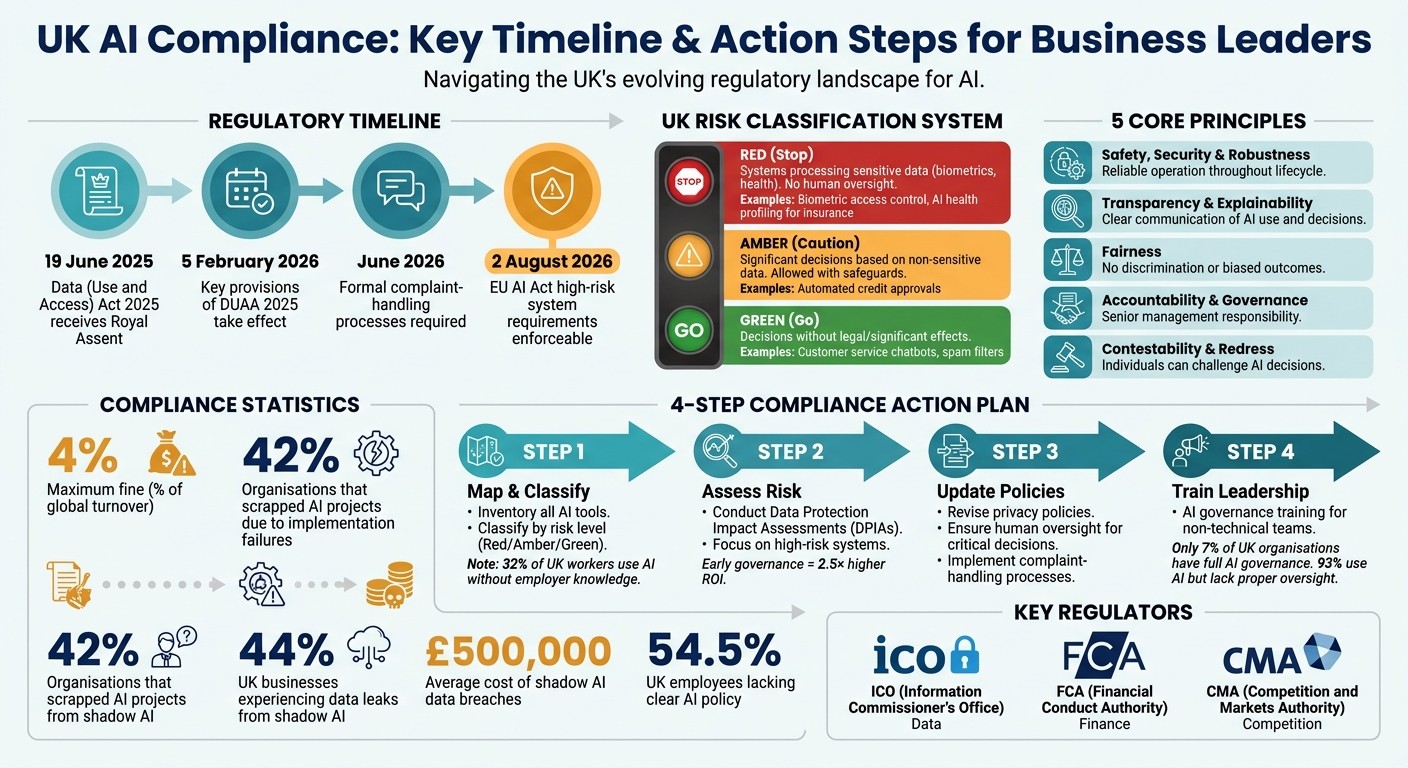
UK AI Compliance Timeline and Action Steps for Business Leaders 2025-2026
Core AI Compliance Principles in the UK
The 5 Principles of UK AI Governance
The UK's approach to AI governance is built around five key principles, enforced by regulators like the ICO, FCA, and CMA.
Safety, security, and robustness ensures that AI systems operate reliably throughout their lifecycle. This involves actively managing risks at every stage. For instance, the FCA requires financial firms to stress-test AI trading algorithms to prevent market instability during volatile periods.
Transparency and explainability demand that organisations clearly communicate when AI is being used and how decisions are made. For example, if an automated system denies credit, it must provide a clear explanation rather than a vague rejection. As the ICO puts it:
"The deployment of an AI system to process personal data needs to be driven by evidence that there is a problem, and a reasoned argument that AI is a sensible solution to that problem, not by the mere availability of the technology."
Fairness tackles the risk of discrimination. AI systems must not infringe on legal rights or produce biased outcomes. A stark example is the 2020 Ofqual A-Level grading algorithm, which unfairly disadvantaged students from state schools and lower-income areas, leading to its abandonment. Similarly, the case of R (Bridges) v. South Wales Police in 2020 highlighted flaws in the Metropolitan Police's facial recognition technology, which was ruled unlawful due to a lack of assessment on potential bias related to race or sex.
Accountability and governance place responsibility for AI decisions squarely on senior management. This cannot be delegated to technical teams. Executives and Data Protection Officers must fully understand the risks associated with AI, as they are legally accountable for compliance. Contestability and redress ensure that individuals can challenge decisions made by AI - whether it's a rejected insurance claim or a recruitment outcome.
By embedding these principles, organisations can innovate responsibly while managing risks effectively.
How to Innovate While Managing AI Risks
Balancing compliance with innovation is possible. The UK's framework is designed to adapt to context - different applications of the same AI technology face varying levels of scrutiny. For example, low-risk uses like article summarisation require less oversight compared to high-risk tasks like providing medical advice.
Conducting Data Protection Impact Assessments (DPIAs) early is crucial for identifying risks before they become unmanageable. For high-risk AI processes, like large-scale monitoring or systematic profiling, the ICO mandates DPIAs by law.
Starting with governance from the outset is not just about compliance - it’s cost-effective. Research shows that embedding controls early can deliver a 2.5× higher return on investment compared to retrofitting systems later or abandoning projects due to unmanaged risks. Alarmingly, nearly 42% of organisations investing in AI have already scrapped initiatives due to implementation failures.
To stay compliant while innovating, integrate recognised frameworks like ISO/IEC 42001 (AI Management System) and ISO/IEC 23894 (Risk Management). These standards provide a structured approach that aligns with UK principles and earns regulatory trust. Above all, maintain real human oversight for critical decisions in areas like recruitment, lending, or insurance. This oversight must go beyond mere formalities - genuine human involvement is essential for accountability and fairness.
Steps to Achieve AI Compliance
How to Classify AI Systems by Risk Level
UK businesses must adhere to both the UK DUAA 2025 and the EU AI Act if their AI systems impact EU users. Start by asking: Does your AI system affect users in the EU? If the answer is yes, it likely falls under these regulations.
The EU AI Act divides AI systems into four risk levels:
Prohibited: Includes practices like social scoring or untargeted facial recognition.
High-Risk: Covers areas such as credit scoring or critical infrastructure.
Limited Risk: Includes tools like chatbots or deepfakes, provided disclosures are made.
Minimal Risk: Encompasses systems like recommendation engines, which have no specific compliance obligations.
The UK DUAA 2025 adopts a simpler traffic-light approach:
RED: Systems processing sensitive data (e.g., biometrics, health information) without human oversight.
AMBER: Systems making significant decisions based on non-sensitive data, allowed only with safeguards.
GREEN: Systems making decisions without legal or significant effects.
Under the UK DUAA 2025, a decision is classified as "solely automated" if it lacks meaningful human involvement. As Ibrahim Mizi from OpenKit explains:
"a 'confirm' button that nobody ever clicks does not satisfy the human oversight requirement."
For example, biometric access control or AI health profiling for insurance would fall into the RED category. Automated credit approvals are typically classified as AMBER, while customer service chatbots or spam filters are considered GREEN.
The EU AI Act's full obligations for high-risk systems become enforceable on 2 August 2026, while prohibited practices have been banned since 2 February 2025. Meanwhile, the UK Data (Use and Access) Act 2025 received Royal Assent on 19 June 2025, with key provisions effective from 5 February 2026.
Once you’ve classified your AI systems by risk level, the next step is to map your tools and identify compliance gaps.
Creating an AI Inventory and Identifying Compliance Gaps
After determining risk levels, the next priority is to gain a clear overview of all AI tools used within your organisation. This is crucial for spotting compliance gaps. You can’t manage what you don’t know exists - this includes "shadow AI", or tools employees use without formal approval. Research indicates that 32% of UK desk workers use AI tools without their employer's knowledge, and 44% of UK businesses have experienced data leaks tied to shadow AI. The average cost of such breaches is estimated at £500,000.
Start with a discovery survey asking all teams to list every AI tool they use. For smaller businesses, a simple Excel sheet or shared drive works well. Record key details like:
Tool name and purpose
Types of data processed
Review procedures in place
Data storage locations
This "One-Page AI and Data Map" should focus on workflows, identifying where personal data flows and where AI-driven decisions occur.
Once your inventory is complete, compare it against relevant compliance frameworks: UK GDPR (Article 22), the DUAA 2025, and the EU AI Act (if applicable). Categorise your AI tools into three groups:
Low Risk: Embedded features like spell-check.
Medium Risk: Enterprise-contracted tools.
High Risk: Consumer tools or those processing sensitive data.
For high-risk tools, document who reviews the outputs to ensure decisions aren’t made solely by automation. Despite 93% of UK organisations using AI, only 7% have fully implemented governance measures, leaving a significant oversight gap. Vendor vetting is also essential - track where vendors store data and whether they use customer prompts to train models. If your business determines the purpose and means of processing personal data via third-party AI tools, you’re acting as the data controller.
Once you’ve mapped your AI landscape, the next step is to establish a governance framework to manage risks effectively.
Building an AI Governance Framework
Strong governance starts with dedicated leadership. Assign a Data Protection Officer (DPO) or a designated lead to oversee AI systems. This person will manage the AI inventory, coordinate technical documentation, and ensure accountability. Organisations that embed AI governance early report 2.5 times higher returns on their AI investments.
Create a multi-layered governance structure that includes:
Executive Steering: Oversight from senior leadership.
AI Governance Office: A central team handling risk, legal, and data issues.
Embedded Teams: Developers and engineers focused on data quality.
Align your framework with global standards like ISO/IEC 42001 (AI Management Systems) or the NIST AI Risk Management Framework, which addresses risks such as performance, security, bias, and transparency. Keep in mind that ISO 27001 certification covers around 30–40% of what the EU AI Act requires for high-risk systems; the remaining 60–70% involves AI-specific measures.
Conduct Data Protection Impact Assessments (DPIAs) before starting any AI processing, as most AI applications are considered high-risk. Map out how data flows across your supply chain and integrate risk checks and bias testing into your development process. Treat compliance as an ongoing effort rather than a final audit step. Senior management should also define and approve the organisation’s risk appetite for AI projects, balancing innovation with potential risks to individuals.
In the UK, sector-specific regulators like the ICO (data), FCA (finance), and CMA (competition) apply core principles relevant to each use case. Document processes for managing updates or security patches to AI systems to avoid data breaches. Formalise job roles that involve AI responsibilities, maintain a centralised AI system inventory, and establish privacy management frameworks. These steps create a structured compliance strategy, allowing UK businesses to meet regulatory demands while continuing to innovate with AI.
Managing Compliance with AI Vendors
Assessing Vendor Compliance Credentials
Ensuring vendor compliance is a key part of any AI governance strategy. When choosing an AI vendor, it's crucial to scrutinise their compliance credentials thoroughly. As one technology solicitor aptly put it:
"Most AI buying mistakes are contract mistakes."
– smedigital.ai
One of the first steps is to confirm data sovereignty. Find out where your data will be processed and stored, and check if the vendor provides UK/EU data residency options, which can simplify adherence to UK GDPR regulations. Additionally, determine whether your data - whether it's prompts, outputs, or fine-tuning data - will be used to train the vendor's models. Enterprise contracts should explicitly include a written opt-out clause for such practices.
Security certifications are another must-have. Instead of relying on marketing claims, ask for proof like SOC 2 Type II reports or ISO 27001 certification, which confirm independent audits. Also, request "model cards" that detail the base model's origin, safety measures, and any known limitations. If the vendor can't clearly explain their governance model in simple terms, consider it a red flag for potential implementation risks. Clarify the controller/processor relationship too. If the vendor determines the "purposes and means" of data processing, they may be a joint controller rather than a processor, which can significantly alter your compliance responsibilities.
Before finalising any agreement, test the AI tool with diverse, real-world data instead of relying solely on the vendor’s demo samples. Look for evidence that the vendor has conducted fairness assessments or bias testing during development. Ensure the data can be exported in a non-proprietary, usable format, and request a deletion certificate upon contract termination to avoid vendor lock-in and ensure a smooth exit strategy.
Once you've verified the vendor's credentials, make sure these standards are enforced through contractual agreements.
Contract Terms for AI Vendor Relationships
Strong contracts are your safety net against compliance risks. Every agreement with an AI vendor should clearly state that intellectual property rights for AI-generated outputs belong to the customer. This avoids potential disputes under the Copyright, Designs and Patents Act 1988. Additionally, include a "no-training" clause to prevent the vendor from using your data to train their models without explicit, written consent. A sample clause might read:
"Supplier shall not use our data or outputs to train, refine or evaluate any model, except in a ring-fenced instance with our prior written consent."
– Lawyerlink
To align with the Data (Use and Access) Act 2025, ensure the contract mandates human oversight, clear explanations for AI decisions, and an appeals process. Specify adherence to standards like SOC 2 Type II and set strict timelines for incident notifications - UK GDPR, for instance, requires notification of personal data breaches within 72 hours. Require the vendor to maintain a live register of all AI components and to provide advance notice (e.g., 30 days) of any significant changes or "model drift" that might affect accuracy or risk levels.
For any AI deployment involving personal data, a signed Data Processing Addendum (DPA) is non-negotiable. To manage token-based billing, negotiate spending caps or trigger alerts at thresholds like 50%, 70%, and 90% of the monthly budget. Ensure you have the right to audit the vendor’s logs and compliance records on demand, which is critical for meeting data subject access requests and regulatory requirements. For high-risk or physically impactful AI systems, include a "kill-switch" clause that allows immediate human intervention. Finally, secure a deletion certificate when the contract ends to avoid being locked into the vendor’s ecosystem.
How AgentimiseAI Supports AI Compliance
AgentimiseAI provides tailored services to help UK SMEs and mid-market businesses navigate AI compliance without the need for deep legal or technical expertise. By connecting regulatory requirements with practical execution, they make AI governance manageable and relevant for organisations of all sizes.
Once you've mapped out your AI landscape and established a governance framework, the next step is implementation. AgentimiseAI focuses on supporting non-technical leaders through three core services, making the process accessible and effective.
AI Leadership Training for Non-Technical Teams
This half-day training session, delivered in straightforward language, equips leaders with actionable AI governance strategies and a ready-to-use policy template. It's especially crucial in a workplace where 54.5% of UK employees lack a clear AI policy, and 32% are already using AI tools without their employer's knowledge.
Henry Green, MD of David Cover & Son Ltd, shared his experience:
"What seemed complex and intimidating was demystified by your expert explanations, making AI's potential truly exciting."
Priced at £1,050 for up to 10 participants, this session transforms non-technical leaders into compliance advocates within their organisations. With only 12% of UK SMEs currently investing in AI training, this programme helps businesses close the gap and stay competitive. For those seeking additional guidance, workshops are also available to further explore compliant AI opportunities.
AI Discovery Workshops for Compliant AI Opportunities
These three-hour, in-person workshops are designed to identify automation opportunities with high returns while embedding compliance from the start. The sessions map out current workflows, highlight bottlenecks, and prioritise potential AI applications based on projected time and cost savings. Participants also receive tailored insights into their organisation's AI readiness, ensuring technical feasibility and regulatory compliance before committing to investments.
Tim Murphy, MD of Murphy McKenna Construction, described the impact:
"We weren't short on ambition when it came to AI, but we lacked direction. Agentimise brought structure to our thinking, helping our leadership focus on actionable, compliant AI opportunities."
Workshops are priced at £1,050 or can be bundled with the Leadership Training for £1,800, offering a 15% saving. This combined approach is particularly valuable given that 93% of UK organisations use AI, yet only 7% have fully embedded AI governance.
Custom AI Agent Development with Built-In Compliance
AgentimiseAI also offers custom AI agent development, ensuring compliance is embedded from the very beginning. These agents integrate seamlessly with existing systems while adhering to the mandatory safeguards under Article 22C of the Data (Use and Access) Act 2025: transparency, challenge, and human oversight. Human-in-the-loop checkpoints allow authorised reviewers to override AI decisions, avoiding classifications of "solely automated" decision-making.
The development process prioritises sovereignty by using UK-based infrastructure and local-first data processing, ensuring UK citizen data stays within national borders. Each decision made by the AI is fully auditable, and high-risk applications - such as those involving health or biometric data - are assessed using a Red/Amber/Green framework.
Pricing for custom AI agent development starts at £1,900, with a clear scope, transparent costs, and ongoing support after launch. This approach provides businesses with AI solutions that are both effective and aligned with regulatory requirements.
Conclusion
Key Points for UK Business Leaders
UK businesses need to prioritise AI compliance without delay. With the UK AI Safety Act in full effect from January 2026 and the Data (Use and Access) Act 2025 requiring formal complaint-handling processes by June 2026, regulatory oversight is now a pressing reality. The UK GDPR remains the cornerstone for managing personal data in AI, with severe penalties for breaches.
As discussed, the UK’s principles-based framework mandates businesses to categorise AI systems by risk, conduct Data Protection Impact Assessments for high-risk applications, and ensure robust human oversight. Despite over 70% of UK businesses adopting or trialling AI solutions, many still lack the governance structures needed to meet these regulatory demands.
"The most successful organisations will be those that view compliance not as a burden but as an enabler of responsible innovation." - AppCoder Software
Next Steps for Your AI Compliance Strategy
To stay ahead, businesses should take concrete steps to strengthen compliance while leveraging it for competitive growth. Start by documenting all AI systems, assessing their risk levels, and identifying areas where compliance needs improvement. Update privacy notices to reflect AI-related processing activities, and for high-risk systems - such as those used in recruitment or credit scoring - implement human-in-the-loop processes and prepare for quarterly reporting to the UK AI Office.
AgentimiseAI offers tailored support to help businesses navigate these challenges. Their AI Leadership Training (£1,050 for up to 10 participants) provides governance strategies for non-technical teams, while AI Discovery Workshops (£1,050, or bundled with training for £1,800) help identify automation opportunities that align with compliance standards. For those ready to launch AI solutions, their Custom AI Agent Development services (starting at £1,900) ensure compliance is integrated from the outset, using UK-based infrastructure with full auditability and human oversight. Early action not only meets regulatory requirements but also transforms compliance into a competitive edge.
FAQs
Are we subject to both the EU AI Act and UK regulations?
UK businesses face the challenge of adhering to both UK regulations and the EU AI Act if their AI systems are either used within the EU or have an impact on EU residents. This is because the EU AI Act has an extraterritorial reach, meaning it applies to organisations even if they are headquartered outside the EU.
What counts as “meaningful” human oversight for AI decisions?
"Meaningful" human oversight is about safeguarding individuals' rights, especially in decisions that carry legal weight or have a major impact on someone's life. It ensures that humans can step in to review, override, or challenge automated decisions when necessary. This process isn't just about having human involvement - it's about making sure that intervention is effective and accountable. Such oversight plays a crucial role in upholding fairness and adhering to data protection laws.
How can we identify and manage 'shadow AI' in our business?
To tackle the challenges of 'shadow AI', the first step is conducting an audit. This helps identify any unauthorised AI tools being used within your organisation. Automated systems can be particularly helpful in providing visibility across various departments and workflows.
Next, establish clear acceptable use policies. These should outline what is and isn’t allowed when it comes to AI tools. Pair these policies with comprehensive training, ensuring employees understand and follow the rules.
Lastly, integrate governance practices into everyday operations. For example, classify AI tools based on their risk levels and maintain detailed AI asset registers. These measures not only reduce risks but also ensure your organisation remains compliant with relevant regulations.