Predictive Analytics for SME Growth
2 Mar 2026
How SMEs can use predictive analytics to forecast demand, reduce costs, improve customer targeting and implement affordable, low-code solutions.

Predictive analytics offers small and medium-sized enterprises (SMEs) a practical way to forecast trends, improve decision-making, and stay competitive in a fast-paced market. By analysing historical data and using tools like machine learning, SMEs can predict customer behaviour, optimise inventory, and reduce costs. Here's how it works:
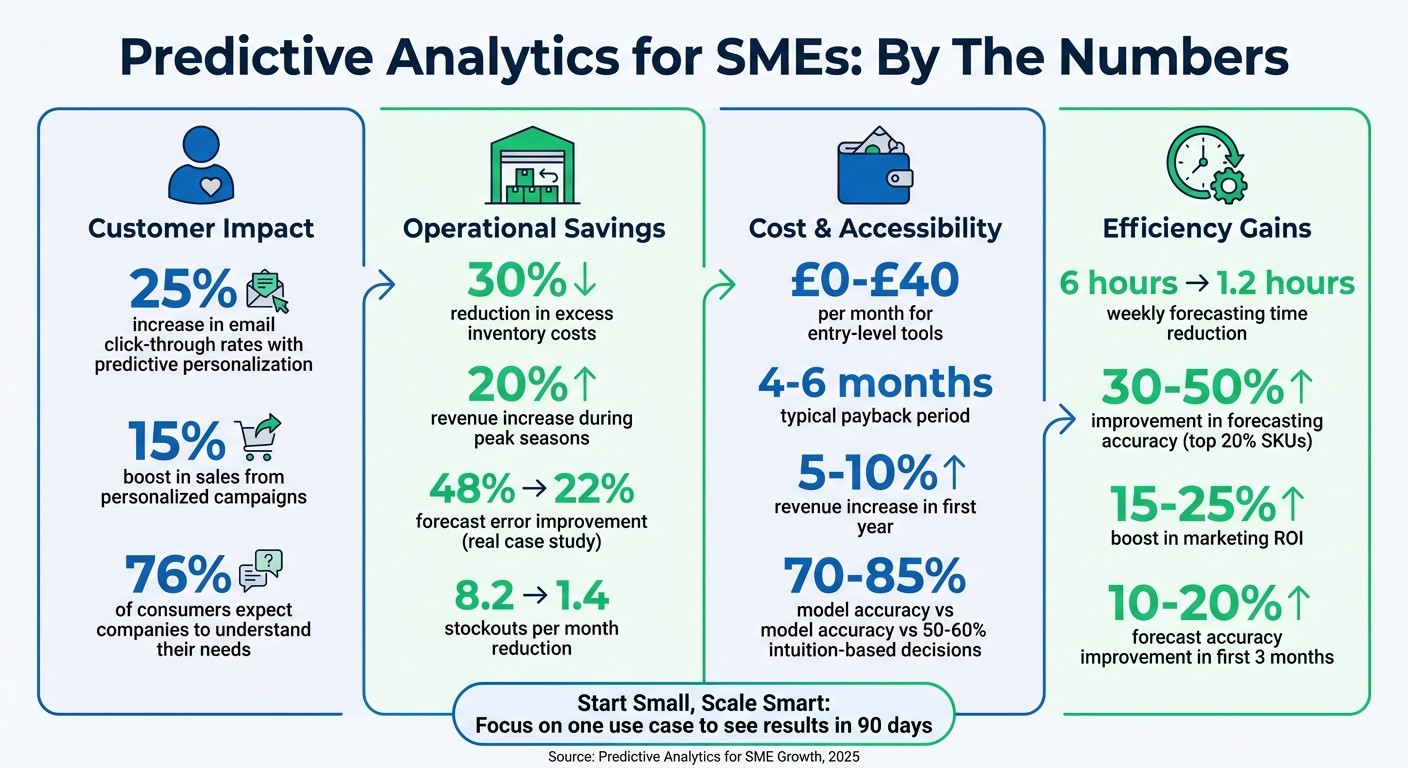
Customer Insights: Predictive models identify buying patterns, segment customers, and forecast churn, helping SMEs improve satisfaction and loyalty. For example, personalised email campaigns can increase click-through rates by 25%.
Operational Efficiency: Tools like demand forecasting cut inventory costs by up to 30% and reduce stockouts. Predictive maintenance also prevents equipment failures, saving time and money.
Affordable Solutions: Entry-level tools like Google Analytics 4 are free, while others, such as Zoho Analytics, start at £20 per month. SMEs can test one use case, like sales forecasting, to see results within 4-6 months.
Overcoming Challenges: Issues like poor data quality and limited technical skills can be addressed with low-code platforms, free training resources, and step-by-step implementation.
Predictive Analytics Benefits and ROI for SMEs: Key Statistics
How Predictive Analytics Helps SMEs
Predictive analytics delivers measurable outcomes that can directly influence your business's success. By shifting from reactive to proactive decision-making, SMEs can gain a competitive edge and achieve sustainable growth in today's fast-paced market.
Better Customer Understanding and Satisfaction
Predictive analytics combines scattered data to uncover future customer preferences. By analysing browsing behaviour, purchase history, and social media activity, businesses can identify patterns that predict what customers are likely to want next. This insight allows SMEs to engage with customers proactively, improving satisfaction and loyalty while reducing the risk of losing them to competitors.
Using clustering and classification models, businesses can segment customers into groups like "likely to convert" or "at risk of churn", enabling more focused marketing strategies. For example, if data shows that customers receiving frequent out-of-stock notifications are likely to stop using your service, you can address this issue before it becomes a problem. Additionally, Customer Lifetime Value (CLV) forecasting helps identify high-value customers who can be prioritised with loyalty programmes or VIP services. Predictive personalisation in email campaigns has been shown to increase click-through rates by 25% and boost sales by 15%.
Improved Operations and Lower Costs
Predictive analytics isn't just about understanding customers - it also streamlines operations. Demand forecasting uses past sales data, seasonal trends, and external factors to optimise stock levels, avoiding costly stockouts and reducing the expense of excess inventory. Businesses that optimise inventory management can cut excess stock by 30% and increase revenue by 20% during peak seasons.
A real-world example comes from a UK-based garden centre. By leveraging predictive models to adjust marketing spend and inventory ahead of a poor weather season, they avoided a 20% drop in margin. Predictive analytics also extends to other areas, such as predictive maintenance, which identifies potential equipment failures before they occur, reducing downtime and prolonging machinery lifespan. Even staff scheduling can benefit, as analytics forecast business activity levels to ensure adequate staffing during busy periods while controlling labour costs during quieter times. These operational improvements not only save money but also strengthen your position in the market.
Staying Ahead of Competitors
Speed and precision are key to staying competitive. While others react to market changes after they happen, predictive analytics enables you to anticipate them. For instance, dynamic pricing models adjust prices in real-time based on competitor actions, current demand, and stock levels, ensuring your pricing remains competitive without compromising margins. By identifying shifts in customer preferences and seasonal trends ahead of time, you can align your offerings with future demand instead of playing catch-up.
Strategic modelling takes this one step further by allowing you to evaluate the financial impact of decisions - such as launching a new product or changing prices - before taking action. Modern machine learning algorithms enhance this process by incorporating external factors like weather forecasts and market trends, offering more accurate predictions than relying solely on historical data. When combined with the customer insights and operational efficiencies mentioned earlier, this comprehensive approach positions SMEs for smarter, faster decisions that drive growth. Instead of merely reacting, you're planning for what's next with confidence.
Overcoming Barriers to Predictive Analytics
Breaking down common obstacles allows businesses to tap into the potential of predictive analytics, leading to sharper customer insights and operational savings. Despite its clear benefits, many SMEs remain hesitant to embrace predictive tools, often due to perceived challenges. The good news? These hurdles can be tackled with practical, straightforward solutions.
Budget Limitations and Cost Concerns
Historically, predictive analytics required expensive software and highly specialised skills. But times have changed. Today, entry-level tools are far more affordable, with costs ranging from £0 to £40 per month. For example, Google Analytics 4 is completely free, while Zoho Analytics starts at around £20 per month. For businesses seeking more advanced options, mid-tier solutions like IBM Watson Analytics begin at approximately £25 per user monthly. If setup support is needed, consultants typically charge a one-off fee of £400 to £1,600.
Economic pressures, such as higher National Insurance contributions and rising minimum wages expected by 2025–2026, have tightened budgets for many SMEs. To minimise financial risks, businesses can focus on a single high-impact use case, like sales forecasting, to prove the value of predictive analytics before committing further. This approach often delivers results quickly – with payback periods of just four to six months – and many SMEs report revenue increases of 5–10% within the first year. Start by auditing existing data from systems like POS, CRM, and accounting tools to identify gaps, avoiding unnecessary costs while building a reliable data foundation. This small-scale approach makes predictive analytics accessible, even for those with limited budgets.
Limited Technical Skills
Concerns about technical expertise shouldn’t hold SMEs back. Modern platforms are designed to simplify analytics, removing the need for advanced skills. Low-code and no-code tools provide drag-and-drop interfaces and automated insights, meaning users don’t need to understand SQL or complex statistics. Conversational AI has made things even easier, enabling users to query databases in plain English rather than navigating complicated dashboards. Additionally, many tools come with ready-made templates tailored to specific industries, streamlining the setup process.
Rather than hiring a specialist, businesses can appoint a "data champion" from their existing team. This person doesn’t need to be a full-time analyst but should have a solid understanding of the business and a curious mindset. Free training resources, such as Google Analytics Academy or Microsoft Learn for Power BI, can help them get up to speed. If extra support is needed, consultants can assist with initial setup and integration. As Tipu Makandar from MyPulse explains:
"The barrier is rarely technical. Tools like Pulse and even advanced Excel templates now offer predictive capabilities that were science fiction a decade ago. What's missing in most SMEs is strategic intent."
Poor Data Quality and System Integration
Even with the right tools, poor data quality can remain a stumbling block. Many SMEs struggle with scattered or incomplete data, but this challenge can be addressed step by step. Start by consolidating existing records from systems like POS, CRM, and web analytics. While having 12–24 months of historical data is ideal, reliable forecasts can often be generated with just three to six months of records.
Data cleaning is a crucial step, involving tasks like filling in missing values, correcting inaccuracies, and ensuring consistent formatting. Though this process can take up to 80% of an analyst’s time, low-code platforms now automate much of the work. For example, forecasting plugins integrated into accounting software like Xero or QuickBooks can help SMEs make sense of their data. These platforms often include features like proactive cash flow or inventory alerts, making it easier to act on insights.
To maintain data quality and ensure compliance with regulations such as GDPR, establish clear data governance policies from the outset. By starting with a small, manageable project, businesses can build confidence in predictive analytics and gradually expand their efforts as they see results.
How SMEs Can Use Predictive Analytics
With fewer barriers to entry, SMEs can now harness predictive analytics to address everyday growth challenges effectively. By starting with a single, practical application, businesses can achieve measurable outcomes quickly. These methods can make a real difference in areas like inventory management, customer targeting, and resource allocation - key factors in driving SME growth.
Forecasting Demand and Managing Inventory
Predictive models take the guesswork out of inventory management. Machine learning tools like SARIMAX or Prophet analyse historical data alongside variables such as weather and local events to uncover demand trends. Take the example of Lena Chen, who owns "Maple & Mortar", an apothecary in Asheville. In February 2026, she implemented a SARIMAX model using Python to optimise her stock of handmade soaps and tinctures. By factoring in local weather and seasonal wellness trends, Lena reduced her forecast error (MAPE) from 48% to 22% within 90 days. This led to a 19% cut in inventory costs and a sharp drop in stockouts for her top 15 products - from 8.2 to 1.4 incidents per month.
Focusing on the top 20% of SKUs, which typically account for 70–80% of inventory value, can improve forecasting accuracy by 30–50%. It also slashes the time spent on weekly forecasting from over six hours to just 1.2 hours. However, full automation isn't always the answer. Predictive models should highlight anomalies and measure uncertainty, leaving final decisions to the business owner. As Dr. Arjun Mehta, Director of Applied AI at the National Retail Federation, explains:
"Small businesses don't fail from bad AI - they fail from unchallenged AI. The model's job is to surface anomalies and quantify uncertainty - not to replace the owner's knowledge of their customers' behaviour."
Segmenting Customers and Targeting Marketing
Predictive analytics allows SMEs to segment customers based on likely behaviours rather than just past demographics. This enables businesses to identify high-conversion prospects, predict churn, and determine which customer groups offer the highest lifetime value. For instance, lead scoring can pinpoint potential buyers, while churn models can detect warning signs - like repeated out-of-stock notifications - that suggest a customer might leave.
In fact, 76% of consumers expect companies to understand their specific needs and preferences. Predictive segmentation also helps SMEs calculate the "Cost to Serve" for different customer segments. This means distinguishing between "Gold Tier" clients - those who generate high revenue with minimal effort - and customers who drain resources and reduce profits. By focusing marketing efforts on the most profitable segments, businesses can maximise their return on investment and allocate resources more effectively.
Allocating Resources and Improving Efficiency
Predictive analytics can help SMEs prioritise resources where they’re needed most, often preventing issues before they arise. For example, businesses can forecast demand to create efficient staff schedules, ensuring peak periods are covered while avoiding unnecessary labour costs during quieter times. Similarly, analysing payment patterns can highlight potential cash flow gaps weeks in advance.
A great example comes from a UK-based garden centre chain in May 2025. Using predictive analytics, they modelled the financial impact of an expected poor summer. By linking weather forecasts with historical sales data, the chain adjusted its marketing budget and rebalanced inventory ahead of time. This proactive approach helped them avoid the 20% margin drop that hit competitors relying on traditional methods.
Many businesses already have predictive tools built into platforms like Xero, QuickBooks, Shopify, or Salesforce. Auditing these systems can uncover untapped features. Starting small - such as reducing late payments or optimising a single product category - can validate the model before scaling up. If using public AI tools like ChatGPT or Claude for analysis, be sure to remove sensitive data and use CSV exports of transaction records.
Steps to Implement Predictive Analytics in Your SME
Diving into predictive analytics doesn't mean upending your entire business. A step-by-step approach is all you need - start by evaluating your current setup, test a single use case, and gradually expand based on what works. This method reduces risks and builds team confidence along the way.
Assess Your Current Capabilities
Begin by taking stock of your existing resources. Define the business problem you want to solve. Are you trying to stabilise cash flow over the next three months? Or perhaps you're looking to identify your most profitable customer segments?
Audit your tools - point-of-sale systems, CRM platforms, website analytics, and accounting software like Xero or QuickBooks. Look out for issues like duplicate entries, unorganised data, or information stuck in silos. Ideally, you'll need 12–24 months of historical data, but even 3–6 months can work for basic models. Be prepared for data cleaning to take up a significant chunk of your time.
Next, evaluate your team's skills. Do you have someone who can act as a "data champion"? They don't need to be a data scientist, but they should understand your business needs and feel comfortable with low-code tools. Also, assess your technical setup. Older systems without proper APIs can slow things down, and you'll need to budget for both initial setup and ongoing maintenance. Keep in mind that deployment costs typically make up only 40% of the total expense, with the rest going to tasks like data preparation and model fine-tuning.
Capability Area | Assessment Criteria | Target Benchmark |
|---|---|---|
Data History | Months of accessible historical records | 12–24 months (ideal) |
Data Quality | Duplicates, silos, or unlabelled data | Clean, consolidated, and labelled |
Technical Debt | Compatibility of legacy systems with modern APIs | API-ready or middleware-compatible |
Human Capital | Staff data literacy and "Data Champion" role | Able to use low-code/no-code tools |
Budget | Maintenance and additional costs | 15% extra for monthly upkeep |
Once you've mapped out your capabilities, you're ready to test a specific use case.
Test with a Single Use Case
With your groundwork in place, start small. Sales forecasting is a great first step because it uses existing data and delivers quick results. Focus on a clear, time-bound goal - like predicting cash flow for the next 45 to 90 days.
Before investing in new software, explore predictive features in tools you already use. For instance, Excel's Analysis ToolPak or add-ons for cloud accounting platforms often come with basic forecasting functions. If you're considering new platforms, try free trials of low-code analytics tools and experiment with their pre-built templates.
Predictive models in small businesses often achieve 70–85% accuracy, compared to the 50–60% accuracy of intuition-based decisions. Some SMEs using predictive analytics for customer scoring have seen a 15–25% boost in marketing ROI. During this pilot phase, adopt a "tweak and iterate" approach: build a simple model, measure its accuracy, and refine it. Many SMEs report a 10–20% improvement in forecast accuracy within the first three months, with payback periods of four to six months.
"The advantage doesn't come from sophistication - it comes from relevance and timing."
Once you've seen success in this initial test, you can look at expanding the approach.
Expand and Refine Your Approach
After proving the value of your first use case, it's time to scale up. This could include areas like inventory management, churn prediction, or more advanced cash flow modelling. Collaboration is key at this stage - bring in teams from operations, marketing, and sales to ensure that insights are turned into actionable strategies.
You might also want to add external data sources, such as weather forecasts, market trends, or competitor pricing, to improve accuracy. However, predictive models need regular updates to stay effective. Allow for an additional 15% in your monthly budget for maintenance and tuning.
As you automate more processes, consider using Human-in-the-Loop (HITL) systems. These systems let AI handle routine decisions but escalate uncertain cases to a human. Raja Sekar, CTO of Troniex Technologies, advises:
"Most agencies will sell you a 'fully autonomous' bot. Don't buy it. We build 'Escalation-First' agents. If the AI is only 80% sure, it asks a human."
When deciding what to automate next, use the "30-Minute Intern Rule": focus on repetitive, simple tasks that a human intern could learn in half an hour. If a project doesn't show measurable results within 90 days, consider pausing or ending it to save resources. Finally, develop leaders within your team who can bridge the gap between technical insights and business strategy.
Conclusion: Growing Your SME with Predictive Analytics
Predictive analytics is no longer just an option for SMEs - it’s a critical tool for staying competitive in 2025 and beyond. As Tipu Makandar from MyPulse puts it, this technology has shifted from being a luxury to an essential resource for small businesses. It allows businesses to stop just reacting to past events and start planning for what’s next, turning reactive problem-solving into proactive strategy.
The benefits speak for themselves. Take Homespun Boutique, for example - a small fashion retailer that cut excess inventory by 30% and saw a 20% revenue boost during peak seasons by analysing past sales and seasonal trends. Or Tech Haven, a small electronics shop, which achieved a 25% increase in email click-through rates and a 15% rise in overall sales using personalised marketing powered by predictive models. These examples highlight how even resource-limited SMEs can unlock growth by combining the right data with accessible tools.
What’s changed? Barriers like high costs and technical expertise are no longer deal-breakers. With cloud-based, low-code platforms, you don’t need a team of data scientists or a massive budget. All it takes is clean data from your existing systems, a clear business problem to address, and a willingness to start small and expand gradually.
Here’s another key fact: 76% of consumers expect businesses to understand their needs and preferences. Predictive analytics equips you to meet those expectations while optimising your operations, reducing costs, and protecting your cash flow. Whether it’s forecasting demand, identifying customers at risk of leaving, or modelling how market changes might affect your finances, this technology helps you make faster, smarter decisions.
The next steps are straightforward: evaluate your current capabilities, start with a single, manageable use case, and scale up based on what works. As Malcolm Gladwell famously said:
"Success is not a random act. It arises out of a predictable and powerful set of circumstances and opportunities".
Predictive analytics gives you the insight to create those circumstances and seize opportunities before your competitors do. By taking small, strategic steps and scaling intelligently, SMEs can turn predictive analytics into a powerful edge in today’s fast-paced market.
FAQs
What data do I need to start predictive analytics?
To dive into predictive analytics, you first need high-quality, relevant data. This might include historical records on things like customer behaviour, sales patterns, inventory levels, or market trends. The data should be clean, well-organised, and pulled together from various sources - think CRM systems, financial tools, or eCommerce platforms.
On top of that, you'll need the right tools to make sense of the data. Machine learning models can help uncover patterns, while data visualisation platforms make it easier to interpret and act on the insights you uncover. Together, these elements form the backbone of effective predictive analytics.
How do I keep forecasts accurate as my business changes?
Maintaining accurate forecasts means leveraging predictive analytics that can adjust to shifting data and market dynamics. AI-powered tools play a crucial role here, as they process both historical and real-time data to spot trends and refine predictions. To keep forecasts relevant, it's important to frequently update data sources, ensure the information is reliable, and fine-tune models to account for market changes and evolving customer behaviour. These steps help align predictions with the ever-changing demands of your business.
How can I use predictive analytics without risking GDPR breaches?
If you're planning to use predictive analytics, it's crucial to handle data responsibly and stay aligned with GDPR regulations. Here are some key practices to keep in mind:
Anonymise or aggregate personal data: Strip away identifiable details to ensure individuals cannot be traced back through the data.
Obtain explicit consent: Make sure users clearly agree to how their data will be used, leaving no room for ambiguity.
Opt for tools that support local data processing: This helps keep sensitive information within the jurisdiction and under stricter control.
Additionally, it’s essential to regularly review your data handling practices, adopt robust security measures, and stay informed about updates to GDPR rules. These steps can help reduce risks while allowing SMEs to harness predictive analytics effectively for growth.