What a Modern Executive Coach Should Be Offering You in 2026
11 May 2026
Modern executive coaches use AI, real‑time support, virtual delivery and industry expertise to speed decisions and improve leadership ROI.

In 2026, executive coaching has evolved to meet the demands of fast-paced leadership roles. Leaders now require real-time support, AI-driven tools, and industry-specific expertise to navigate complex decisions and manage hybrid teams of humans and AI. Traditional fortnightly sessions no longer suffice, as they fail to align with the immediacy of modern challenges.
Here’s what you should expect from a modern executive coach today:
Real-Time Support: Reflex coaching offers targeted guidance exactly when you need it, not just during scheduled sessions.
AI Integration: Advanced tools provide instant feedback, automate follow-ups, and assist with routine decisions, freeing up coaches to focus on critical issues.
Customised AI Assistants: AI systems tailored to your coach’s methods offer 24/7 access to their thinking, helping you make informed decisions between sessions.
Virtual Accessibility: Remote-first coaching ensures support across time zones and schedules.
Industry Expertise: Coaches with deep knowledge of your sector’s challenges, like AI governance or ethical dilemmas, provide actionable advice.
What a Modern Executive Coach Should Provide
Coaching that relies solely on scheduled, retrospective sessions no longer meets the demands of today's leaders. By 2026, executives should expect their coaches to blend human insight with data-driven tools, virtual accessibility, and industry-specific expertise that reflects the complexity of their roles. This combination of personalised guidance and advanced analytics addresses the pressing challenges of modern leadership.
Data-Driven Feedback and Performance Assessments
Coaching has moved beyond relying on gut instincts and anecdotal observations. Today’s coaches utilise AI-powered platforms that integrate seamlessly into your digital workflow - tools like calendars, Slack, or Microsoft Teams - to deliver real-time performance insights. These platforms analyse conversation patterns, sentiment shifts, and even biometric data, creating a dynamic leadership performance dashboard.
For example, platforms like Cloverleaf incorporate DISC, Enneagram, and CliftonStrengths data to provide tailored, proactive nudges. AI note-takers go a step further, capturing coaching sessions in real time and breaking them down into actionable tasks, accountability reminders, and emotional highlights. This approach doesn’t replace a coach’s judgement but complements it with long-term analytics that track behavioural changes over time. Studies reveal that nearly 75% of high-performing coaching businesses now use AI tools, with 45% reporting that these tools significantly enhance their services. In short, data-driven feedback has become the new standard.
Virtual Delivery and Remote Access
The hybrid-first approach is reshaping coaching. Executives working across time zones need support that extends beyond scheduled calls - whether it’s 6am in Singapore or late at night in London. Modern coaches meet this need using AI agents and digital platforms that offer 24/7 engagement. This goes far beyond traditional one-on-one sessions, ensuring timely guidance whenever it’s required.
The benefits are tangible. For instance, ServiceNow cut onboarding time for 8,000 sales staff from three months to just six weeks using an AI sales coach - a 50% reduction. Similarly, Braintrust leveraged the Yoodli AI platform to create an "AI oncologist" persona for a pharmaceutical client. This allowed sales reps to practise complex clinical conversations, improving their ability to connect personally from 10% to 84% in just three months. Virtual tools also include AI-driven translation and adaptive microlearning, which enhance knowledge retention by 25–60% compared to traditional methods. This means coaches can effectively support global teams and individuals who speak different languages, all without overextending themselves. As a result, you get guidance that works around your schedule, no matter where you are.
While virtual tools ensure constant availability, the best coaches also bring a deep understanding of your industry’s unique challenges.
Industry-Specific Knowledge and Experience
General leadership advice won’t cut it when you’re dealing with sector-specific regulations, ethical dilemmas, or market pressures. For instance, a coach working with FTSE 100 leaders must be well-versed in the EU AI Act, governance frameworks, and the strategic implications of autonomous AI in finance. Meanwhile, a coach guiding a tech startup founder needs expertise in rapid scaling, investor relations, and managing hybrid teams.
Modern coaches combine real-time data and virtual accessibility with specialised industry knowledge, enabling them to address complex, specific challenges. By 2026, 60% of Fortune 100 companies are expected to appoint heads of AI governance, and 40% of enterprise applications will include task-specific AI agents. This means coaches need to understand regulatory and ethical considerations unique to your field, as well as how to guide leaders in managing hybrid teams of humans and AI. They should also anticipate the broader effects of technology adoption - like shifts in job meaning or burnout risks - and help you develop "change fitness" to tackle emerging obstacles.
When choosing a coach, make sure they’ve worked with leaders in similar roles and industries. A coach who understands your market’s constraints and opportunities will provide actionable advice tailored to your needs, not generic theories.
Continuous Decision Support Through AI
Scheduled coaching sessions often leave gaps where critical decisions are made without the benefit of reflective guidance. By the time the next session rolls around, you might already have chosen a path - potentially missing out on insights that could have led to a stronger outcome. This is where continuous AI support steps in, building on the AI-driven coaching principles discussed earlier.
Private AI Trained on Your Coach's Thinking
The year 2026 marks a shift towards AI assistants that are tailored to reflect a specific coach's methods, moving away from generic AI models. These private systems allow coaches to upload their unique frameworks, session notes, videos, and proprietary tools into a custom AI model. The result? An assistant that mirrors the coach’s tone, asks the same reflective questions, and applies their intellectual approach - all available 24/7.
This isn’t just another chatbot; it’s a personalised assistant designed to think like your coach. Advanced platforms now incorporate long-term memory, enabling them to recall past challenges and provide contextually relevant advice. Integrated with tools like Slack, Teams, or your calendar, the AI can deliver timely, structured prompts. For example, if you have a board meeting at 14:00, the system might nudge you with preparation tips based on your coach’s strategies for high-stakes communication.
The impact of this between-session AI support is clear: clients using it achieve their goals 34% more effectively than those relying solely on scheduled sessions. Instead of waiting days to address a challenge, you can tap into your coach’s thinking in real time and use your next live session to fine-tune the results.
With a personalised AI assistant, making faster, more informed decisions becomes part of your daily routine.
Making Better Decisions Faster
AI tools aren’t here to replace your judgement - they’re here to refine your decision-making process. When time is tight, the assistant applies your coach’s framework to help you identify blind spots, weigh trade-offs, and consider reflective questions that encourage clearer thinking. Ethan Mollick, a professor at Wharton, sums it up well:
"For any intellectual task that you think AI may be able to do that takes more than a few hours, assign the task to the AI, then check the work later."
This approach works just as effectively for leadership decisions. You can outline the context, let the AI suggest an initial strategy based on your coach’s methodology, and then refine it during your next session. This "assign and review" method has become a go-to for executives leveraging AI-augmented coaching. While human oversight remains critical - especially for decisions involving empathy, ethics, or office dynamics - this process significantly speeds up decision-making and ensures a well-structured starting point.
Executives who engage in daily AI coaching check-ins report achieving their goals 2.3 times faster than those who check in weekly. By offering guidance in the moment, when decisions are being made, these tools remove barriers and integrate seamlessly into the flow of work.
The Return on Investment from Modern Coaching
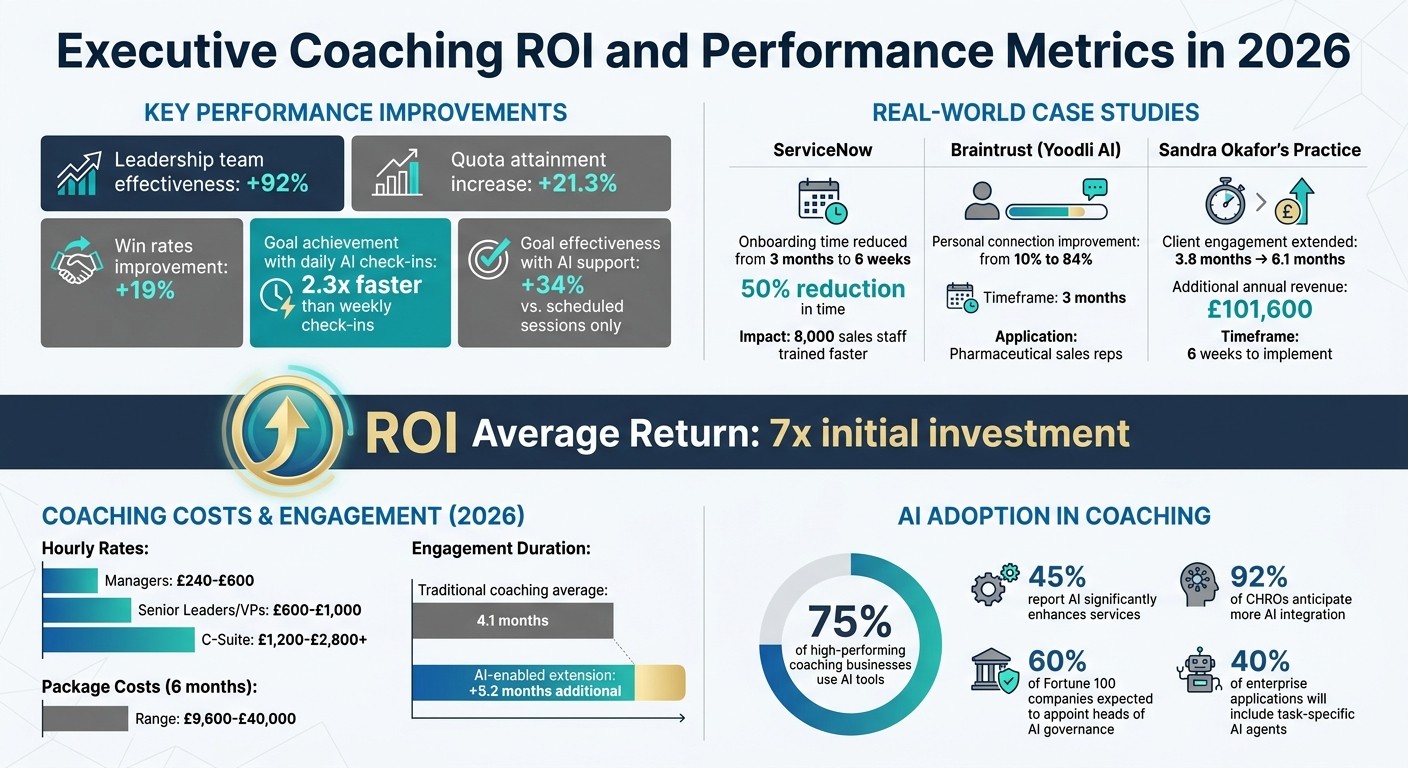
Executive Coaching ROI and Performance Metrics in 2026
Measurable Improvements in Leadership and Business Performance
Executive coaching today delivers results you can actually measure - results that directly influence your organisation's performance. For example, modern coaching techniques can boost leadership team effectiveness by 92%, increase quota attainment by 21.3%, and improve win rates by 19%. These aren't just abstract claims; they're tied to key business metrics like employee engagement, retention, and operational efficiency.
In 2026, ServiceNow's AI sales coach cut onboarding time from three months to just six weeks - a 50% reduction - by focusing on skill-based metrics. Similarly, Sandra Okafor, who runs a £960,000 executive coaching practice, used an AI-driven retention system to extend her average client engagement from 3.8 months to 6.1 months in only six weeks. This change brought in an additional £101,600 in annual revenue, all without needing to bring in new clients. With continuous AI support, leaders can solve problems in real time, make faster decisions, and avoid costly mistakes. This kind of support ensures that insights are timely and actionable, driving tangible improvements across the board.
Typical Costs and Engagement Timelines
Now that the measurable benefits are clear, let’s look at what you can expect in terms of costs and timelines.
In 2026, executive coaching fees vary depending on the leader's level of authority and the potential risks tied to their decisions. For managers, hourly rates range from £240 to £600, while senior leaders and VPs pay between £600 and £1,000 per hour. C-suite executives can expect rates from £1,200 to £2,800+ per hour. For a six-month coaching package, costs typically fall between £9,600 and £40,000, depending on the complexity of the challenges being addressed.
The most effective programmes today combine scheduled sessions with ongoing AI support, giving leaders the chance to test and refine their decisions between meetings. While traditional coaching engagements average 4.1 months, AI-enabled approaches extend this by an additional 5.2 months on average. For senior leaders, a 12-month commitment is often recommended to allow for proper assessment, experimentation, and reinforcement. With an average ROI of about seven times the initial investment, executive coaching proves to be a smart financial decision, particularly when weighed against the costs of unresolved leadership issues and poor decision-making.
What to Look for in Your Executive Coach
Traditional coaching methods often fall short in today’s fast-paced decision-making environment. As you evaluate a coach in 2026, one of the first things to consider is whether they use AI tools tailored to your specific business and relationship context. Generic solutions won’t cut it anymore. A modern coach should demonstrate how they integrate these tools into their approach, offering personalised AI support between sessions. Look for someone who is not just technically skilled but also capable of using AI to analyse results, uncover biases, and align insights with your strategic objectives.
It’s also important to see if their methods fit seamlessly into your existing routines. The most effective AI-enabled coaching complements practices you already have in place, like Monday planning sessions or Friday reflections, rather than forcing you to adopt entirely new workflows. Check whether they track meaningful behavioural indicators (KBIs), such as how often you hold one-to-one meetings or test difficult conversations, instead of focusing on superficial metrics. Transparency is key - ensure they clearly outline which outputs are AI-generated and keep a "human-in-the-loop" for sensitive matters. If a coach spends more than 30% of a session talking, it might signal a shift from collaborative facilitation to directive advising, which could limit your growth.
Another crucial factor is whether they understand the dynamics of hybrid teams, where human employees work alongside AI agents. With 92% of CHROs anticipating more AI integration in their organisations, your coach should not only acknowledge this trend but actively guide you through it. If your current coaching setup relies solely on fortnightly calls with no additional support in between, it’s worth questioning whether it meets the demands of 2026 leadership. Modern coaching should offer ongoing decision-making support, leveraging tools like GuidanceAI for continuous engagement.
How GuidanceAI Extends Your Coach's Availability
GuidanceAI illustrates how technology can bridge the gap between live coaching sessions. This platform is designed for those moments when you need quick advice, reassurance, or a space to organise your thoughts before your next meeting with your coach. Unlike generic AI assistants, GuidanceAI is customised to reflect your coach’s unique methodology and built on the foundation of your established relationship.
The platform offers a safe environment to explore bold ideas or practise difficult conversations without any real-world consequences. Because it mirrors your coach’s insights, it ensures consistency with the guidance you’ve already received. Whether you’re preparing for a critical board meeting at dawn or weighing a major decision late on a Sunday, GuidanceAI provides continuous access to the same strategic thinking your coach has honed over months or years. When assessing a coach, ask whether they offer this kind of AI-enabled, round-the-clock support to enhance your leadership journey.
FAQs
How do I know if a coach’s AI support is truly personalised?
When AI supports a coach, it truly becomes personalised by aligning with your individual leadership style and offering clear, tailored guidance. The focus should be on building consistent daily habits that nurture long-term skill development. Choose tools that provide insights directly relevant to your unique goals and requirements.
What data will coaching AI tools access about me at work?
AI coaching tools tap into work-related data to tailor leadership development to your specific needs. They assess factors like performance metrics, behaviour trends, communication habits, decision-making styles, and even feedback from your peers. By examining long-term session data, these tools can also offer forward-looking insights to guide your growth. Importantly, they function within strict ethical boundaries, ensuring data privacy and security remain a top priority - especially under the UK's rigorous data protection laws.
How can I measure coaching ROI in my role?
To gauge the return on investment (ROI) of coaching, focus on key metrics like performance improvements, engagement duration, and client retention. AI tools can play a significant role here, offering ways to quantify progress and identify signs of disengagement. These tools have been shown to boost client retention by up to 34% and extend coaching engagements by more than 5 months. By prioritising measurable outcomes, you can better assess the value your coaching delivers.