
How to Get More From Your Executive Coach Between Sessions
7 May 2026
Turn coaching insights into results: set SMART goals, prepare agendas, track one priority action, and use coach-specific AI between sessions.

Executive coaching only works when you put insights into action. Most people forget 80% of what they’ve learned within a week if they don’t follow up with deliberate steps. The real progress happens not during the session but in the days after, as you apply new ideas, reflect, and adjust. Here’s how you can make the most of your coaching and stay on track:
Set clear goals: Define specific, measurable objectives that align with your priorities. Use the SMART framework to focus on what you can control.
Prepare and follow up: Come to sessions with a clear agenda and document key takeaways immediately after. This prevents "coaching amnesia" and keeps insights actionable.
Take small, focused actions: Choose one behaviour to work on before the next session. Track your progress weekly to stay accountable.
Leverage technology: Tools like AgentimiseAI can provide personalised support between sessions, ensuring you don’t lose momentum.
Coaching success depends on consistent effort. These steps will help you turn advice into lasting growth.
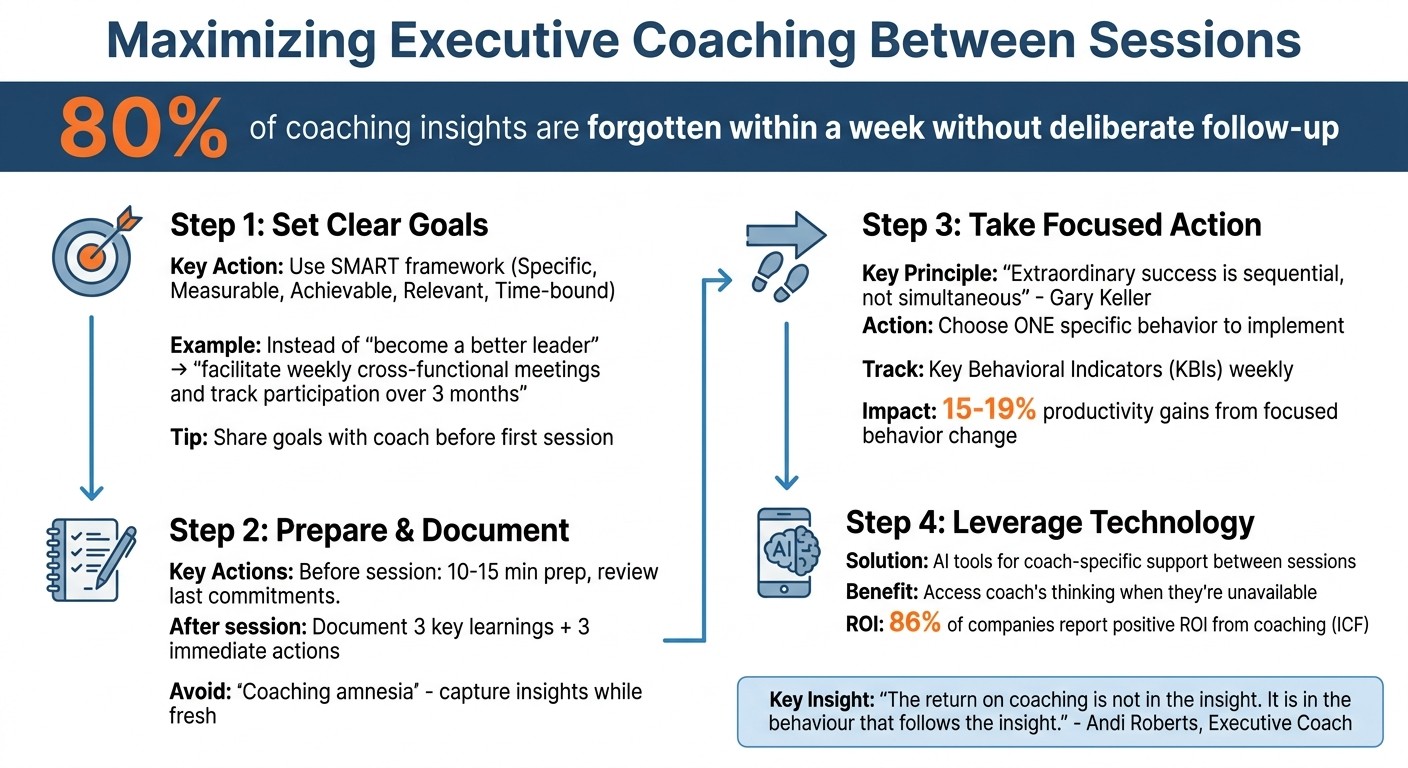
4-Step Framework to Maximize Executive Coaching ROI Between Sessions
Set Clear Coaching Goals
Without clear goals, coaching can lose its direction. The difference between executives who genuinely grow through coaching and those who simply enjoy the process often boils down to one thing: knowing exactly what they want to achieve.
Executive coach Andi Roberts explains it well:
Defining your growth agenda means deciding on specific business outcomes and personal professional shifts that matter now, and naming them clearly enough that both you and your coach can orient to them with purpose rather than letting the coaching drift into general talk about improvement.
Instead of vague discussions, create a focused growth agenda that anchors each session in measurable results. When priorities inevitably shift, having a clear baseline ensures you can track progress effectively.
Define Specific, Measurable Goals
Avoid setting ambiguous goals like "become a better leader." Instead, use the SMART framework to create goals that are Specific, Measurable, Achievable, Relevant, and Time-bound.
Start by asking yourself questions like, "What is my most pressing leadership challenge right now?" or "What change would have the greatest impact if I addressed it?" Your goals should focus on areas within your control - your actions and decisions - rather than external factors like changing your boss or overhauling an entire system. For example, instead of saying, "get my team to collaborate better", you could aim to "facilitate weekly cross-functional meetings and track participation over three months."
Measure both external outcomes (e.g., team performance, revenue growth) and internal changes (e.g., improved conflict resolution, better decision-making). As Stefanie Mockler, Ph.D., from The Violet Group, notes:
The biggest shifts often happen in how you think, not just in what you do. While external results matter, internal shifts are just as important.
To start strong, send your written growth agenda to your coach before your first session. This ensures the first conversation stays focused and establishes a shared understanding of your objectives. Sharing your goals with one or two trusted colleagues can also provide valuable feedback and keep you accountable between sessions.
With clear goals, you can turn coaching insights into tangible progress.
Revisit and Adjust Goals as Needed
As coaching progresses, regular review is crucial. Growth often changes your perspective - what once felt like a major breakthrough might eventually become second nature, making it easy to overlook how far you've come.
Every few sessions, take a moment to reflect: "What can I do now that I couldn’t do before?" Track recurring themes rather than isolated topics. For instance, instead of just noting that you discussed delegation, identify deeper patterns, such as developing a healthier relationship with control or feeling more empowered. Pay attention to how your language evolves - moving from "I’m terrible at boundaries" to "I set a boundary and it went well" is a clear sign of progress.
Turn identity-based goals into actionable steps. Instead of aiming to "be more confident", set a goal like "speak first in three out of five leadership meetings." Before each session, review your previous commitments and recurring themes. This quick reflection ensures each conversation builds on the last.
Make the Most of Each Session
The difference between a coaching session that drives results and one that veers off into casual chat often boils down to preparation and follow-through. Executives who come prepared with a clear agenda and leave with actionable commitments tend to see far better outcomes. These practices lay the groundwork for the follow-through strategies covered later.
Prepare an Agenda in Advance
Take 10–15 minutes before the session to shift gears from your usual work mindset to a coaching frame of mind. Silence your devices and review what you committed to during your last session. Reflect on what you tried, what succeeded, and any challenges that cropped up.
Pinpoint your single most pressing issue for discussion. If you’ve got several topics in mind, rank them based on their potential impact. As Patrick Lencioni wisely said, "If everything is important, then nothing is." A simple structure can help: jot down your top three wins since the last session, rate your current outlook on a scale of 1–5, summarise your progress on commitments, note anything you’ve been avoiding, and identify the main issue you want to address.
Focus your agenda on things within your control - like your own thoughts, emotions, and actions - rather than trying to solve problems involving others who aren’t present. Don’t shy away from uncomfortable topics like doubts or unspoken frustrations, as these often hold the key to real change. For ongoing sessions, consider sharing your agenda topics 24 hours in advance to keep discussions sharp and on-point.
Once the session wraps up, make sure you document the key insights with the same level of care.
Document Key Takeaways After Sessions
Right after the session, take a moment to capture your insights while they’re still fresh. A quick one-minute voice memo can work wonders - highlight your main breakthrough, your specific commitment, and any metaphors or ideas that stuck with you. This simple habit helps you avoid what coaches call "coaching amnesia."
At the end of every session, clearly outline three key learnings and three immediate actions to tackle before the next meeting. Keep an action log that includes who’s responsible for each task and when it’s due. Separate narrative notes (your observations and feelings) from action points (specific tasks to complete). Coaching often involves abstract insights, like recognising patterns in behaviour, so capturing the emotional context is just as important as listing practical next steps. These habits create a cycle of learning and action that ensures you get the most out of your coaching experience.
Implement Between Sessions
Once you've captured insights and set clear goals, the real work begins in the days between coaching sessions. The value of coaching lies not in the insights themselves but in how you act on them. As executive coach Andi Roberts explains: "Coaching creates change only when you treat your development as an active craft rather than an event that happens in the coaching room. The return on coaching is not in the insight. It is in the behaviour that follows the insight." In short, the coaching room sparks the ideas, but transformation happens in the actions you take outside of it.
Interestingly, research shows that organisations focusing on a few targeted behaviours and aligning leadership routines around them have reported productivity gains of 15% to 19%. The key difference between leaders who achieve results and those who don’t often boils down to consistent action. It’s about doing the work now, not waiting for the next session.
Choose One Action to Implement
Pick one specific, observable behaviour to focus on and test before your next session. Gary Keller, founder of Keller Williams, puts it perfectly: "Extraordinary success is sequential, not simultaneous." Instead of overwhelming yourself with multiple changes, zero in on a single, manageable action. Trying to tackle too much at once can lead to burnout and missed opportunities for real progress.
Turn your insights into concrete, measurable actions within the next seven days. Swap vague goals like "be more confident" for something actionable, such as "speak first in three meetings this week" or "send updates without over-editing." Specificity makes success easier to measure. Right after your session, while the conversation is still fresh, spend ten minutes identifying what resonated most and deciding on the exact action you’ll take next.
Track Progress Against Your Goals
Once you've chosen your priority action, tracking its impact is crucial. Regular, brief reflections - just ten minutes a week - can help you identify progress and patterns. Pay attention to shifts in your mindset and language. Moving from "I'm terrible at X" to "I'm working on X" to "I did X well" is a clear sign of growth, but it’s easy to overlook without keeping a record.
Instead of focusing on surface-level metrics, track Key Behavioural Indicators (KBIs) like "held weekly 1:1s", "provided timely feedback", or "followed up on delegated tasks." Keep a journal of what you tried and the outcomes to turn vague impressions into solid evidence of change. To strengthen this process, involve a trusted colleague who can observe your behaviour in action. While your coach understands your intentions, a peer can provide valuable insights into how your actions are impacting others. This combination of self-monitoring and external feedback builds accountability and keeps you moving forward between sessions.
Extend Your Coach's Support with Technology
You've set your goals, taken note of valuable insights, and committed to actionable steps. But here's the challenge: your coach is only available for an hour every fortnight, while the decisions that shape your progress often can’t wait for that next session. The real question is whether the support you need between meetings reflects your coach's unique perspective or defaults to generic advice that lacks your context.
Access Your Coach's Thinking Between Sessions
Without a structured system, crucial coaching insights can slip away. The session ends, notes get filed away, and when a tough decision arises midweek, you're left trying to recall what your coach might have suggested. This is where technology steps in - but only if it’s tailored to your coach’s approach.
AI tools now offer the ability to capture and build on your coach's specific methodology, creating a detailed record of your growth over time. Rather than relying solely on session notes, these systems track voice debriefs, recurring themes, and the evolution of your thinking. For example, in May 2026, Point Taken Consulting adopted AgentimiseAI to enhance their executive coaching programmes. The AI tool analysed participants’ nonverbal cues, vocal patterns, and presentation styles, delivering objective insights. This freed up coaches to focus on strategic advice, while participants benefited from measurable progress and deeper engagement.
While generic AI tools provide broad advice, AgentimiseAI remembers the exact commitments and insights from your sessions. It doesn’t replace your coach’s expertise - it reinforces the strategies that make their guidance actionable, even when they’re not available. By doing this, AgentimiseAI transforms coaching insights into practical, daily support.
Use AgentimiseAI for Coach-Specific Support
AgentimiseAI allows coaches to train a private AI model based on their unique approach and philosophy. Your coach develops the system, and you gain access to it between sessions. This isn’t a chatbot spouting generic motivational lines - it’s a tool designed to mirror your coach’s specific thinking, grounded in the frameworks and language they’ve developed with you.
Before a challenging meeting or decision, you can ask the AI to summarise previous discussions, identify recurring patterns, or simulate your coach’s perspective on the issue. After each session, a quick voice debrief captures your emotional state and key takeaways, feeding into the system to ensure continuity. This creates a dynamic feedback loop, where each interaction builds on the last.
The International Coaching Federation found that 86% of companies reported a positive ROI from coaching engagements. However, that return depends on whether the insights gained translate into consistent action. Technology doesn’t create change - it ensures that the thinking driving that change remains accessible and actionable long after the session ends. AgentimiseAI bridges the gap, ensuring progress doesn’t stall by midweek.
Conclusion
Executive coaching only makes a difference when insights are put into practice. Interestingly, most people forget around 80% of what they learn in a session within a week if they don’t take action on it[1].
The strategies shared here - setting clear goals, preparing effectively, documenting key points, and committing to one actionable step - help create a framework to avoid losing those valuable insights. These steps keep your coach’s advice actionable and relevant throughout the week. But even with the best structure in place, challenges can pop up midweek when your coach isn’t available. That’s where technology can step in - not as a replacement, but as a bridge to keep the value of your coach’s thinking within reach.
As executive coach Andi Roberts explains:
"The return on coaching is not in the insight. It is in the behaviour that follows the insight."
AgentimiseAI ensures you have continuous access to your coach’s personalised frameworks and guidance. Unlike tools offering generic advice, it reflects the specific methods your coach has designed with you, turning insights into practical, daily actions.
Coaching works best as a cumulative process - progress depends on the steps you take between sessions. The real question isn’t whether your coach is effective, but whether their guidance is accessible when you need it most.
Take a moment to evaluate your current coaching setup. Consider asking your coach how they ensure their clients can access their advice between sessions - or even share this article with them.
FAQs
What should I do if my coaching goals keep changing?
If your coaching goals seem to shift frequently, it’s time to focus on creating a clear plan for growth. Start by identifying specific outcomes that are most important to you. Make it a habit to revisit this plan regularly, adjusting it as your priorities evolve over time. Tracking your progress and noting shifts in your mindset or behaviour can help you remain mindful of your journey. Refining your goals is simply part of the process of growing and improving.
How can I stay accountable between coaching sessions?
To keep yourself on track, try incorporating simple, repeatable habits into your day - like setting aside 15 minutes for a coaching check-in. You can also use AI tools to log insights, monitor your progress, and remind yourself of the commitments you’ve made during sessions. These approaches help you stay focused, avoid forgetting key takeaways (sometimes called 'coaching amnesia'), and maintain steady progress between sessions.
How does AgentimiseAI capture my coach’s approach between sessions?
AgentimiseAI leverages AI tools to document your coach's advice and strategies during sessions, making them easy to revisit whenever needed. With your coach's consent, sessions can be recorded and transcribed, ensuring no important detail is missed. The AI also analyses notes to identify patterns over time, helping you stay on track with your coaching goals and understand how their methods contribute to your progress. This way, you can benefit from their expertise even between sessions.