Why Senior Leaders Are Asking Their Coaches for Always-On Access
11 May 2026
Scheduled coaching misses critical moments; senior leaders need personalised, always-on guidance embedded in their workflow.

Senior leaders often face critical decisions outside of scheduled coaching sessions, creating gaps in support when they need it most. Traditional coaching models, with fixed monthly or quarterly meetings, often fail to align with the unpredictable nature of high-stakes leadership challenges.
Key reasons why leaders are turning to always-on coaching access:
Timing matters: Decisions like budget reviews or restructuring often arise unexpectedly and can't wait for the next session.
AI isn't enough: While general-purpose AI tools are always available, they lack personal context and fail to address deeper leadership challenges.
Real-time support improves outcomes: Immediate coaching during pivotal moments reduces errors, reinforces new behaviours, and supports better decision-making.
Always-on coaching combines human expertise with tailored tools, making guidance available when leaders need it most. This approach doesn't replace traditional coaching but ensures leaders have the support to navigate complex, high-impact decisions in real time.
The Gaps in Scheduled Coaching
Fixed coaching schedules often fail to align with the unpredictable nature of leadership challenges. As Jimmy Burroughes points out, this creates an "accessibility problem": leaders frequently encounter critical moments that demand immediate advice, but their coach isn’t available until the next scheduled session. This mismatch can lead to costly mistakes during pivotal decision-making moments.
The Hidden Costs of Waiting
The real issue lies in the downtime between sessions. Leaders often slip back into old habits just when timely coaching could make the biggest difference. Effective development requires reinforcement in the moment, not weeks later when the urgency has faded.
Research shows that focusing on a small set of behaviours and managerial routines can boost productivity by 15–19%. However, these gains are often lost when leaders lack access to real-time support during high-stress situations. Under pressure, high cognitive load makes it harder to retain and apply new skills. As Burroughes puts it:
"Development fails when it depends on memory. It works when it is embedded into the workflow."
Delays in accessing support during critical moments can have serious consequences, particularly when decisions need to be made quickly.
When Decisions Can't Wait for the Next Session
Some situations demand immediate guidance: a sudden budget review requiring careful messaging, a tense restructuring conversation, or a high-stakes board negotiation where a misstep could undo months of work. These moments don’t come with advance warnings, nor do they wait for your next coaching appointment.
Most professional learning happens on the job, but traditional coaching models consistently miss these key moments. Without timely support, leaders either delay decisions - missing opportunities - or act without proper guidance, increasing the likelihood of costly errors. In today’s economy, where AI has amplified the impact of critical decisions, the fallout from a poorly-timed choice can be more damaging than ever.
Why Generic AI Doesn't Replace Your Coach
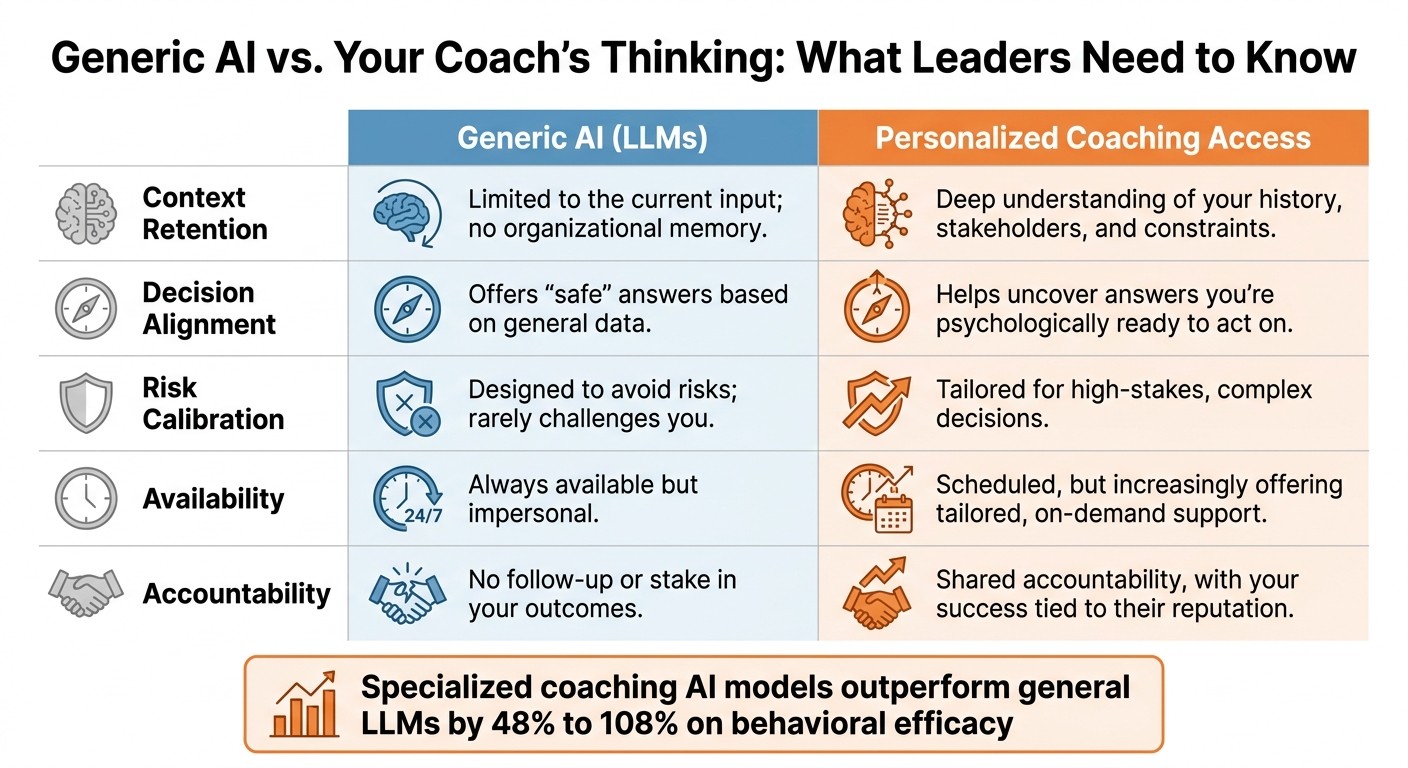
Generic AI vs Personalized Coaching: Key Differences for Senior Leaders
When you're under pressure and your coach isn't immediately available, it might seem appealing to turn to tools like ChatGPT or other general-purpose AI systems. But here's the catch: these tools don't know you. They don’t understand your organisation, its dynamics, or the nuanced challenges you face. They're built to assist, not to push you to confront blind spots or explore what you might be avoiding.
Generic AI vs. Your Coach's Thinking
Generic AI relies solely on the information you provide in the moment. It doesn’t remember past discussions about your board’s risk appetite, it can’t grasp the organisational dynamics that make certain decisions impractical, and it has no insight into your long-term personal growth goals. As Graham Ward, Adjunct Professor of Organisational Behaviour at INSEAD, aptly puts it:
"AI may offer the 'correct' answer. But coaching helps a person discover the needed answer – the one they're ready for."
A study of 400 interactions revealed a telling difference: general-purpose language models (LLMs) often act as "efficiency enablers", helping leaders document problems but failing to challenge whether their leadership style might be part of the issue. Specialised coaching AI models, on the other hand, outperform general LLMs by 48% to 108% on behavioural efficacy. Why? Because they’re designed to think like a specific coach, rather than offering one-size-fits-all solutions.
Here’s a side-by-side look at how generic AI and personalised coaching differ:
Comparison Table: Generic AI vs. Your Coach's Thinking
Feature | Generic AI (LLMs) | Personalised Coaching Access |
|---|---|---|
Context Retention | Limited to the current input; no organisational memory | Deep understanding of your history, stakeholders, and constraints |
Decision Alignment | Offers "safe" answers based on general data | Helps uncover answers you’re psychologically ready to act on |
Risk Calibration | Designed to avoid risks; rarely challenges you | Tailored for high-stakes, complex decisions |
Availability | Always available but impersonal | Scheduled, but increasingly offering tailored, on-demand support |
Accountability | No follow-up or stake in your outcomes | Shared accountability, with your success tied to their reputation |
The Cost of Impersonal Advice
The biggest danger isn’t necessarily bad advice - it’s advice that misses what’s truly important. Ian Kinnery, recognised as European Business Coach of the Year, puts it bluntly:
"No artificial intelligence bot has ever had a sleepless night worrying about payroll or redundancies, or felt the crippling weight of responsibility that employing dozens of people brings."
Generic AI tools can’t detect when vague language or hesitation hints at deeper issues. Nor can they recognise when the "right" solution clashes with unspoken organisational values. They focus on the mechanics - structuring plans or drafting messages - while overlooking the subtleties of leadership behaviour. In critical moments, this lack of depth can come at a high cost, highlighting why tailored coaching is so essential. It’s not just about solving problems; it’s about addressing the person behind the decisions.
How Coaches Make Their Judgment Available Between Sessions
Coaches are finding ways to make their expertise accessible even outside of scheduled sessions, turning their approach into an interactive, always-available resource.
What Productised Coaching Judgment Means
Productised coaching judgment involves transforming a coach’s unique expertise into a digital tool tailored to their specific methods, mental models, and communication style. This isn’t a generic AI solution - it’s a customised system, built to reflect the coach’s personal approach. Ian Price, an executive coach and business mentor, explains:
"Guidance provides the opportunity to pull from any number of mental models or tools that might not immediately present themselves to me in that moment. Guidance in that respect is a whole lot smarter than I am."
These systems are carefully crafted using the coach's frameworks and principles, ensuring the advice aligns with the guidance you'd receive in a live session. The coach defines the tone, scope, and boundaries, while platforms like GuidanceAI manage the delivery. This approach ensures that leaders can access relevant, consistent advice when they need it most, bridging the gap between sessions.
The Difference Tailored On-Demand Support Makes
This isn’t about replacing your coach - it’s about eliminating the wait. On-demand support allows leaders to validate decisions as they arise, offering the same level of insight they’d get in their next session. Since the system remembers organisational context and prior discussions, there’s no need to start from scratch each time.
This shift allows live coaching sessions to focus on broader, strategic issues, while pressing concerns can be addressed instantly. Small problems are resolved in real-time, leaving more room for tackling larger, complex challenges during scheduled sessions.
How to Get Always-On Access from Your Coach
If you’re looking for continuous access to your coach’s expertise, it’s crucial to ensure they’re set up to deliver real-time support. Traditional coaching sessions often miss those critical, unplanned moments, so understanding your coach's technological capabilities and framing your needs clearly can make all the difference.
Assessing Your Coach's Tech Readiness
Not all coaches are equipped to provide always-on access, so it’s important to evaluate their tech setup. Start by asking whether they use persistent AI agents - tools that can access your files and documents in real time, rather than relying on memory or manually uploaded notes. Also, check if they offer a tech co-agreement. This document should outline the tools they use, how your data is stored, and the difference between automated insights and human-reviewed feedback.
A tech-savvy coach should be able to work with three layers of context: your business environment, your leadership style, and their unique coaching approach. Without this depth, the advice they provide might feel too generic or disconnected from your actual challenges.
Ask for a permission log to understand what access their systems have to your calendars, files, and communication channels. Ensure there are clear privacy controls and that access is limited to specific folders or data points. It’s also wise to confirm that their system supports data portability, so you can export your progress history if you decide to switch platforms. Lastly, make sure they’re using advanced, paid AI models rather than older or free tools, which often lack the ability to handle complex reasoning or nuanced tasks.
Here’s a quick guide to key capabilities to look for:
Evaluation Category | Key Capability to Look For |
|---|---|
Booking & Scheduling | Calendar sync and instant self-booking |
Progress Tracking | Long-term charts, automated trend detection, KPI dashboards |
Security & Privacy | Encryption, clear consent prompts, and auditable logs |
Workflow Integration | Automated session recaps within 15 minutes |
With these benchmarks in place, you’ll be ready to test out their on-demand support capabilities.
Starting the Conversation and Testing the System
Once you’ve confirmed your coach’s tech readiness, it’s time to address the practical side. Start by identifying specific support gaps - those moments when you needed guidance but couldn’t access it. For example, think about times like when a stakeholder unexpectedly challenged your decision or the night before a crucial budget discussion. Highlighting real situations makes your case for continuous access far more compelling than a vague request.
Next, propose a pilot routine rather than making a sweeping change. Begin with one recurring task, such as receiving post-session summaries, Monday morning planning prompts, or weekly accountability check-ins. Use this trial to evaluate the system’s effectiveness. For instance, present a current challenge and see if the response you receive is tailored to your leadership style and business context or if it feels generic.
To measure success, define one to three clear outcomes, such as improving weekly one-to-ones, delivering timely feedback, or consistently following up on commitments. Ensure your coach includes a human-in-the-loop process, where AI-generated insights are reviewed before being shared with you. This is especially critical for sensitive topics like conflict management or wellbeing. The idea isn’t to replace your coach’s expertise but to ensure their guidance is available when you need it most - even outside scheduled sessions.
Conclusion
Leadership development often stumbles in the spaces between scheduled coaching sessions. These are the moments when you need to test a decision or get a quick perspective on a conversation, but your coach isn't immediately available. Waiting until the next session means relying on memory or turning to generic AI that lacks the personal context your coach brings.
This is where always-on access makes a difference. It integrates your coach's insights directly into your workflow. Whether you're preparing for a challenging meeting, clarifying tasks before delegating, or revisiting a decision while it's still fresh, this approach ensures support is there when it matters most. Leadership Coach Jimmy Burroughes sums it up perfectly:
"Development fails when it depends on memory. It works when it is embedded into the workflow."
This approach doesn't replace human judgement - it enhances it. AI takes care of routine tasks like recaps, reminders, and initial brainstorming, freeing your coach to focus on the complex challenges: navigating ambiguity, managing internal dynamics, and addressing critical decisions.
To get started, consider integrating on-demand coaching into your routine. Begin with something simple, like a weekly check-in or a post-session summary, to ensure the system aligns with your coach's personalised approach.
As automation continues to streamline execution, the importance of senior-level judgement grows. The key question is whether your coaching setup is designed to deliver that insight precisely when you need it most.
FAQs
What counts as “always-on” coaching?
“Always-on” coaching offers leaders continuous, on-demand access to expert guidance, bridging the gaps between formal coaching sessions. This approach leans on productised judgment - a structured way of delivering expert insights - and ensures support is readily available whenever it's required. It’s all about providing timely, relevant advice exactly when leaders need it most.
How is it different from using generic AI?
AgentimiseAI stands out from generic AI tools by providing constant, personalised access to a coach's expertise and judgement. While generic AI can handle structured tasks like conversation practice, it falls short when it comes to the nuanced, trust-based, and context-aware insights that senior leaders rely on for crucial decisions. AgentimiseAI fills this void, delivering expert, tailored guidance whenever needed - far beyond the capabilities of standard automated responses.
What should I ask my coach about privacy and data access?
When working with a coach, it's important to ask how they handle your privacy and manage access to your data. Focus on understanding what information is collected and stored, how it is used, and who has access to it. This becomes even more crucial if they use always-on AI tools, which might introduce extra risks. Make sure your coach has well-defined policies in place to protect your data and maintain confidentiality.