How AI Optimises Social Media Ad Budgets
23 Feb 2026
AI reallocates social media ad budgets in real time to cut wasted spend, lower CPA and boost ROAS with predictive allocation and automated bidding.

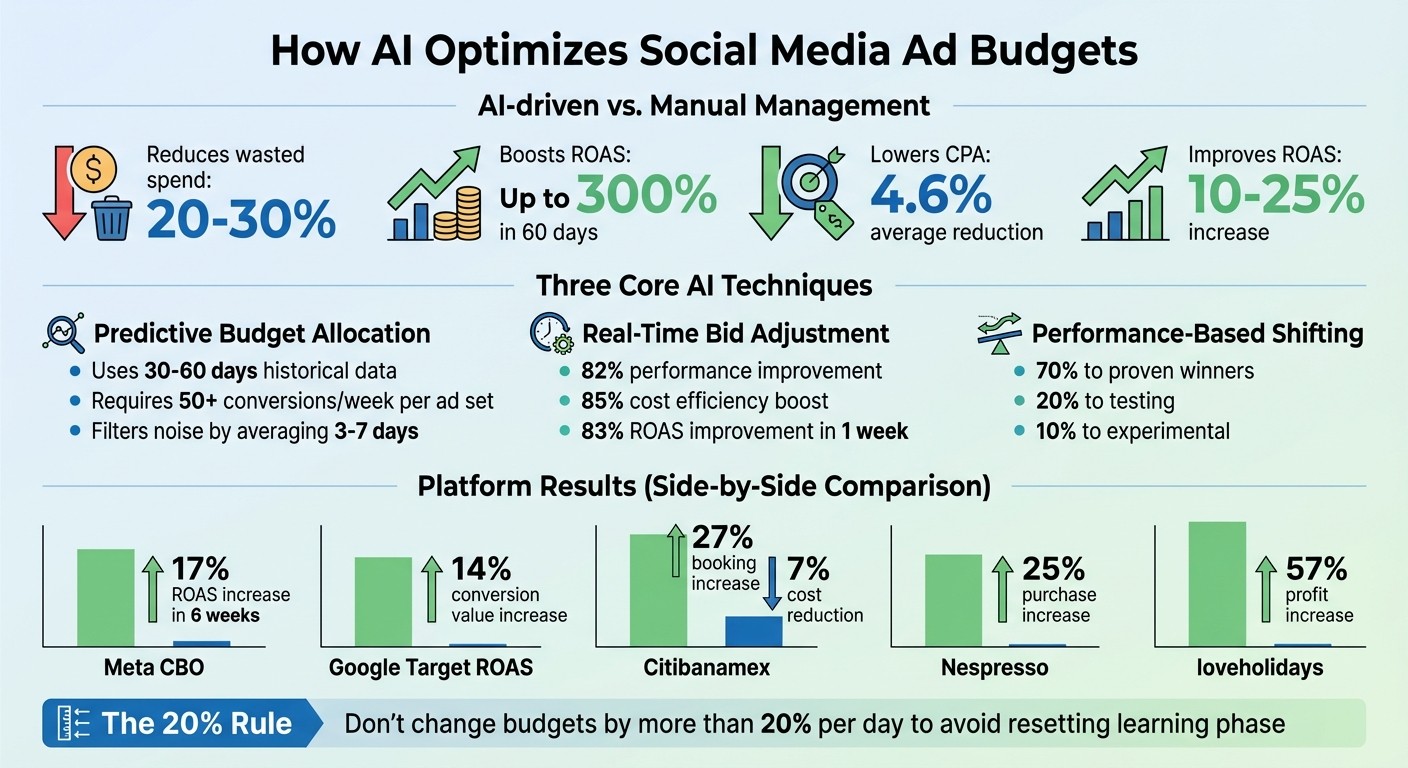
Managing social media ad budgets manually is time-consuming and often wasteful. AI changes the game by reallocating budgets in real time, cutting wasted spend by 20–30% and boosting return on ad spend (ROAS) by up to 300% in just 60 days. Tools like Meta's Advantage+ and Google’s automated bidding systems use predictive data, live auction insights, and performance-based adjustments to focus budgets where they deliver the best results.
Key benefits of AI-driven ad budget management:
Real-time adjustments: AI reallocates funds instantly to top-performing ads.
Lower costs: Reduces cost per acquisition (CPA) by 4.6% on average.
Improved efficiency: Saves time by automating repetitive tasks.
Higher returns: Increases ROAS by 10–25% or more.
AI tools analyse historical data, predict trends, and optimise bids to prevent overspending on underperforming ads. Platforms like Meta and Google provide built-in solutions, while cross-platform tools centralise budget management across multiple ad accounts. For the best results, set clear goals, connect data sources, and monitor performance regularly. AI allows advertisers to focus on strategy while achieving better results with less manual effort.
AI vs Manual Ad Budget Management: Key Performance Metrics Comparison
AI Techniques for Budget Allocation
AI is reshaping how budgets are managed by automating the process of analysing performance data and reallocating funds to maximise returns. Instead of manually monitoring dashboards and moving money between ad sets, AI continuously evaluates performance signals and adjusts budgets where they'll deliver the best results. This transformation is powered by three key techniques: predictive allocation, which forecasts future performance; real-time bid adjustment, which responds instantly to live auction conditions; and performance-based shifting, which reallocates funds to top-performing campaigns as results come in. Let’s delve deeper into these methods.
Predictive Budget Allocation
Predictive allocation relies on historical data (typically 30–60 days) to identify patterns of strong performance in your account. By analysing this data, AI predicts how varying budget levels will affect delivery and audience saturation. It pinpoints the combinations of creative assets, audience segments, and placements that have historically achieved the highest return on ad spend (ROAS) or the lowest cost per acquisition (CPA). Instead of reacting to yesterday’s numbers, AI considers multiple factors - like audience behaviour trends and seasonal changes - to anticipate which impressions are most likely to convert.
This method avoids the pitfall of "budget whiplash", where funds are wasted chasing one-day performance spikes. By averaging results over 3–7 days, AI filters out noise and provides actionable insights in seconds. To ensure accuracy, ad sets generally need at least 50 conversions per week to offer a statistically reliable dataset.
"AI doesn't guess. It learns... The longer your campaigns run (with solid conversions), the better your bid strategy performs. It becomes predictive, not reactive." - LeadEnforce
Before enabling predictive AI, it’s important to export 30–60 days of performance data (CPA, ROAS, CTR) to document your current decision-making patterns. Set minimum and maximum budget thresholds to prevent overspending on saturated audiences or underfunding new tests. Once AI is active, avoid frequent manual changes, as these reset the system’s learning phase and reduce predictive accuracy.
Real-Time Bid Adjustment
Real-time bid adjustment works during live ad auctions, dynamically altering bid amounts based on the predicted value of each impression. AI evaluates millions of data points - such as conversion likelihood, auction competitiveness, time of day, device type, and audience behaviour - and adjusts bids accordingly. It raises bids for high-probability conversions while throttling them for less promising opportunities.
The impact can be dramatic. AI-driven bid strategies have been shown to improve overall performance by 82% and boost cost efficiency by 85%. One platform even reported an 83% improvement in ROAS within a week of adopting real-time adjustments. By operating continuously, the system reduces wasted spend and capitalises on emerging opportunities.
To maintain control, set CPA or ROAS limits to avoid overbidding and inflated costs per click (CPC). Follow the 20% rule: don’t increase or decrease campaign budgets by more than 20% in a single day, as larger changes can reset the platform’s learning phase. Allow the AI at least 3–5 days to gather sufficient data before intervening manually. For those new to AI bidding, start with auto-bidding strategies like "Lowest Cost" to let the system learn audience behaviour before progressing to more advanced options like Cost Caps or Min ROAS.
Performance-Based Budget Shifting
Performance-based shifting focuses on redistributing budgets to the ad sets delivering the best results. Tools like Meta’s Advantage+ (formerly Campaign Budget Optimisation) embody this approach by automatically reallocating funds in real time to winning combinations of copy, audience, and placement. Specialised AI agents evaluate creative effectiveness and budget allocation to ensure resources are directed where they’ll make the most impact.
A recommended strategy is to allocate 70% of the budget to proven winners, 20% to testing new audiences, and 10% to experimental campaigns. AI dynamically adjusts these allocations as performance metrics shift throughout the day. Unlike native platform tools that check conditions hourly, third-party AI systems can analyse performance every few minutes, allowing them to seize fleeting opportunities.
To ensure testing ad sets aren’t prematurely cut off, set minimum spend limits. Reserve 15–20% of your total budget as a flexible pool that can be quickly deployed when AI identifies a standout performer. Use cost caps set 20–30% above your target CPA to give the system room to optimise without risking excessive costs during market fluctuations. As always, avoid frequent manual adjustments - give the AI at least 3–5 days to gather enough data before making changes.
"Budget optimisation isn't about spending more - it's about reallocating what you're already spending to the campaigns, audiences, and placements that actually drive results." - AdStellar
How to Use AI Tools on Social Media Platforms
After understanding how AI can optimise budgets, the next step is to apply these strategies using tools available on popular advertising platforms. These tools translate AI techniques into actionable features, helping you optimise spending and improve returns. Below, we explore how platforms like Meta and Google, as well as cross-platform tools, bring these methods to life.
Meta's Campaign Budget Optimisation (CBO)
Meta's Advantage Campaign Budget (formerly known as Campaign Budget Optimisation) is a key tool for managing budgets effectively. By setting a single campaign budget, Meta’s algorithm redistributes funds in real time, funnelling resources to ad sets that are most likely to convert at the lowest cost. This eliminates the need for constant manual adjustments.
To get the best results from CBO, your campaign structure needs careful planning. Ad sets should target distinct audiences - for example, a 1% lookalike audience versus a broad interest group - to avoid overlap and competition within your campaign. Meta advises limiting campaigns to 2–70 ad sets, as exceeding this range can fragment data and slow down the learning process. Each ad set typically requires 50 conversions per week to exit the learning phase and optimise effectively.
Advertisers using CBO have reported an average 17% increase in ROAS within six weeks, while Advantage+ budgets have reduced CPA by an average of 4.6%. To avoid overfunding or underfunding, set budget limits for each ad set and consider using automated rules. For instance, you can pause ads if costs exceed a certain threshold or increase budgets if ROAS remains high.
Patience is key with CBO. Avoid making changes to budgets or creatives during the first 72 hours, or ideally for 5–7 days, to allow the algorithm to stabilise. When scaling successful campaigns, increase the budget incrementally - by about 20% every other day - to prevent resetting the learning phase. For most conversion-focused goals, the "Highest Volume" bid strategy (previously "Lowest Cost") offers the AI more flexibility to find cost-effective results.
Google Ads AI Budget Features
While Meta focuses on CBO, Google’s AI tools excel in value-driven bidding strategies. Options like Target ROAS and Target CPA use machine learning to predict which auctions are most likely to convert, adjusting bids accordingly. These strategies require at least 15 conversions per month at the account level to generate enough data for effective optimisation.
Switching to Target ROAS can lead to a 14% increase in conversion value without reducing ROAS. For example, Citibanamex, a leading bank in Mexico, adopted value-based bidding and saw a 27% increase in credit card bookings while cutting the cost per booking by 7%.
"Google AI helped us detect patterns quickly, catch users with potential to convert and increase our sales by optimising towards value." - Karla Guerrero, Online Acquisition Manager at Citibanamex
Google’s Performance Max campaigns take automation even further. These campaigns combine multiple Google channels - Search, Display, YouTube, Gmail, and Discover - into a single AI-managed campaign. The system tests combinations of headlines, images, and videos, allocating budgets to the best-performing assets. For instance, Nespresso used AI-driven Search campaigns to boost direct-to-consumer sales, achieving a 25% increase in purchases. Similarly, loveholidays saw a 57% increase in profit by using Smart Bidding instead of their own in-house solution.
To let Google’s AI perform at its best, give it two weeks or three conversion cycles before evaluating results or making major changes. If using Target ROAS, avoid setting restrictive daily caps to ensure the AI can capture high-value opportunities. Use the Insights page to identify new audience segments the AI has detected beyond your original targeting.
Cross-Platform AI Management
For advertisers managing multiple platforms, cross-platform AI tools offer a unified solution. While Meta and Google’s tools work independently, cross-platform tools centralise data from multiple accounts (e.g., Meta, Google, TikTok, LinkedIn) to optimise budgets across channels based on overall performance.
Start by consolidating data. Connect ad accounts through official APIs for secure, real-time access, and sync additional sources like your CRM or Google Analytics 4 (GA4). Set minimum and maximum spend limits for each channel to prevent over-investment in one platform or underfunding another.
Define a key performance metric - such as Target CPA or ROAS - to guide the AI’s allocation decisions. The AI then analyses performance trends and identifies "saturation points" where extra spending no longer yields better returns. A good rule of thumb is the 70/20/10 approach: allocate 70% of your budget to proven platforms, 20% to testing new ones, and 10% to experimental channels.
AI-driven ad spending reached £296 billion in 2022 and is expected to surpass £1 trillion by 2032. Despite this growth, 77% of marketers still spend over 10 hours a week manually cleaning data and creating reports. Cross-platform tools automate these tasks, evaluating performance every few minutes - far faster than Meta’s hourly automated rules. To maintain efficiency, review AI recommendations weekly, retrain models monthly to account for seasonality, and update business rules quarterly. This integrated approach ensures your budget delivers the best possible return on investment.
Step-by-Step Guide to Setting Up AI-Driven Ad Budgets
Now that you're familiar with the tools, it's time to dive into setting up AI-driven budget management. This process involves three key stages: defining your goals, connecting data sources, and establishing a monitoring routine to help the AI learn while keeping your budget safe from costly errors.
Step 1: Define Campaign Goals and KPIs
Start by exporting 30–60 days of historical data on CPA, ROAS, and conversions. This will give you a performance baseline and help you set realistic targets for the AI to aim for.
Next, choose a primary optimisation metric that matches your business goals. For example:
If profitability is your focus, prioritise ROAS.
For higher lead or sales volume, target CPA is a better fit.
For brand awareness, metrics like CPM or Reach work best.
The AI needs a clear metric to guide its decisions. Keep in mind that Meta's algorithm typically requires at least 50 conversions per ad set each week to fully optimise. If your account doesn’t hit this volume, consider consolidating ad sets or using a longer conversion window.
Set spending thresholds to control costs, such as minimum budgets for data collection and daily caps at 2–3× your average spend. Additionally, create performance triggers to guide the AI, like instructing it to increase the budget by 20% if CPA stays 20% below target for three consecutive days. For automated bidding, set cost caps 20–30% above your target CPA. This gives the algorithm room to find conversions without overspending.
Once your goals and KPIs are in place, the next step is connecting your data sources to enable AI-driven insights.
Step 2: Connect Data Sources and Enable AI Analysis
AI tools need accurate, real-time data to function effectively. Start by connecting your ad accounts - like Meta, Google, or LinkedIn - using official APIs with OAuth authentication. This ensures secure, real-time access to your data. If you're managing multiple platforms, use automated connectors to pull all spend and performance data into a centralised system like Google Sheets, Looker Studio, or BigQuery.
Integrate your CRM and revenue systems to link ad spend directly to business outcomes, including metrics like leads, sales, and customer lifetime value. This ensures the AI focuses on actual profitability rather than platform-reported metrics. Make sure your conversion tracking match quality is at least 95% for reliable signals. Use tools like Google Analytics 4 alongside platform data to catch any attribution discrepancies before they impact the AI's decisions.
Once your data is connected, enable the AI features on your chosen platform. Whether it’s Meta's Advantage Campaign Budget, Google's Target ROAS, or a cross-platform tool, give the system time - about two weeks or three conversion cycles - to gather enough data before making significant changes. Campaigns with fewer than 20 clicks or five conversions during this period won’t have enough data for effective AI modelling.
With your data feeds live, you can shift your focus to monitoring and scaling for continuous optimisation.
Step 3: Monitor, Adjust, and Scale Campaigns
To get the best ROI from AI-driven budget management, you’ll need to monitor, adjust, and scale your campaigns regularly. Check daily for anomalies, like a 20% or greater deviation in spend or CPA. Conduct weekly reviews to spot performance trends, and perform a deeper strategic audit each month.
Set automated guardrails to pause underperforming ad sets. For instance, you might pause an ad set if it spends twice the target CPA without a conversion within 48 hours. Configure alerts for sudden CPA spikes - anything over a 50% increase in a day - so you can act quickly.
When scaling successful campaigns, follow the 20% rule: increase budgets gradually to avoid disrupting performance. Use vertical scaling (boosting budgets on high-performing campaigns) for faster growth, and horizontal scaling (expanding into new audiences or regions) to avoid audience saturation. Stick to the 70/20/10 allocation strategy, and watch for the "efficiency cliff", where additional spending causes CPA to jump - often by 40% or more.
Measuring Success: AI vs Manual Budget Management
After implementing AI-driven budget management, the next step is proving its effectiveness. The real difference between AI and manual approaches lies in how they impact your key metrics - provided you measure and interpret them accurately.
Key Metrics to Monitor
Ad spend efficiency: This metric shows how much of your budget leads to conversions rather than just impressions or clicks. AI systems excel at reallocating funds to high-intent users in real time, often reducing wasted spend by 20–30% on average, according to comparative tests.
Cost per acquisition (CPA): With AI optimising bids and placements, CPA should decrease. For instance, Meta's Advantage+ campaigns reportedly cut CPA by an average of 4.6%. To gauge AI's impact, track CPA trends over several weeks rather than relying on short-term data.
Return on ad spend (ROAS): ROAS, which measures the revenue generated for every pound spent, is a critical profitability metric. AI fine-tunes ad spending to focus on the most lucrative opportunities, improving overall returns.
Ad frequency control: AI helps manage how often your audience sees your ads, preventing oversaturation and maintaining engagement without wasting your budget.
Additionally, attribution accuracy and spend pacing are essential. These ensure your system correctly links ad interactions to revenue and distributes your budget effectively over time.
These metrics provide a solid foundation for comparing AI-driven approaches to manual methods.
Comparing Pre- and Post-AI Performance
Once you've identified your key metrics, the next step is to measure the tangible impact of AI compared to manual budget management. Start by exporting 30–60 days of performance data from your manual campaigns as a baseline. Allow the AI at least 7 days to complete its learning phase before evaluating its performance.
Manual management often requires hours of daily input, whereas AI operates 24/7, adapting to auction changes within minutes. This responsiveness is particularly valuable for teams managing multiple campaigns.
When comparing results, focus on campaign-level data, such as total conversions and average cost-per-result, instead of micromanaging individual ad sets. This broader view underscores AI's ability to maximise ROI by streamlining budget management.
Finally, consider the workload difference. Manual methods might work for smaller budgets under £5,000 per month, but AI thrives in more complex scenarios. Whether it's managing over 20 ad sets or running global campaigns across multiple time zones, AI delivers efficiency and scalability that manual approaches simply can't match. For larger campaigns, the advantages of AI become even more apparent.
Conclusion
AI has reshaped how social media ad budgets are managed, making real-time budget reallocation not just possible, but seamless. Gone are the days of manually sifting through spreadsheets and making reactive changes. Instead, AI tools now handle real-time bid adjustments and budget shifts across platforms - tasks that are nearly impossible to manage manually at scale.
The impact is undeniable. Research indicates that AI-driven optimisation can cut wasted spending by 20–30%, improve ROAS by 10–25%, and lower CPA by 15–30%. These numbers highlight how AI doesn’t just automate processes - it drives measurable results.
However, this isn’t about removing human involvement entirely. As one AI expert explains:
"The goal isn't to remove yourself entirely - it's to shift from daily budget babysitting to strategic oversight that drives better results with less effort".
Your role evolves from executing day-to-day tasks to focusing on high-level strategy. This means dedicating more time to creative work and brand development while leaving repetitive optimisation to AI.
For SMEs with tight budgets and smaller teams - especially as average marketing spend dropped to 7.7% of company revenue in 2024 - AI offers a chance to compete on equal footing. Tools like Meta's Advantage+ and Google's automated bidding solutions, alongside platforms like AgentimiseAI, make enterprise-level capabilities accessible. AgentimiseAI, in particular, caters to founder-led businesses by providing tailored AI agents that deliver strategic insights without the need for full-time executives.
To get started, test AI on your highest-spend channel with clear KPIs. Set guardrails to manage spending and replace daily micromanagement with weekly strategic reviews. As digital advertising becomes increasingly complex and fast-paced, adopting AI-driven strategies isn’t just an option - it’s essential. Platforms like AgentimiseAI can help you move beyond ad optimisation to elevate your entire marketing approach.
FAQs
How much conversion data do I need before AI can optimise properly?
AI systems need a solid base of conversion data to spot trends and fine-tune campaigns effectively. The specific amount required can differ based on factors like the platform being used and how complex the campaign is. However, once a sufficient volume of data is gathered, it becomes easier to identify consistent patterns that guide reliable performance improvements.
What guardrails should I set so AI doesn’t overspend my budget?
To keep AI from overspending, it’s important to set up safeguards like automated budget pacing and real-time performance monitoring. These tools help track how quickly your budget is being spent, identify potential risks, and adjust allocations when necessary.
You should also establish performance-based rules, such as setting maximum spend limits for individual campaigns. By pairing these measures with regular analysis, you can maintain better control over your ad spend and minimise wasteful overspending.
How can I measure whether AI is beating my manual budget changes?
To see if AI can do a better job than your manual budget tweaks, take a close look at key performance metrics like ROAS (Return on Ad Spend), cost per conversion, and overall campaign efficiency. AI tools can help by analysing performance trends, automating insights, and offering real-time recommendations. Over time, this data-driven method makes it easier to determine if AI is producing better outcomes than your manual efforts.