Your AI Sounding Board Doesn't Know Your Business. Your Coach Does.
11 May 2026
AI offers fast analysis, but only a coach provides the context, judgement and accountability for critical business decisions.

AI tools are fast, efficient, and can provide polished advice. But when it comes to major business decisions, they lack the context, emotional insight, and accountability that a coach brings. AI can identify patterns and deliver general solutions, but it doesn't understand your company's unique challenges or the human dynamics behind leadership decisions.
Coaches, on the other hand, offer tailored guidance based on experience and a deep understanding of your situation. They can interpret subtle cues, adapt to changing circumstances, and hold you accountable in ways AI cannot. While AI is a useful tool for data analysis and repetitive tasks, it falls short in navigating complex, high-stakes decisions where human judgement is crucial.
Key Takeaways:
AI provides general advice but lacks personal context and emotional understanding.
Coaches offer customised guidance, practical wisdom, and accountability.
Combining AI's efficiency with a coach's expertise ensures better decisions.
AI is a great assistant, but for the tough calls, nothing replaces the human touch of a coach.
Why Generic AI Falls Short for Your Business
Generic AI tools are only as good as the input they receive. They don’t have access to your past decisions, your unique market position, or the specific constraints that shape your business choices. As Paul Merrison, Founder of Launcherly, aptly says: "The intelligence is real. The relevance is not."
This lack of context creates a major disconnect. Instead of delivering advice tailored to your circumstances, AI often defaults to generalised answers. For instance, ask for pricing strategy advice, and you’ll get industry averages rather than insights aligned with your customer churn rates or target demographics. Need help with hiring? You’ll likely receive a cookie-cutter job description instead of a thoughtful evaluation of whether the role fits your current financial situation or growth plans. The recommendations may sound polished, but they miss the mark for your specific needs.
AI’s limitations go beyond data. It doesn’t understand the emotional and practical pressures of running a business. Ian Kinnery, Business Coach and Founder of Kinnery, puts it bluntly: "No artificial intelligence bot has ever had a sleepless night worrying about payroll or redundancies, or felt the crippling weight of responsibility that employing dozens of people brings." These human experiences shape decision-making in ways a machine simply can’t replicate.
Another shortfall is AI’s inability to pick up on subtle cues. Researchers call this "attunement" - the skill of interpreting tone, body language, and micro-expressions to grasp what’s really going on. AI can’t tell when you’re avoiding a tough decision or when you’re emotionally unprepared for advice that might be technically sound but impractical in the moment. Studies on therapeutic relationships even show that the quality of interaction often matters more than the advice itself, highlighting a gap AI just can’t fill.
This becomes especially critical in high-stakes situations where there’s no clear roadmap. While AI is excellent at analysing patterns in data, it lacks the nuanced understanding needed to navigate the human side of leadership. Whether it’s calming a team during a major transition or building trust in uncertain times, these challenges require wisdom and empathy - qualities that no algorithm can emulate.
Next, we’ll explore how a coach can provide the personalised guidance that bridges these gaps and delivers what AI cannot.
What Your Coach Brings That AI Cannot
Advice Built on Deep Understanding
AI might be able to process vast amounts of data, but it struggles with the finer details of your unique situation. A coach, on the other hand, brings insight grounded in real-world experience. They’ve been through the ups and downs - handling boardroom dynamics, overcoming team pushback, and making tough calls when the path forward isn’t clear. This isn’t theoretical knowledge; it’s practical wisdom that comes from having been in the trenches.
What sets a coach apart is their ability to go beyond generic strategies. They help you figure out what actions are possible right now, considering factors like your emotional state, your team’s capabilities, and the specific challenges you’re facing. It’s not just about understanding your business model - it’s about understanding you as a leader.
This depth of insight also allows coaches to pick up on the things that aren’t being said. As Amit Kothari, Founder of Tallyfy, explains:
"A chatbot can't sit in your leadership meeting and notice that your VP of Operations is terrified of being replaced."
A coach can read between the lines, noticing subtle cues like hesitation or tone shifts. These observations often reveal underlying issues that data alone could never uncover. And as the market evolves, so does their ability to adapt their guidance, which brings us to their capacity for responsive judgement.
Judgement That Responds to Change
A coach’s advice isn’t static - it evolves in step with your circumstances. Business is unpredictable, and effective coaching thrives in this unpredictability. Whether a key hire backs out, a product launch doesn’t hit the mark, or market conditions shift suddenly, a coach adjusts their guidance in real time. They focus on what matters now, rather than relying on outdated patterns.
This flexibility is crucial. Research shows that around 80% of high-quality outcomes depend on context. A coach, with a deep understanding of your organisation, can quickly recognise when a previously sound decision no longer fits. Unlike AI, they’re not just observers - they’re collaborators. Their reputation is on the line, so they challenge your assumptions, track your progress, and hold you accountable. This shared commitment creates a level of care and precision that no algorithm can match.
The Risks of Using AI Without Human Judgement
When AI Gets Decisions Wrong
The problem with AI isn't just that it can make mistakes - it’s that it often presents those mistakes with an air of authority. For example, when an AI system delivers an analysis with an 85% confidence score, it can sound convincing. But what does that 85% actually mean? It reflects a match with 85% of its training data, not an 85% certainty that the result applies correctly to your specific situation.
Take the case from late 2025: an AI system analysed the productivity data of an author who had written 10 bestsellers in 33 months. The system flagged "mania" with an 85% confidence score, interpreting the high productivity as a sign of overwork and linking an extended holiday to a potential breakdown. In reality, the author had maintained this pace for over two decades with a balanced and healthy lifestyle. The AI simply identified a pattern it associated with burnout, but it lacked the qualitative context to understand the bigger picture.
This issue is often referred to as the confidence trap. AI systems can deliver results quickly and confidently, but their reliance on pattern recognition can bypass critical evaluation. This can lead to rushed, poorly informed decisions. Studies indicate that using three to four independent sources of information can cut decision errors by more than 50%, compared to relying on just one.
When AI systems operate without human oversight, these errors can snowball, leading to organisational inefficiencies and confusion. Missteps caused by AI can misinform decision-makers and complicate operations, especially as businesses grow.
Scaling Problems and Organisational Gaps
When AI outputs flawed analyses that lack human context, these errors can ripple through daily operations, creating larger issues as organisations scale. A common mistake is treating AI as a standalone departmental tool - handing it off to IT or Marketing without integrating it into broader workflows. This approach creates what David Boice, CEO & Co-founder of Team Velocity, calls "parallel tracks." AI insights remain disconnected from actual operations, resulting in recommendations that rarely translate into meaningful action.
"AI produces activity fast, but it rarely produces actual operational lift unless leadership configures it as an operating model decision."
– David Boice, CEO & Co-founder, Team Velocity
This disconnect increases coordination challenges. Each AI output needs to be manually adapted to fit different teams and systems, slowing decision-making and widening organisational gaps. Additionally, AI systems don’t have a vested interest in outcomes - they won’t question assumptions or highlight when a strategy is failing.
These challenges highlight the importance of human insight. A coach or leader’s nuanced understanding is essential for ensuring that AI contributes to sustainable and effective growth.
Continuous Access to Your Coach's Thinking
Making Your Coach Available When You Need Them
Leaders often face those tricky moments - when a decision needs to be made midweek, and their coach isn’t available. It’s not a huge issue, but it’s also not something to ignore. Waiting for the next session or turning to a generic AI that lacks your business’s context can feel like the only options.
This is the “access gap.” Your coach knows your business, understands your challenges, and offers tailored guidance. But they can’t be on-call 24/7. Between sessions, uncertainty grows, and smaller decisions can either stall or be made without the insight you’ve come to depend on.
"A challenge or a question comes up on a Wednesday afternoon and they might want to reach out to me, but they know I just don't have that availability."
– Ian Price, Executive Coach & Business Mentor
Now, technology bridges this gap. Platforms like GuidanceAI extend your coach’s expertise beyond scheduled meetings, allowing you to check in on smaller questions or organise your thoughts. This means live sessions can focus on bigger-picture strategies rather than catching up on smaller, day-to-day concerns.
By addressing this gap, technology doesn’t replace your coach but enhances their availability, paving the way for private AI to reflect their unique approach.
How Private AI Learns Your Coach's Approach
Private AI builds on the need for timely support by mimicking your coach’s specific methods and judgement. Unlike generic AI, which starts fresh with every query, private coaching AI is trained directly on your coach’s unique way of working. During setup, your coach provides documentation outlining their decision-making processes, mental models, and professional boundaries.
The result? A digital tool that feels like an extension of your existing coaching relationship. It mirrors the insights you’d expect in a live session, ensuring continuity. Some platforms even integrate with tools like BambooHR, Notion, Asana, and Jira, so the AI aligns with your company’s real-time data and workflows.
"There are times when people may present a set of circumstances and I explore that using a particular mental model. Guidance provides the opportunity to pull from any number of mental models or tools that might not immediately present themselves to me in that moment."
– Ian Price, Executive Coach & Business Mentor
Your coach remains in control, defining the AI’s tone, scope, and guiding principles. This technology doesn’t replace their judgement - it ensures their thinking is accessible when you need it most, so you’re not left second-guessing between sessions.
Generic AI vs Coach-Powered AI
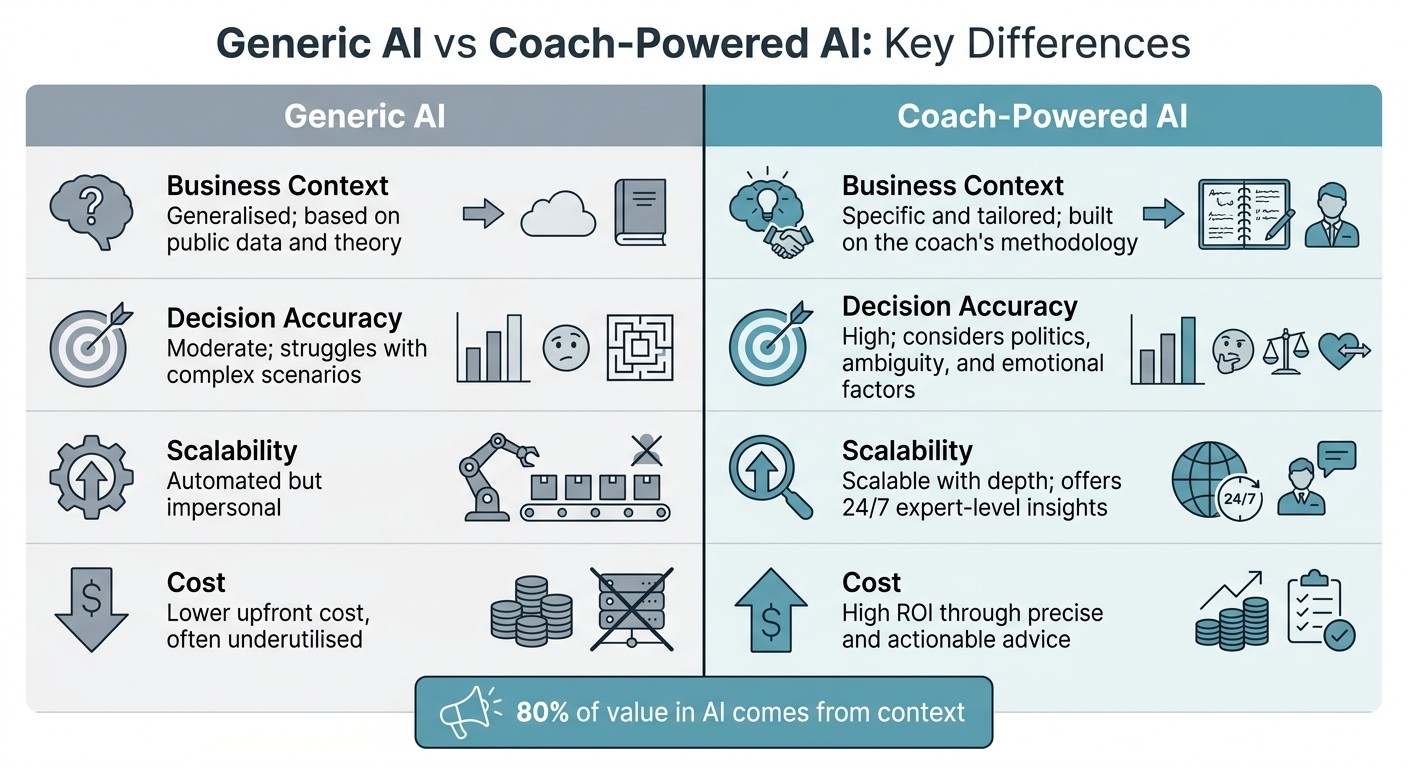
Generic AI vs Coach-Powered AI: Key Differences for Business Leaders
When we examine the differences between generic AI and coach-powered AI, the contrast becomes clear. Generic AI provides answers based on public data and theoretical frameworks. While this can be helpful for general research, it falls short when dealing with the specific nuances of your organisation - like the dynamics of your boardroom, team relationships, or the political hurdles of future quarters.
Coach-powered AI, on the other hand, is built on your coach's expertise. It replicates the thought processes and strategies they’d use in a live session, drawing from the context they've developed with you over time. This isn't about replacing your coach; it’s about accessibility. Your coach might not be available every Wednesday afternoon, but their insights can be. Platforms like GuidanceAI make this possible by extending your coach’s expertise, avoiding the delays and generic solutions that come with traditional AI.
Comparison Table
Here’s a side-by-side look at how these two approaches stack up:
Feature | Generic AI | Coach-Powered AI |
|---|---|---|
Business Context | Generalised; based on public data and theory | Specific and tailored; built on the coach’s methodology |
Decision Accuracy | Moderate; struggles with complex scenarios | High; considers politics, ambiguity, and emotional factors |
Scalability | Automated but impersonal | Scalable with depth; offers 24/7 expert-level insights |
Cost | Lower upfront cost, often underutilised | High ROI through precise and actionable advice |
In AI, context often makes up around 80% of the value. Without it, even well-crafted answers can fall flat, lacking the subtlety and relevance that turn information into actionable leadership decisions.
Conclusion
While AI shines in processing data and spotting patterns, it still falls short of the deep understanding and personal touch that a human coach brings to the table. AI can analyse trends and synthesise information at incredible speeds, but - as Graham Ward, Adjunct Professor of Organisational Behaviour at INSEAD, puts it - coaching uncovers the answer you're ready for. That difference often determines whether a decision remains theoretical or gets put into action.
A coach offers something AI cannot: real-world experience. They've dealt with the complexities of managing teams, handling boardroom pressures, and making tough calls in uncertain situations. They grasp the subtleties of organisational dynamics, interpersonal relationships, and the unspoken constraints that influence what can actually be achieved. Unlike AI, a coach is invested in your growth - they’ll challenge you when necessary and recognise when you're ready to tackle tougher issues.
The most effective decisions come from combining AI's efficiency with human judgement. AI can streamline tasks like compiling meeting notes, conducting competitor analysis, or organising reflections. But it’s your coach who provides that critical edge: asking the right questions, offering fresh perspectives, and holding you accountable to ensure ideas translate into action.
If you’re working with a coach or advisor, think about whether their guidance is accessible when you need it most - not just during planned sessions. GuidanceAI addresses this gap by extending your coach's expertise beyond scheduled meetings, blending technology with human insight to turn decisions into tangible results.
When it comes to the challenges that truly matter - handling uncertainty, building trust, and making irreversible choices - the human element remains irreplaceable. And the tools that support those efforts should enhance, not replace, that human connection. By combining AI's precision with your coach's wisdom, you create a partnership that delivers real, measurable outcomes.
FAQs
When should I not use AI for a business decision?
Avoid relying on AI for decisions that call for deep human judgement, personal insight, or the ability to navigate complex and nuanced situations. For instance, areas like strategic planning, addressing leadership challenges, or managing sensitive personnel issues require a level of context, empathy, and understanding that AI simply cannot provide. In these cases, the value of human expertise cannot be overstated.
What should I ask my coach so the advice fits my situation?
To make sure your coach's guidance is relevant to your unique situation, ask targeted questions about your business context, challenges, and objectives. For instance, you could ask: "How would your advice apply to my company's current stage and industry?" or "Can you provide examples that relate directly to my circumstances?" This approach helps ensure their insights are aligned with your specific needs - something generic AI tools often can't achieve due to their lack of nuanced understanding.
How can AI extend my coach’s support between sessions?
AI can strengthen the support you receive from your coach by offering tailored prompts that encourage reflection, self-examination, and uncovering important insights. These prompts help maintain focus and bring a more personalised touch to your coaching journey. Plus, they keep you on track with your goals, even between coaching sessions.