
AI ROI Metrics: What SME Leaders Need to Know
26 Feb 2026
Practical metrics and a five‑pillar framework for SMEs to measure AI ROI, account for hidden costs and achieve faster payback.

For small and medium-sized enterprises (SMEs), tracking the return on investment (ROI) of AI is no longer optional. With 70–85% of AI projects failing and hidden costs often underestimated, effective measurement can mean the difference between growth and financial instability. Here's what SME leaders need to focus on:
AI ROI Challenges: SMEs face tighter budgets and higher stakes. Hidden costs like integration (£60,000–£200,000), maintenance (15–25% of initial spend), and data governance (£4,000–£12,000 annually) often derail projects.
Key Metrics: Measure financial returns, operational efficiency, and customer impact. Use formulas like ROI =
(Discounted Benefits – Total Costs) / Total Costs × 100and track metrics like time savings, automation rates, and customer satisfaction.Payback Periods: SMEs need AI investments to pay off within 6–18 months, unlike larger companies that can wait years.
Frameworks: A structured approach, such as the Five-Pillar Framework, helps track cost reduction, revenue impact, time recovery, error reduction, and scalability.
Common Mistakes: Poor data quality, lack of training, and unrealistic expectations often lead to failure. Start small, track weekly progress, and budget for contingencies (20% extra).
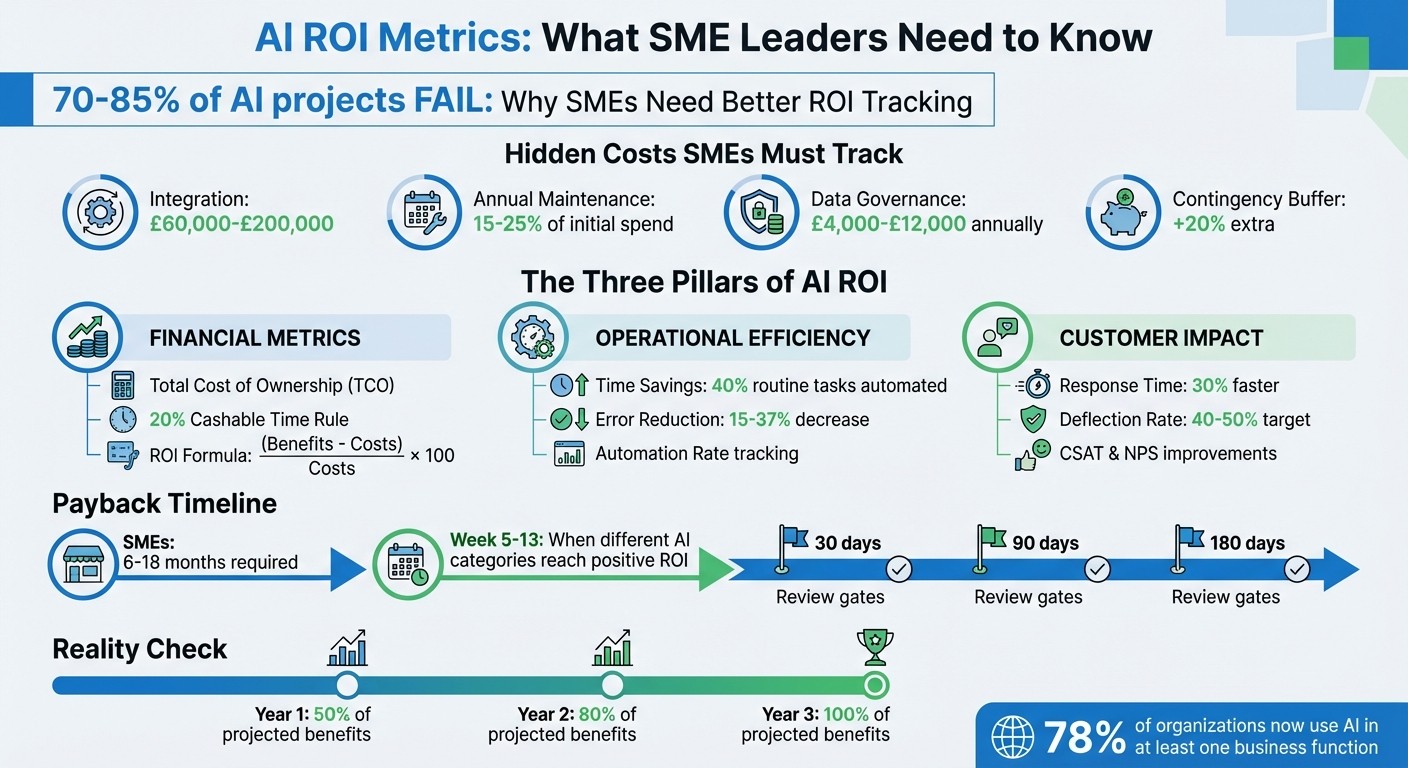
AI ROI Metrics Framework for SMEs: Key Costs, Timelines and Success Rates
Core Metrics for Measuring AI ROI
Tracking the right metrics can turn AI from a costly experiment into a strategic advantage. For small and medium-sized enterprises (SMEs), the focus should be on three key areas: financial returns, operational efficiency, and customer impact. Each of these requires targeted measurements that align with the realities of running a lean business. Let’s start with financial metrics before moving on to operational and customer-focused ones.
Financial Metrics: Calculating Costs and Returns
To measure ROI, use this formula: (Discounted Benefits – Total Costs) / Total Costs × 100. The difficulty lies in accurately capturing all costs and benefits.
Total Cost of Ownership (TCO) goes beyond subscription fees. SMEs need to account for hidden expenses like data preparation, system integration, staff training, and ongoing maintenance. These often-overlooked costs can derail AI projects if not planned for.
The 20% Cashable Time Rule is a critical concept for understanding how productivity gains translate into actual financial savings. Typically, only 20% of time saved converts into cash unless roles are eliminated or hiring plans are adjusted. For example, if your AI tool saves 10 hours per week, only 2 hours of that time will result in tangible financial benefits, with the rest being "soft" productivity gains.
A practical way to assess your maximum monthly AI investment is through this formula: (Monthly Time Savings in Hours × Hourly Rate × 0.40) + (Monthly New Capability Value × 0.25). This approach accounts for the fact that not all time savings translate into cash, and new capabilities may take time to generate revenue.
To calculate the payback period, use: Total Cost of Investment / (Monthly Value Created – Monthly Maintenance Cost). When building multi-year ROI models, apply a 3.5% discount rate for benefit projections unless specified otherwise by your finance team. Also, factor in a 10–15% annual cost inflation for cloud services and API fees.
Once costs and returns are mapped out, it’s time to examine how AI impacts daily operations.
Operational Efficiency Metrics
Operational metrics help track how AI transforms day-to-day work. Time savings are one of the easiest metrics for SMEs to measure. Calculate time savings by comparing task durations before and after AI implementation: (Hours saved per week × 52) × Fully-Loaded Hourly Cost. Establish baseline averages - like 10 minutes for an email or 30 minutes for a report - before deployment to measure improvements accurately.
The automation rate measures the percentage of routine tasks handled entirely by AI without human involvement. For SMEs, a realistic goal is automating 40% of routine customer inquiries. This metric directly ties to increased capacity, allowing teams to manage more work without additional staff.
Error reduction is another important metric, tracking the decrease in rework, refunds, or compliance-related corrections. The impact varies by function: manufacturing might see a 15% drop in errors, while finance operations using tools like Xero often report a 37% reduction in mistakes. Preventing errors saves both direct costs and the hidden cost of staff time spent fixing them.
Monitor these metrics weekly for the first 12 weeks. Early ROI is often negative (e.g., -65% in week three), but it usually turns positive later (e.g., 719% by week eight). Monthly averages can obscure this learning curve, so tracking weekly results is key to avoiding premature project abandonment.
AI Category | Positive ROI Milestone | Primary Reason for Delay |
|---|---|---|
Design / Creative | Week 5+ | Minimal training; immediate capability boost |
Content / Writing | Week 9+ | Learning brand voice; heavy initial editing |
Customer Service | Week 11+ | High initial error rates; training phase |
Analytics / Insights | Week 13+ | Data preparation; skill development needed |
Operational improvements lay the groundwork for better customer experiences, which we’ll explore next.
Customer-Focused Metrics
Customer metrics link AI investments to revenue growth. Response time acceleration is one such metric, as faster responses often lead to higher conversion rates. AI chatbots, for example, can reduce customer service response times by 30%. Automated lead qualifiers ensure prospects are engaged within minutes, not hours or days.
Metrics like Customer Satisfaction (CSAT) and Net Promoter Scores (NPS) provide measurable insights into how AI-driven interactions are perceived. Higher scores often lead to more referrals and reduced churn. For instance, a professional services firm with 50 employees could see a 1% increase in customer retention translate into £25,000 in annual revenue.
The deflection rate - the percentage of inquiries resolved by AI without human help - should aim for 40–50%. Striking the right balance is crucial: a rate that’s too high might indicate inadequate support, while a low rate suggests underused AI potential.
Other useful metrics include complaint volume and resolution time, which act as proxies for quality and accuracy. Serious complaints or breaches can cost an average of £45,000 per incident, making AI’s ability to reduce these risks a major benefit. Review these metrics at launch, after 90 days, and quarterly thereafter to fine-tune prompts and improve performance based on actual results.
Frameworks for Measuring AI ROI
Building a Complete ROI Framework
To measure the return on investment (ROI) of AI initiatives effectively, a robust framework that combines financial, operational, and customer metrics is essential. It’s worth noting that 70%–85% of AI projects fail to meet their expected business value, often due to inadequate planning.
The Five-Pillar Framework offers a structured approach for 2026, focusing on Cost Reduction, Revenue Impact, Time Recovery, Accuracy/Quality Improvement, and Workflow Scalability. For instance:
Cost Reduction: Consider your Total Cost of Ownership, factoring in hidden expenses like integration and compliance.
Revenue Impact: Track metrics such as increases in conversion rates and changes in customer lifetime value.
Time Recovery: Measure the hours saved by automating tasks.
Accuracy/Quality Improvement: Monitor error rates and reductions in rework.
Workflow Scalability: Assess how well processes can handle increased demand without additional costs.
To avoid overestimating benefits, apply a "reality discount": assume only 50% benefit realisation in Year 1, 80% in Year 2, and full benefits by Year 3. This adjustment accounts for the learning curve involved in adopting new tools, preventing inflated expectations and premature abandonment of projects.
It’s also crucial to establish review gates at 30, 90, and 180 days to compare actual outcomes with projections. Early on (30–90 days), focus on adoption rates to ensure users are engaging with the tool. By the 180-day mark, assess cashable savings and revenue impacts to identify underperforming pilots and reallocate resources if necessary.
Tailoring the framework to your industry can maximise its effectiveness. For example:
Legal and Professional Services: Prioritise tracking billable hours saved, such as 37 hours per month per lawyer.
Customer Service: Monitor deflection rates (aiming for 40–50%) and reductions in first response times.
Retail and Sales: Focus on lead response times and conversion rate improvements.
Manufacturing and Telecom: Emphasise metrics like downtime reduction and error rate decreases.
Once the framework is tailored, establish continuous monitoring to capture performance shifts promptly.
Real-Time Monitoring and Analytics
A comprehensive ROI framework becomes even more powerful with real-time monitoring, which turns static metrics into actionable insights. The BIO Framework - Baseline, Instrumentation, and Outcomes - provides a practical structure for this process.
Start by defining your Baseline, a clear "before" picture of your metrics. Then, implement Instrumentation by equipping your AI tools with admin dashboards or logging systems to track usage. Use a tagging framework to classify workflow stages as machine-generated, human-verified, or human-enhanced, helping to identify which improvements are directly linked to AI.
"I tell executives to stop asking 'what is the model's accuracy' and start with 'what changed in the business once this shipped.'" – Salome Mikadze, Co-founder, Movadex
Create a unified dashboard that consolidates data across the five pillars, such as hours saved, costs reduced, revenue generated, errors prevented, and customer satisfaction scores. For example, PayPal effectively applied this approach in November 2023. Under CISO Assaf Keren, the company used transformer-based deep learning for fraud reduction, nearly doubling annual payment volumes from $712 billion in 2019 to $1.36 trillion in 2022. Additionally, PayPal cut its loss rate by 11% in Q2 2023 through improved AI-driven risk management.
Real-time monitoring also involves tracking reliability signals, such as hallucination rates, guardrail intervention rates, override rates in human-in-the-loop reviews, and model drift. These metrics act as early warnings, helping to address issues before they affect customers or ROI. Combine these "hard" metrics with qualitative insights from employee surveys, which can reveal self-reported productivity gains. High adoption rates often signal future financial benefits, making them a critical indicator to watch.
Case Studies and Industry Benchmarks
Practical examples show how accurately tracking ROI can turn AI investments into measurable benefits across various business areas.
Customer Service AI: ROI and Metrics
In 2024, a UK-based fashion e-commerce business with 35 employees invested £44,000 in a multi-channel AI agent. Within six months, the system resolved 65% of customer queries, cut response times from 8 hours to under 30 seconds, and achieved a 132% ROI in its first year. Sarah Johnson, the company’s COO, highlighted the remarkable improvement in their customer service operations.
The financial benefits of automating customer service are becoming increasingly apparent. AI-driven resolutions typically cost between £0.75 and £1.50 per interaction, compared to £4.50 to £9.00 for human-handled tickets. On average, support automation projects deliver a 3.7x ROI in their first year, with most small and medium-sized enterprises (SMEs) breaking even within three to six months.
"The $0.99 vs $6-12 equation makes the 2026 AI customer service ROI case undeniable - if you measure correctly. Use ROAR (Resolved on Automation Rate), not deflection."
– Digital Applied
High-volume queries, like order status checks (80–90% deflection) and FAQs (70–85%), typically offer the fastest returns. The most critical metric to monitor is ROAR (Resolved on Automation Rate), which tracks how many issues are fully resolved rather than just whether a session ended. Many organisations start with 20–40% deflection on Day 1, increasing to over 60% within 6–12 months as their AI systems and knowledge bases mature.
Knowledge Management and Automation
AI is not just transforming customer service - it’s also reshaping internal processes like knowledge management. For instance, a Manchester law firm with 40 lawyers invested £84,000 in AI tools for legal research and document drafting in 2024. The results were impressive: research times dropped by 67%, and standard contract drafting times were cut by 75%. This freed up enough time for each lawyer to add five extra billable hours per week, delivering a 671% ROI in the first year, with the investment paid back in just 1.6 months.
"In professional services (legal, consulting, accounting), ROI comes from freeing time for higher-value work, not reducing headcount. Frame the project as 'increasing billable hours' for better adoption."
– Technova Partners
In the B2B consulting space, a London firm led by VP of Sales James Mitchell implemented an AI-powered lead qualification tool in 2024. After a 10-week rollout, the system auto-qualified 70% of leads and improved the lead-to-opportunity conversion rate from 15% to 28%, achieving a 181% ROI in its first year.
Benchmarks also show that finance teams typically achieve 81% auto-categorisation of expenses, while HR departments automate 58% of onboarding tasks. For a typical service-based SME with six office staff, saving 45 minutes per employee each day through AI automation could translate into annual savings of approximately £21,384. However, it’s wise to use conservative estimates - assume only 20% of time savings result in cash savings unless roles are reduced or hiring slows.
Best Practices and Common Mistakes
For AI to truly deliver value, it’s not enough to have sound metrics; you also need solid practices to avoid common traps. Between 70% and 85% of AI projects fall short of their expected outcomes, while top performers can achieve returns over 10.3 times their investment. The difference? It often comes down to how SMEs handle implementation, set expectations, and organise their projects right from the start.
Investing in Data Quality and Governance
The number one reason AI projects fail? Poor data quality. If your data is scattered across outdated systems, no amount of advanced AI will produce reliable results.
"Garbage in, Garbage out is the iron law of AI." – OpenKit
For SMEs in the UK, annual data governance and compliance costs typically range from £4,000 to £12,000. On top of that, integrating AI with older ERP or CRM systems can add anywhere from £60,000 to £200,000 to initial budgets. A great example of how this pays off: in 2025, Lewis Roca, a prominent law firm, used AI to sift through over 600,000 documents in a construction litigation case. Thanks to their investment in proper data structuring, the AI automatically filtered out 90% of irrelevant documents.
To mitigate risks like algorithmic bias and transparency issues, consider adopting governance frameworks like ISO 42001. It’s also critical to ensure your AI vendor adheres to "zero data retention" policies, meaning they don’t use your proprietary data to train public models.
Once your data and governance are in order, the next step is preparing your team to make the most of the tools.
Training and Change Management
Here’s a surprising statistic: only a third of employees receive formal AI training. This leads to what’s called the "Power User Gap" - where expensive AI systems are underused because teams lack the skills to unlock their full potential. Successful projects flip the spending ratio, dedicating 70% of the budget to people and processes, and just 30% to technology.
It’s also worth noting that productivity often dips by 15–25% during the first three to six months of adoption as teams adjust. This is a normal part of the process, often referred to as the "productivity J-curve." To navigate this, senior leaders should commit 2–4 hours a week during the first 8–12 weeks to ensure the transition stays on track.
Avoiding Unrealistic Expectations
Unrealistic goals are a common - and costly - mistake. A recent MIT study revealed that 95% of generative AI investments fail to deliver measurable returns, mostly due to overambitious projections and poor tracking. To avoid this, start small. Use a "Minimum Viable Pilot" approach: focus on a single high-friction workflow, limit the pilot to 4–8 weeks, and define clear KPIs before you begin. Also, assume only 50% of the projected benefits will materialise in the first year.
Be prepared for surprises by including a 20% contingency in your budget to cover unexpected costs like cloud usage, compliance monitoring, or additional training. Keep in mind that ongoing maintenance can cost 15–25% of the initial implementation annually. Finally, set up a "kill switch" - a predefined point at which you’ll stop the pilot if it doesn’t meet key metrics within the agreed timeframe.
"Applied to a chaotic, undefined process, [AI] multiplies chaos. Applied to a well-understood, measured process, it multiplies value." – OpenKit
This method ensures you’re not just protecting your investment but also laying the groundwork for sustainable growth.
Conclusion: Measuring AI ROI for Growth
Measuring AI ROI is essential for creating a growth strategy that works in the long term. The difference between the 70–85% of AI projects that fail to meet expectations and those that achieve at least a 110% ROI within the first year often boils down to three key factors: setting clear benchmarks, tracking metrics consistently, and maintaining realistic expectations about AI's capabilities.
Start by assessing how long manual tasks take - things like drafting emails or summarising reports. Then, adopt a phased approach. Focus on one high-friction workflow to begin with, and set formal review points at 30, 90, and 180 days. If the benefits are underperforming by 25% at the 90-day mark, implement a stop-go review process. Don’t forget the earlier advice to apply a "reality discount" to your projections.
It’s also important to account for hidden expenses. Allocate funds for data governance (£4,000–£12,000 annually), expect a 15–25% dip in productivity during the initial three to six months, and set aside a 20% contingency for unexpected costs. Keep in mind that only about 20% of time savings typically translate into actual cash savings unless you reduce headcount or avoid future hires. Focus on outcomes that can genuinely affect the bottom line.
This careful cost evaluation highlights AI's role as a strategic asset. With 78% of organisations now using AI in at least one part of their business, it's clear that treating AI implementation as a major capital investment - with clear governance, ongoing validation, and flexibility to adapt - is the path to success.
"Technology alone is not a strategy. Applied to a chaotic, undefined process, it multiplies chaos. Applied to a well-understood, measured process, it multiplies value." – OpenKit
The next step is tapping into tools that provide actionable insights at the leadership level. For UK SMEs, platforms like AgentimiseAI (https://agentimise.ai) offer AI agents designed to turn detailed ROI measurements into practical business strategies. Similarly, GuidanceAI connects businesses with virtual C-suite advisors trained by experienced professionals, offering top-tier guidance without the expense of full-time senior executives. Whether you're just beginning or scaling up, focus on tracking the metrics that matter, staying realistic, and letting data shape your decisions. By doing so, SMEs can turn AI investments into a lasting competitive edge.
FAQs
What costs do SMEs usually miss when budgeting for AI?
SMEs often miss out on accounting for hidden costs such as data preparation, integration, ongoing maintenance, compliance, and opportunity costs. These overlooked expenses can inflate AI project budgets by as much as 20% to 50%, potentially jeopardising the project's success. To steer clear of these surprises, careful and thorough planning is absolutely critical.
How do I turn “time saved” into real, cashable ROI?
To turn "time saved" into a measurable return on investment (ROI), start by assigning a monetary value to the hours saved through AI. This involves estimating the hourly cost of the employees or processes impacted and multiplying it by the total time saved. These freed-up hours can then be redirected towards more productive, high-value tasks or used to trim staffing costs.
Next, add these savings to other gains, such as reduced expenses or increased revenue. Use standard ROI formulas to calculate a clear and comprehensive figure that reflects the overall financial impact.
Which AI KPI should I track first in the first 90 days?
In the first 90 days, prioritise AI-related KPIs that showcase immediate, measurable outcomes. Key metrics to monitor include cost savings, productivity gains, and revenue increases. For instance, you could track metrics such as time saved on specific tasks, quicker response times, or early reductions in operational expenses - tailored to align with your business goals.